
Fortune 500 companies face a specific set of requirements when running influencer marketing campaigns that most agencies are simply not equipped to handle. Multi-platform execution, cross-functional approval chains, rigorous FTC compliance, paid amplification, and C-suite-level reporting are not optional at this scale. They are baseline. The right influencer marketing agency for a Fortune 500 brand is one that has already solved those operational challenges, has the client history to prove it, and can integrate into complex internal workflows without creating friction. This guide covers what that looks like and why it matters.
Table of Contents
Why Fortune 500 Campaigns Are a Different Category
Most influencer marketing campaigns, even good ones, are built around a relatively simple model: identify creators, brief them, publish content, track engagement. That model works for brands with straightforward campaign goals and lean approval processes.
Fortune 500 campaigns operate differently. Consider this scenario: a global CPG brand wants to launch a new product line across TikTok, Instagram, and YouTube simultaneously, with influencer content that also feeds a paid amplification strategy. Legal needs to review every piece of creator content before it goes live. The media team needs reporting that maps influencer performance to actual sales lift, not just impressions. The brand’s communications team needs to approve all influencer selections. And everything needs to be coordinated across three internal departments and an external agency partner.
That is not an edge case. That is the standard operating environment for a Fortune 500 marketing team.
An agency that is built for speed and volume will create problems in that environment. Missed compliance steps, inconsistent reporting, or influencer selections that were not properly vetted can generate reputational risk at a scale that smaller brands never have to think about.
What Fortune 500 Brands Need From an Influencer Partner
Here is what genuinely separates agencies that can serve this tier from those that cannot.
Full campaign ownership. Fortune 500 marketing teams do not have the bandwidth to project-manage an influencer campaign internally. The agency needs to own strategy, talent sourcing, vetting, contracting, content auditing, FTC compliance, scheduling, paid media integration, and analytics. Every single step, end to end.
Talent validation, not just talent access. Access to a large creator database is not a differentiator at this level. What matters is the agency’s ability to validate that each influencer’s audience is authentic, their content history is brand-safe, and their positioning is genuinely aligned with the brand’s values. A single bad influencer selection for a Fortune 500 brand can become a news story.
Multi-platform fluency. Enterprise campaigns rarely live on one platform. A Fortune 500 brand working in the consumer space needs an agency that can execute across TikTok, Instagram, and YouTube simultaneously, with platform-specific content strategies rather than repurposed assets.
Paid amplification built in. According to Later’s 2025 Influencer Marketing Report, the industry has shifted decisively toward ROI-first strategies, with brands moving away from vanity metrics toward measurable business outcomes. Organic reach alone rarely delivers the scale a Fortune 500 campaign requires. Paid amplification of top-performing creator content is now a core part of what effective enterprise influencer marketing looks like.
Analytics that hold up internally. The final report from an influencer campaign needs to be defensible at the executive level. That means tracking earned media value, sentiment, and conversion attribution, not just engagement rates and follower counts.
What HireInfluence Brings to Fortune 500 Campaigns
HireInfluence has operated as a full-service influencer marketing agency since 2011, building a client roster that includes Microsoft, McDonald’s, Meta, Target, Oreo, and Southwest Airlines. Those are not logo placements. They represent years of running large-scale campaigns for brands with complex internal requirements, significant compliance obligations, and high expectations for measurable outcomes.
The agency manages every stage of the campaign process: strategy development, influencer curation, validation, negotiation, contracting, payments and 1099 processing, content auditing, FTC compliance, paid media, and tailored analytics. For a Fortune 500 marketing team, that operational coverage matters because it eliminates the coordination burden that typically falls on the client.
HireInfluence’s approach to measurement is also worth noting. Their analytics infrastructure, led by a dedicated Chief Data Scientist, tracks campaign performance using earned media value, sentiment analysis, and conversion data. That level of rigor makes it possible to bring influencer marketing performance into the same reporting framework as other enterprise marketing channels. You can see how that plays out in practice on their campaign work page.
For brands that want to understand how influencer tiers factor into campaign design at this scale, the agency’s specialties page covers how different creator types serve different campaign objectives, from mega-influencers for broad reach to targeted micro-influencer activations for specific audience segments.
The Oreo and McDonald’s Example
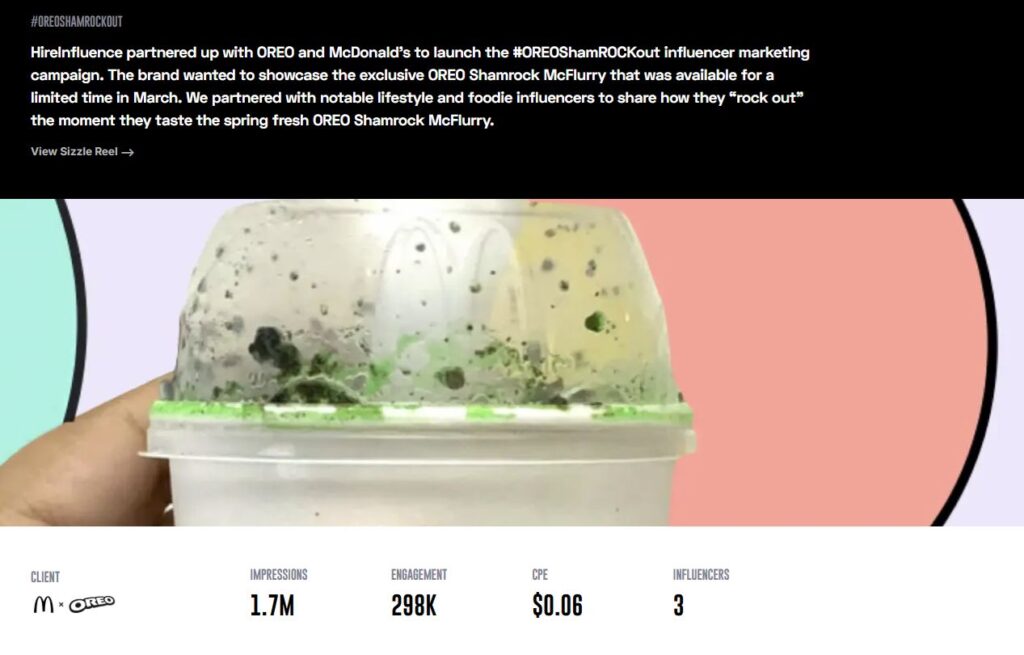
A useful reference point is HireInfluence’s work on the Oreo Shamrock McFlurry campaign for McDonald’s. The campaign paired lifestyle and food-focused influencers with a culturally specific moment, generating 1.7 million impressions with a cost per engagement of $0.06.
That kind of efficiency at the Fortune 500 level does not happen by accident. It comes from disciplined talent selection, creative brief quality, and campaign execution that keeps the brand standard intact throughout.
You can read more about how HireInfluence approaches campaign execution across different brand types and verticals.
For more context on how Fortune 500 and large enterprise brands are using influencer marketing broadly, the Fortune 1000 influencer marketing guide on the HireInfluence blog covers the strategic rationale in detail.
How to Start the Conversation
If you are evaluating influencer marketing agencies for a Fortune 500 or large enterprise brand, the right starting point is a direct conversation about your campaign objectives, compliance requirements, and internal approval structure. Generic proposals based on templated briefs waste time at this level.
HireInfluence works with enterprise brands on a project basis. Minimum engagements start at $100,000, which reflects the operational depth required to run a campaign that meets Fortune 500 standards across talent, compliance, execution, and measurement.
Reach out to the HireInfluence team to start that conversation. If you want to understand more about what full-service influencer campaign management actually involves before that call, the campaigns overview covers the full scope of what they manage on behalf of enterprise clients.
The agencies that serve Fortune 500 brands well are not the ones with the biggest creator databases. They are the ones that have already proven they can operate at that level of complexity without creating problems for the brand.