
Influencer Marketing


A good influencer agency RFP checklist forces every prospective partner to answer the same questions on the things that actually determine results. A 2026 dataset of social media benchmarks found that 94% of organizations say influencer marketing outperforms traditional digital advertising, often returning two to three times the spend, that more than 60% of product discovery now happens on TikTok, Instagram, and YouTube rather than on Google, and that short-form video delivers the highest return of any video format at 41%. The same research showed that human-generated content ranks as the number one thing consumers want from brands in 2026, and that there are now 5.6 billion social media users worldwide. With that much at stake, an RFP that probes scope, sourcing, verification, measurement, and pricing is what lets a brand compare agencies on substance rather than on the polish of a pitch.
An RFP is only as useful as the questions it asks, and the strongest ones are built around the areas where agencies genuinely differ. The categories below give a brand a structure for comparing partners on the same terms, so that the choice rests on capability rather than presentation. Each maps to a decision a brand will care about once a program is underway.
Scope of services is the first thing an RFP should pin down. It should ask each agency to state exactly which functions it handles in-house, strategy, sourcing, production, paid amplification, and measurement, and which it outsources or does not offer. A clear answer tells a brand whether an agency can run a whole program or only part of one, and comparing scope across respondents surfaces differences that a polished deck can otherwise obscure. This is the category that determines whether an agency even fits the shape of the work. An agency that offers only a slice of what a program requires is not disqualified, but a brand needs to know that upfront so it can plan to fill the gaps, rather than discovering mid-program that a function it assumed was covered is not.
Sourcing and verification is the second category, and it deserves detailed questions. The RFP should ask how each agency finds creators and, crucially, how it confirms their audiences are real, covering authenticity, engagement quality, and audience fit. Given how much of a program’s value rides on reaching genuine audiences, a vague or thin answer here is a meaningful signal, and a specific, process-driven one is a good sign. This is often the category that separates a disciplined agency from one that books familiar names. Sprout Social’s finding that most product discovery now runs through social platforms is a reminder of how much rides on reaching the right, genuine audiences, which is exactly what the sourcing and verification section of an RFP is meant to test, and why a hand-waving answer there should give a brand pause.
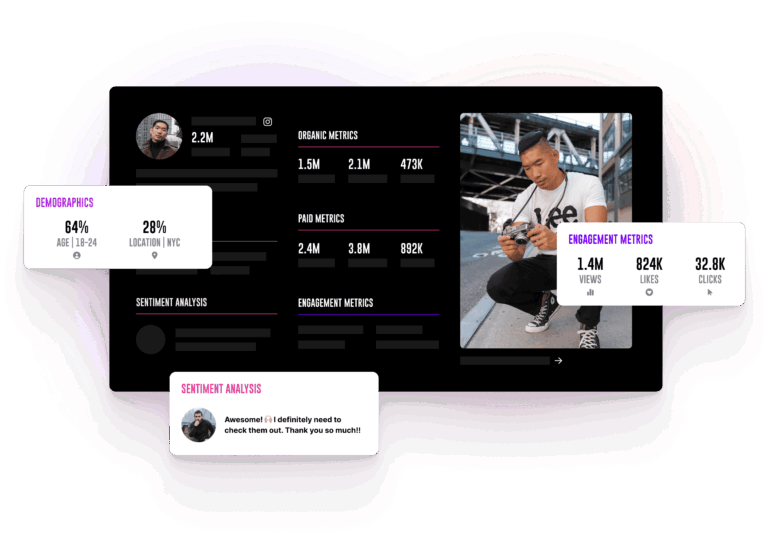
Measurement and reporting is the third category. The RFP should ask how each agency defines success, what it reports, and how it attributes results, so a brand can see whether an agency measures against outcomes or defaults to vanity metrics. Because influencer marketing now stands or falls on measurable return, a brand should weigh how rigorously each respondent proposes to track and report performance. Comparing measurement approaches across agencies often reveals more than comparing their creative samples. Anyone can present attractive content, but the discipline of defining success in advance and reporting honestly against it is harder to fake, which is why the measurement section tends to expose real differences in how seriously an agency takes accountability.
Relevant experience and pricing form the fourth and fifth categories. The RFP should ask for results from comparable programs, described with real figures rather than adjectives, and for a clear breakdown of how pricing works and where budget goes across sourcing, production, amplification, and measurement. Experience shows whether an agency has done the work a brand needs, and pricing transparency shows whether a brand can trust how its money will be spent. Together, these categories let a brand judge substance and value side by side across every respondent. Asking for real figures rather than adjectives is the key discipline here, since a claim of strong results means little without the numbers behind it, and an agency confident in its work will usually be comfortable sharing them.
The functions below are what a capable agency owns across a program, and they double as the substance an RFP should probe in each respondent.
Delivery is the evidence an RFP should ask every agency to supply. A creator program for Grammarly enlisted 133 creators to generate 214M impressions, 33.1M views, and $15M in earned media value, the kind of concrete result an RFP should request rather than accept in the abstract. The #CoatYourThroat program for Ricola worked with 18 influencers to reach 26M impressions, 20.5M reach, a 13.17% engagement rate, and 62,500 MikMak retail clicks, a result documented in the Ricola case study. The #SouthwestSaysAloha campaign for Southwest Airlines reached 56M impressions and 3M engagements, and the #MyMTVStyle activation for MTV delivered 16.1M impressions and 216,600 engagements at a $0.01 cost per view and a $1.50 CPM on TikTok. Set against the broader work portfolio, these campaigns point to one pattern: results reported with real figures are what an RFP should weigh, and what strong agencies can provide.
The RFP responses matter most when read against a consistent set of questions. First, ask each agency to detail its scope of services. The agency should state clearly what it handles in-house and what it does not, because scope determines whether it can run the program a brand actually needs, and a straight answer here saves a great deal of trouble later.
Second, ask how each agency sources and verifies creators. The agency should describe the channels it draws on and how it confirms audience authenticity and engagement quality, since this is where a program’s value is most often protected or lost.
Third, ask how each agency measures and reports on success. The agency should tie its work to outcomes the brand cares about and explain how it attributes reach, engagement, and, where the campaign allows, conversion, rather than leaning on vanity metrics.
Fourth, ask each agency for results from comparable programs. The agency should be able to supply real figures from relevant work, because concrete results are far more telling than described capabilities, and a reluctance to share numbers is itself worth noting.
Fifth, ask how each agency prices programs and where the budget goes. The agency should walk through what drives creator rates and how spend splits across sourcing, production, amplification, and measurement, and a cost of influencer marketing guide is a useful reference for checking whether a proposal is reasonable.
The agency’s client roster includes Microsoft, Southwest Airlines, Target, Coca-Cola, Walmart, and Meta, and it works to a six-figure engagement floor that matches the scope of the programs it runs. As a TikTok Shop Lite Program partner since July 2024, it connects creator content directly to commerce, and its recognition includes Marketing Agency of the Year at the 2024 MUSE Creative Awards and Digital Marketing Agency of the Year at the 2026 U.S. Agency Awards.
The through-line from the research is worth restating plainly: with influencer marketing outperforming traditional advertising and so much of a program riding on genuine reach and rigorous measurement, the brands that build their RFP around scope, sourcing, verification, measurement, and pricing are the ones that choose partners on substance rather than on a pitch.



Influencer Marketing
Influencer Marketing
Influencer Marketing