The SaaS market is not slowing down. According to Gartner’s February 2026 IT spending forecast, worldwide software spending will grow 14.7% in 2026 to more than $1.4 trillion, accelerating from 11.5% growth in 2025. That is roughly $180 billion in net new software spending in a single year. For SaaS brands, that number represents both opportunity and pressure. More money flowing into software means more competition for the same buyers, and those buyers are more sophisticated than ever. They research longer, involve more stakeholders, and rely heavily on trusted voices rather than vendor-produced content to form opinions.
Table of Contents
That last point is where influencer marketing services becomes a strategic asset rather than a nice-to-have. SaaS buyers do not trust press releases. They trust practitioners who have actually used the product, industry analysts who have evaluated the category, and creators who explain complex software in ways that make sense to their audience. A creator-led awareness campaign for a SaaS brand does something no amount of banner advertising can: it puts the product in the hands of a trusted voice and lets that person tell the story to an audience already primed to care.
For SaaS brands at enterprise scale, the question is not whether to invest in creator-led marketing. It is whether your agency has the infrastructure to execute it at the level the category demands.
Why SaaS Is a Distinct Challenge for Influencer Marketing
Most influencer campaigns are built around physical products. A creator tries the product, shows it on camera, shares a reaction, and links to a purchase page. SaaS does not work that way. Software needs to be explained, not just shown. The value proposition is often abstract, the purchase cycle is long, and the decision involves multiple stakeholders who each need different information.
That creates specific requirements for how SaaS influencer campaigns are structured. Creators need to be technically credible enough to discuss the product in ways that resonate with practitioners, but accessible enough to communicate to buyers who are not yet deep in the category. The content itself needs to do more work than a product unboxing: it needs to establish the problem, position the product as the solution, address the questions that come up during evaluation, and create enough trust that a viewer takes a next step, whether that is a trial signup, a demo request, or a deeper research visit.
Platform selection also matters differently in SaaS than in consumer categories. YouTube dominates for long-form product walkthroughs, tutorials, and comparisons, content that reaches buyers who are actively researching a category. LinkedIn is increasingly relevant for B2B SaaS brands targeting enterprise decision-makers, where thought leadership and product education from credible voices can move consideration in ways that paid social cannot. TikTok and Instagram play a growing role in building brand familiarity with younger practitioners who will eventually become the buyers and champions inside enterprise accounts.
An agency that has only run consumer campaigns will treat SaaS like CPG with a longer URL. An agency that understands the category builds campaigns that match content format to funnel stage, creator profile to audience sophistication, and platform to purchase intent.
The Grammarly Model: What SaaS Influencer Marketing Looks Like at Scale
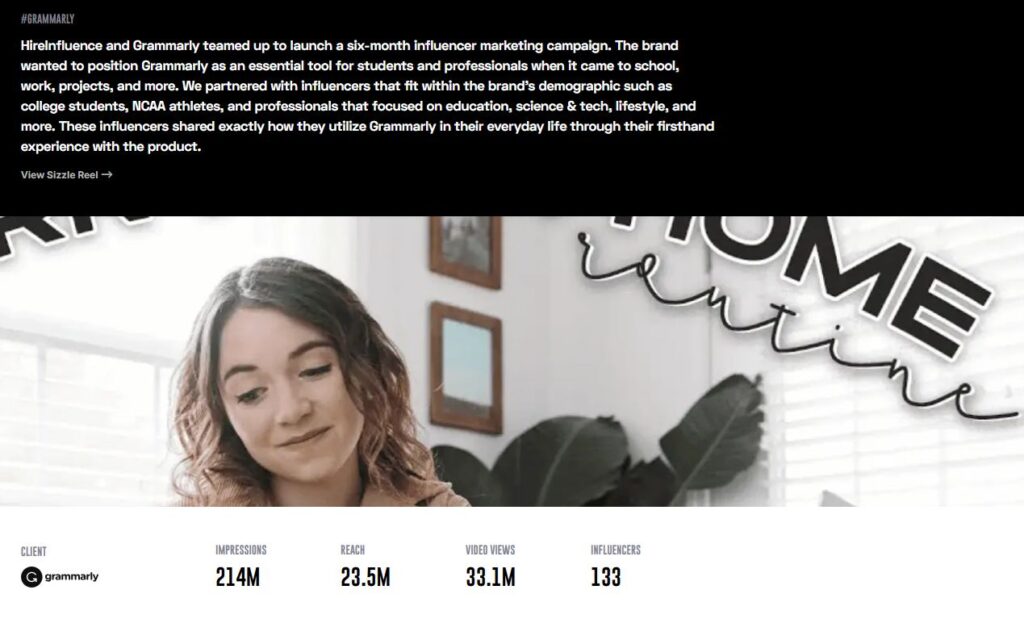
HireInfluence’s Grammarly campaign is the clearest example of what enterprise SaaS influencer marketing can accomplish. The campaign deployed 133 top-tier creators across YouTube, TikTok, and Instagram, generating 214 million impressions, 33.1 million views, and $15 million in earned media value.
What made that campaign work was not just scale. It was the architecture: a multi-tier creator mix that combined reach with credibility, multi-platform execution that caught the same buyer at different stages of their journey, and content that integrated the product naturally into workflows that the audience already cared about. Lifestyle creators showed how Grammarly fit into everyday writing. Professional creators explained why writing quality matters in a workplace context. The result was a campaign that built broad awareness while reaching the right audience with the right message.
That model, broad reach plus niche credibility plus multi-platform sequencing, is exactly how SaaS brands should be thinking about influencer marketing. Not a single Instagram post from a tech influencer, but a coordinated program that touches the buyer across platforms and content formats throughout the consideration window.
What Enterprise SaaS Brands Need from an Agency
SaaS brands operating at enterprise scale have requirements that smaller or mid-market agencies are not equipped to handle.
Creator vetting at the intersection of reach and credibility. A creator with 500,000 followers who does not understand the product category will produce content that sounds inauthentic to a technical audience. A creator with 50,000 followers who is deeply embedded in the relevant practitioner community can move real consideration. Getting that balance right requires genuine category knowledge, not just a database filter.
UGC infrastructure for product marketing. Creator content produced during a campaign does not have to stop working when the campaign ends. SaaS brands can repurpose high-performing influencer content into product landing pages, paid social ads, onboarding sequences, and sales enablement materials. Building content rights and repurposing pathways into the campaign brief from the start is how enterprise SaaS brands extract compounding value from creator programs.
Paid amplification of organic creator content. The organic reach of any individual creator post is a fraction of what the same content can achieve when amplified through whitelisting and paid media. For SaaS brands targeting specific company sizes, job titles, or technology stacks, running creator content through paid channels with precise targeting is how broad creative gets focused on the right accounts.
Analytics and attribution that connect creator activity to business outcomes. Impressions and engagement rates do not move ARR. SaaS brands need attribution infrastructure that connects creator content to trial signups, demo requests, and pipeline movement. That requires pre-built tracking, UTM discipline, and a reporting cadence that surfaces actionable signals during the campaign rather than after it ends.
FTC compliance and legal infrastructure. Every sponsored post needs proper disclosure. At scale, across dozens of creators and hundreds of pieces of content, maintaining compliance without a dedicated process creates real risk. Enterprise SaaS brands with legal and communications teams that review marketing activity need an agency that treats compliance as a standard operational function, not an afterthought.
Why HireInfluence for SaaS
HireInfluence has been executing full-service influencer campaigns since 2011, with a client roster that includes Microsoft, Grammarly, and Meta, three of the most prominent technology brands in the world. The campaign portfolio reflects the kind of multi-platform, multi-tier execution that SaaS brands need: coordinated programs that move buyers through the funnel rather than generating awareness that goes nowhere.
The Grammarly campaign alone demonstrates the capacity to operate at the scale and complexity that enterprise SaaS demands: 133 creators, three platforms, $15 million in EMV, and content designed to integrate naturally into the professional workflows the audience already uses. That is not luck. It is what structured full-service execution looks like when the agency understands the category.
HireInfluence’s minimum engagement is approximately $100,000, which reflects the operational investment required to build and execute a creator program that actually drives pipeline for a SaaS business. For enterprise software brands competing in a $1.4 trillion market where every CMO is looking for channels that can justify their spend in business terms, that investment is the starting point for a program built to perform.
The SaaS brands that win the next phase of this market will not win on product features alone. They will win on trust, familiarity, and the ability to reach buyers through voices those buyers already respect. That is what creator-led marketing does at scale. The question is who builds it for you.