B2B buyers do not trust vendor marketing. They trust people. According to the 2025 Edelman-LinkedIn B2B Thought Leadership Impact Report, 71% of hidden B2B decision-makers say thought leadership from credible experts is more effective than conventional marketing or sales materials at demonstrating a vendor’s potential value. Another 64% say they trust content from credible voices more than marketing materials and product sheets when evaluating a vendor’s capabilities. These are not marginal preferences. They reflect a fundamental shift in how enterprise buying decisions get made.
Table of Contents
The implication for B2B brands is direct: the most effective way to influence a buying committee is not through advertising or sales outreach. It is through the credible, expert voices those buyers already follow and trust. That is what B2B influencer marketing does at its best. It puts a brand’s message in the hands of practitioners, analysts, and industry voices whose audiences are exactly the people sitting on buying committees at enterprise accounts.
For B2B brands trying to build pipeline, accelerate consideration, and win deals in competitive categories, this is no longer a peripheral strategy. It is how the most sophisticated enterprise marketing teams are allocating budget in 2026.
Why B2B Influencer Marketing Is Structurally Different
B2B and B2C influencer marketing share the same basic mechanism: a brand partners with a trusted voice to reach that voice’s audience. Everything else is different.
The B2B buying process involves multiple stakeholders with different roles and different information needs. The end user evaluates fit and usability. The technical team evaluates architecture and security. Finance evaluates total cost of ownership. Legal evaluates risk and compliance. Each of these stakeholders consumes different content on different platforms and trusts different types of voices. A single creator campaign that talks to all of them simultaneously is almost always talking effectively to none of them.
Effective B2B influencer marketing maps creator profiles to specific stakeholder types. A practitioner with deep technical expertise in a relevant category speaks to the evaluation layer of the buying committee. A business leader who has deployed the product at scale speaks to the financial and executive layer. An analyst who has researched the category speaks to the research and validation phase. Activating the right voice for the right audience at the right stage of the buying cycle is the structural challenge that makes B2B influencer campaigns more complex than their B2C counterparts.
Platform selection also differs. LinkedIn is the dominant platform for B2B influencer content, where industry experts and business leaders build audiences of professional practitioners. YouTube matters for in-depth product demonstrations, technical tutorials, and category education that reaches buyers in active research mode. Podcasts and industry publications carry disproportionate weight in certain verticals. A B2B influencer agency needs to understand how these platforms intersect with the specific buying journey rather than defaulting to the consumer platforms that dominate B2C campaigns.
The Three Buyer Roles That B2B Influencer Campaigns Must Reach
The Edelman-LinkedIn research highlights a reality that every B2B marketer knows but often fails to account for in campaign planning: more than 40% of B2B deals stall due to internal misalignment within buying groups. The visible decision-maker is rarely the only voice that matters. Finance, legal, operations, and procurement all have influence over whether a deal closes, and those stakeholders are often not the same people consuming the content in the top-of-funnel awareness phase.
Structuring a B2B influencer program to reach all three layers of a buying committee requires distinct content strategies for each:
The practitioner layer needs content that validates the product’s technical credibility and fit for their specific use case. The creators who work here are specialists with deep category expertise and audiences of professionals who do the same work.
The business leadership layer needs content that connects the product to business outcomes: revenue impact, cost reduction, operational efficiency, competitive advantage. The creators who reach this layer are executives and operators who have built and run the kinds of companies the buyer manages.
The risk and compliance layer needs content that addresses concerns about security, regulatory exposure, vendor reliability, and implementation complexity. This audience is typically the hardest to reach through influencer channels, but thought leadership from credible legal, security, or regulatory voices can move them in ways that no amount of vendor-produced content can.
The content format matters as much as the creator. Long-form YouTube walkthroughs and LinkedIn essays work for the research and evaluation phase. Short-form video and social proof content work for the awareness phase. Case study-style content featuring real outcomes and named results works for the late-stage validation phase, when a buying committee is comparing finalists and looking for evidence that a vendor has delivered for brands similar to theirs. A B2B influencer agency that treats all content formats as interchangeable will produce awareness content when the buyer needs validation, or validation content before the buyer has any awareness. Sequencing the right format to the right stage of the buying cycle is a core execution skill, not an afterthought.
A campaign that addresses all three layers with the right creators, content formats, and platforms is structurally more complex and requires more operational infrastructure than a consumer campaign. It is also substantially more effective at moving enterprise deals.
What HireInfluence Brings to B2B Campaigns
HireInfluence has been executing full-service influencer campaigns for enterprise brands since 2011, with a client roster that includes Microsoft, Grammarly, Meta, and McDonald’s. The full-service infrastructure built across those relationships, covering creator sourcing, multi-platform execution, paid amplification, UGC production, FTC compliance, and proprietary analytics, transfers directly to B2B campaign requirements.
The campaign work across that client roster reflects the kind of enterprise execution complexity that B2B brands require: coordinated multi-platform programs, multi-tier creator mixes, and measurement infrastructure that connects creator activity to business outcomes. The Grammarly campaign is the most instructive case study in the portfolio for B2B context. Grammarly is a software product with both consumer and professional audiences. HireInfluence deployed 133 creators across YouTube, TikTok, and Instagram to generate 214 million impressions, 33.1 million views, and $15 million in earned media value. The operational scale of that execution, coordinating hundreds of creator relationships across multiple platforms with consistent messaging and full attribution tracking, is precisely the infrastructure B2B brands need when running campaigns designed to reach buying committees across multiple touchpoints and content formats.
For B2B brands with longer sales cycles, the Ricola campaign demonstrates the attribution model: 26 million impressions, 13.17% engagement rate, and 62,500 tracked retail purchase clicks through MikMak retail link integration.
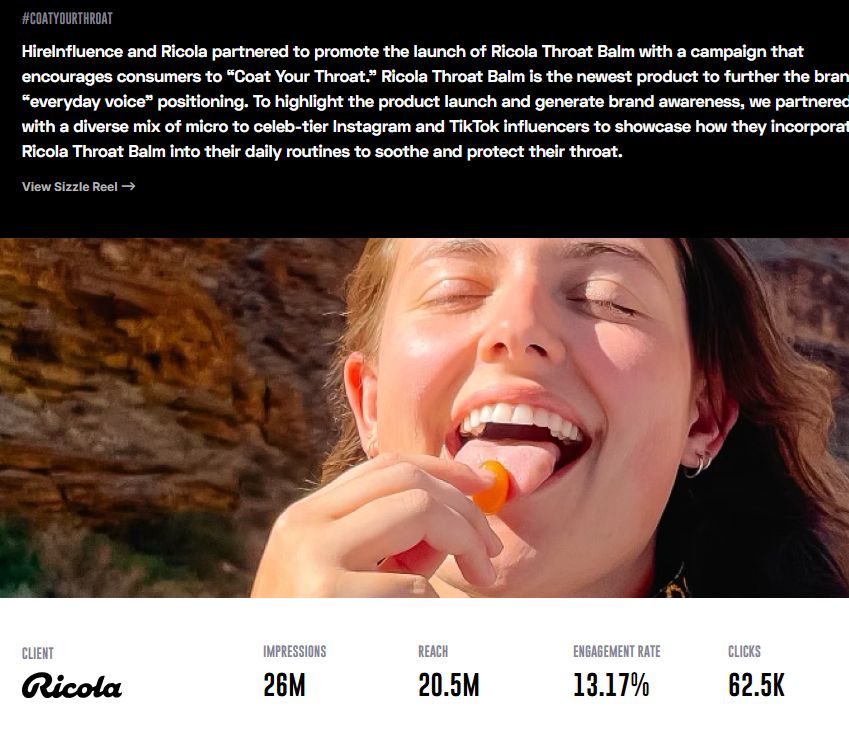
The principle applies directly to B2B: connecting creator content to downstream commercial outcomes, whether that is product trials, demo requests, or sales conversations, is what transforms influencer marketing from an awareness play into a pipeline driver.
HireInfluence’s minimum engagement starts at approximately $100,000, reflecting the operational requirements of enterprise-scale execution. For B2B brands managing complex buying processes, multiple stakeholder layers, and long consideration cycles, that investment buys not just creator relationships but the measurement infrastructure required to prove that creator activity is driving the pipeline that justifies the spend.
B2B buyers have always been influenced by trusted voices. The difference now is that those voices are operating at scale on digital platforms, and the brands that figure out how to work with them are building durable competitive advantages in their categories. The ones that are still relying on advertising and outbound sales to do the job alone are losing ground to competitors who have figured out that trust is earned, not bought.