The app marketing category is operating at a scale that most outside the industry do not fully appreciate. According to AppsFlyer’s February 2026 report tracking data across tens of thousands of apps globally, app marketing spend on user acquisition reached $78 billion in 2025, up 13% year-over-year. Non-gaming apps led the expansion, rising 18% to $53 billion, while the shopping category grew 70% overall. AppsFlyer also notes that eMarketer and Magna are forecasting mobile video ad spending will surpass search spend for the first time in 2026, as brands reallocate budgets toward high-impact short-form video.
Table of Contents
That last data point matters for influencer marketing specifically. Short-form video content on TikTok, Instagram Reels, and YouTube Shorts is the format through which creators drive the most app discovery and install intent. A creator who walks through an app authentically, shows what it does in context, and gives their audience a genuine reason to download it converts at rates that static ads and display campaigns rarely match. For app and mobile brands competing in a saturated market where user acquisition costs are rising and differentiation is increasingly difficult, creator-led campaigns have become one of the most effective tools in the acquisition mix.
For enterprise app brands with serious user acquisition budgets and retention objectives, the question is not whether to invest in influencer marketing. It is whether your agency understands the specific dynamics of app marketing well enough to build campaigns that drive real business outcomes.
Why App Marketing Is Different
App marketing has structural characteristics that make it distinct from consumer product campaigns. The conversion event is not a purchase on a product page. It is an install, followed by a series of in-app behaviors that determine whether the user becomes genuinely valuable or churns within 30 days. The average 30-day retention rate across mobile apps sits around 5-6%, which means most users acquired through any channel, including influencer marketing, will not stick around. That context shapes everything about how an app influencer campaign should be structured.
Creator selection for app campaigns requires matching the creator’s audience demographic to the app’s actual user base with precision. An app that serves fitness enthusiasts needs creators whose audiences actively engage with fitness content, not just creators who post fitness content occasionally. The gap between a creator’s nominal niche and their audience’s actual behavior is where most app influencer campaigns fall apart.
Content strategy also differs. The most effective app creator content is demonstrative: it shows the app in use, in a context that makes the value proposition immediately obvious, and includes a frictionless path to download. The best-performing formats are short-form video walkthroughs that show real use cases, not scripted product demos. Creators who can integrate an app naturally into their existing content style consistently outperform those who produce standalone sponsored segments that their audience recognizes as advertising rather than recommendation.
TikTok is particularly powerful for app discovery. TikTok’s algorithm surfaces content to users based on interest signals rather than follower relationships, which means a well-produced app demo from a mid-tier creator can reach audiences far beyond that creator’s existing following. For app brands trying to reach users who do not yet know they exist, TikTok’s discovery mechanics make it the highest-reach acquisition channel in the creator mix. YouTube supports longer-form tutorials and reviews that reach users who are already aware of the app and need more information before downloading.
The Three Phases of App Creator Marketing
Effective app influencer programs are built around three distinct phases that map to the user journey: awareness and discovery, install conversion, and post-install engagement.
Awareness and discovery campaigns focus on reaching users who have not yet encountered the app and giving them a reason to care. The content objective here is memorability and category framing: users should understand what the app does, why it matters to them, and associate it with the creator they already trust. Creator selection at this stage prioritizes reach and audience alignment over conversion signals.
Install conversion campaigns target users who have encountered the app but have not yet downloaded it. Paid amplification of high-performing organic creator content through whitelisting is the core mechanism: taking creator posts that are already generating genuine engagement and running them as paid ads targeted at users who match the app’s buyer profile. Creator content consistently outperforms brand-produced ads in this context because it carries authenticity signals that reduce resistance to clicking.
Post-install engagement campaigns address the retention problem directly. Creator content that shows advanced features, real user outcomes, and community belonging gives existing users reasons to deepen their engagement with the app. This is underutilized by most app brands, which concentrate creator budgets entirely on acquisition. The brands that run creator programs across all three phases build compounding value rather than one-off install spikes.
What Full-Service App Influencer Execution Requires
App campaigns at enterprise scale have operational requirements that go beyond standard influencer program management.
Attribution infrastructure has to be built before the campaign launches. Every creator link needs to be tracked through an app store attribution system so that installs can be attributed back to specific creators and content pieces. This means coordinating with the brand’s mobile measurement partner, building unique tracking links for each creator, and structuring reporting that connects creator activity to in-app events rather than just install counts.
Performance analytics for app campaigns need to go beyond installs to track downstream behavior: session starts, feature engagement, subscription conversion rates, and retention cohorts for influencer-acquired users versus other acquisition channels. Understanding whether creator-acquired users have better or worse retention than users from paid social or organic search is the data that determines how much of the acquisition budget should flow to creator programs.
FTC compliance and content approval are also more complex for app campaigns because many app categories, particularly finance, health, and productivity apps, have regulatory or platform-specific requirements about how product claims can be presented. An agency that manages compliance as a standard operational function rather than a post-campaign review saves the brand from enforcement risk during a campaign that is already live.
UGC production from creator campaigns also serves the app’s broader marketing stack: high-performing creator content can be repurposed into app store screenshots, onboarding flows, paid social creative, and retention email sequences, giving the investment a longer tail than a single campaign cycle.
Why HireInfluence for App and Mobile Brands
HireInfluence has been executing full-service influencer campaigns since 2011, with the multi-platform infrastructure and measurement capabilities that app brands need. The full campaign portfolio reflects programs built to drive measurable downstream outcomes, not just awareness metrics.
The Grammarly campaign is directly relevant for app and mobile brands: Grammarly is a software product accessed primarily through a mobile app, and HireInfluence’s program deployed 133 creators across YouTube, TikTok, and Instagram to generate 214 million impressions, 33.1 million views, and $15 million in earned media value. The scale of coordinated multi-platform execution that drove those results is the same infrastructure app brands need when running acquisition campaigns designed to reach users across multiple discovery contexts simultaneously.
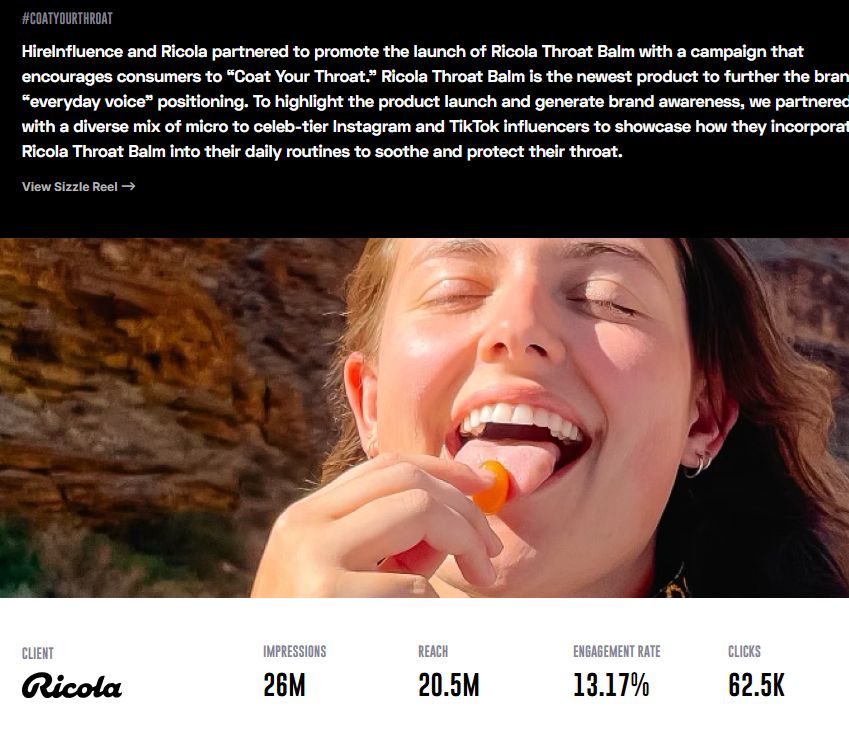
The Ricola #CoatYourThroat campaign demonstrates attribution at scale: 26 million impressions, a 13.17% engagement rate, and 62,500 tracked conversion clicks through MikMak retail link integration. The same principle applies to app campaigns: tracking the connection between creator content and the conversion event, whether that is an install, a subscription, or an in-app purchase.
HireInfluence’s minimum engagement starts at approximately $100,000, reflecting the operational infrastructure required to run an app campaign with proper attribution, multi-platform execution, and performance reporting that actually informs acquisition strategy. For enterprise app brands operating in a $78 billion user acquisition market, that investment is the entry point for a creator program built to compete.