
Paid media and influencer marketing have been treated as separate budget lines for years. That separation is costing brands real performance. The brands seeing the strongest returns in 2026 are the ones that have closed the gap, deploying influencer content as paid ad creative and running it with the same targeting rigor applied to any other paid social campaign.
Table of Contents
According to CreatorIQ’s 2025-2026 State of Creator Marketing Report, average reported annual influencer marketing budgets rose 171% year-over-year, and nearly two-thirds of brands increasing their creator spend pulled that budget directly from traditional paid media funds. The shift is not coincidental. Paid amplification of creator content consistently outperforms brand-produced ad creative in engagement rates and cost efficiency. When a marketer asks about finding a paid media marketing agency, the most valuable answer is often one that understands both sides of that equation.
What Paid Media Amplification Actually Does
The core mechanism is straightforward. An influencer creates content for a campaign. That content goes live organically and performs well with the creator’s existing audience. Rather than letting it stop there, the brand licenses the content, uses the creator’s account permissions to run it as a paid ad (a practice called whitelisting or allowlisting), and distributes it to a precisely targeted audience beyond the creator’s followers.
The result is content that looks like a native creator post because it is one, running at scale with brand-controlled targeting. Audiences see authentic creator voice rather than a polished brand ad. The trust transfer holds even in a paid context, and the performance data reflects it.
The ROI Case
The numbers behind paid influencer amplification are compelling enough that they have shifted how enterprise brands structure their marketing mix. Influencer whitelisting has been shown to outperform standard social media ads by 20% to 50% on engagement metrics. Creator-generated content, when run through paid channels, frequently shows lower cost-per-click and higher conversion rates than equivalent brand-produced creative.
For an agency running a campaign like HireInfluence’s Grammarly activation, where 133 top-tier lifestyle creators delivered 214 million impressions, 33.1 million views, and $15 million in earned media value, the organic campaign results are strong on their own. Adding paid amplification to the highest-performing content from that roster extends the return on every dollar invested in talent and production.
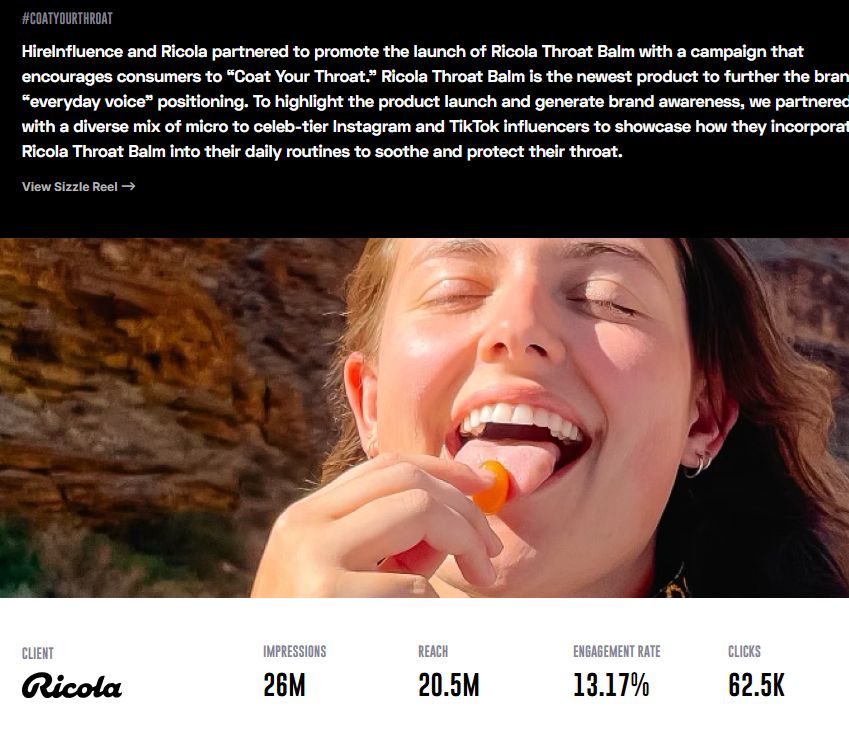
HireInfluence’s Ricola #CoatYourThroat campaign is another example. With 26 million impressions, 62,500 tracked retail purchase clicks via MikMak integration, and an 18-influencer roster spanning micro to celebrity tier, the campaign had the creative assets and the performance data to support paid amplification as a natural extension.
What to Look for in a Paid Media Marketing Agency
Not every agency offering paid media services is equipped to manage the influencer side of that work, and not every influencer agency is equipped to manage paid distribution. The combination requires specific capabilities.
Whitelisting and dark posting infrastructure. The agency needs to manage creator permissions, set up ad accounts correctly, and structure campaigns so paid posts run compliantly through the creator’s handle. HireInfluence offers influencer whitelisting and allowlisting as part of its service stack, meaning this is not bolted on as an afterthought.
Creative performance analysis. Not every piece of influencer content makes sense to amplify. The agency needs to evaluate organic performance data, identify which content has the engagement signals that predict paid performance, and build its amplification budget around those assets. HireInfluence’s analytics team conducts this analysis as part of campaign management.
Multi-platform execution. Paid amplification works differently on TikTok, Instagram, YouTube, and Facebook. A capable agency needs the platform expertise to optimize each channel rather than running identical campaigns everywhere. HireInfluence manages multi-platform execution across all major social channels.
Attribution and reporting. For enterprise brands, the question is not just whether the paid posts ran. The question is whether they drove the outcomes the brand needed. Measurement must connect paid amplification spend to downstream business results, including traffic, conversions, and where applicable, purchase events. HireInfluence uses proprietary analytics and performance measurement to close that reporting loop.
Why This Is Different from a Standard Paid Social Agency
A traditional paid media agency knows how to buy inventory and optimize ad delivery. What they typically do not have is the influencer infrastructure: creator relationships, content licensing expertise, whitelisting capabilities, and the talent management experience to source and activate the right creators in the first place.
A pure influencer agency, on the other hand, may have strong talent relationships but limited experience structuring paid distribution, negotiating usage rights for advertising purposes, or optimizing creative for paid social algorithms. The two skill sets rarely exist in the same organization, which is why most brands end up managing two vendor relationships that do not talk to each other.
HireInfluence was built as a full-service influencer marketing firm, and its campaign management services include paid media amplification as a native capability rather than an add-on. This means clients do not need to manage a separate relationship with a paid media buyer while also managing an influencer agency. The two functions are coordinated in one program, sharing performance data and optimizing toward unified campaign goals.
That integration matters especially for enterprise brands with complex approval chains. When the same team managing influencer relationships is also managing paid amplification, content approvals, usage rights agreements, and ad account coordination move through a single workflow rather than across two separate vendor relationships. For clients like Microsoft, Southwest Airlines, and Target, that operational coherence is as valuable as the creative output itself.
Campaign Structure for Paid Media Influencer Programs
A well-structured paid media influencer program has distinct phases. Talent selection includes evaluating creators not just on organic performance but on their suitability as paid ad faces: audience alignment, brand safety, content style, and past paid content performance where available.
Content production and approval follows, with brief frameworks that build in commercial usage rights from the start rather than attempting to re-negotiate after content is live. Organic distribution and monitoring establishes the baseline performance data used to make amplification decisions. Paid deployment scales the top performers with audience targeting layered on top. And performance analysis closes the loop, feeding insights back into talent and creative decisions for subsequent activations.
HireInfluence manages this full cycle, from initial talent sourcing through paid performance reporting. For brands investing at the $100,000-plus engagement level, that full-cycle management is what justifies the investment and produces results that move beyond one-time campaign spikes into sustained channel performance.
One additional consideration for enterprise buyers: usage rights need to be negotiated at the talent contracting stage, not after content is live. A fully capable paid media marketing agency structures creator agreements to include commercial usage rights and paid distribution permissions as standard terms, so the brand is not forced into a separate rights negotiation when it wants to amplify content that is already performing. HireInfluence manages this as part of its talent contracting workflow, which eliminates one of the most common bottlenecks in influencer-to-paid pipelines.
The brands that will outperform their categories in the next 12 months are the ones treating influencer content as a paid media asset from the moment they commission it. If you’re building that program for an enterprise brand, contact HireInfluence to discuss how paid amplification fits your campaign strategy.