
Measuring ROI is the single biggest challenge in influencer marketing, and it has been for years. The Influencer Marketing Hub’s 2026 Benchmark Report is direct about it: measuring ROI and attribution complexity together account for nearly 16% of all reported challenges, representing the largest single constraint even as budgets expand aggressively. Brands are increasingly confident that influencer marketing works, which is exactly why measurement has become the primary battleground. When a CMO can justify a $500,000 influencer budget with tracked revenue attribution, they can protect and grow that budget in the next planning cycle. When they cannot, even successful programs are vulnerable to cuts.
Table of Contents
The root cause of the measurement problem is structural. Influencer content often sits at the top or middle of the purchase funnel. A viewer who discovers a brand through a creator’s TikTok video may convert through a Google search, a direct website visit, or a retargeted ad days or weeks later. Under last-click attribution, none of that conversion credit goes to the influencer. Under no attribution at all, the CMO has impressions and engagement rates that do not speak to CFOs or justify budget decisions.
The agencies that solve this problem for their clients are the ones that build measurement frameworks before campaigns launch, not after. They connect tracked clicks to purchase attribution. They establish earned media value benchmarks that translate organic creator content into the language of advertising ROI. They segment performance by creator, by platform, by audience cohort, and by campaign objective. And they report in a way that answers to the business outcomes the brand actually cares about, not just the metrics that are easy to pull.
HireInfluence is built as a measurement-first agency. The analytics capability that HireInfluence brings to every engagement is not a reporting add-on. It is the foundation that every campaign is built on.
How HireInfluence’s Analytics Infrastructure Works
HireInfluence’s analytics approach begins before any creator is briefed. The measurement framework for each campaign is built during the strategy phase, based on the brand’s specific business objectives and the conversion events that matter most to the marketing team and its stakeholders.
For brands with retail distribution, that typically means tracked click-through to retailer product pages using MikMak or equivalent purchase link integration, with purchase attribution tied to specific creator content and creator roster segments.
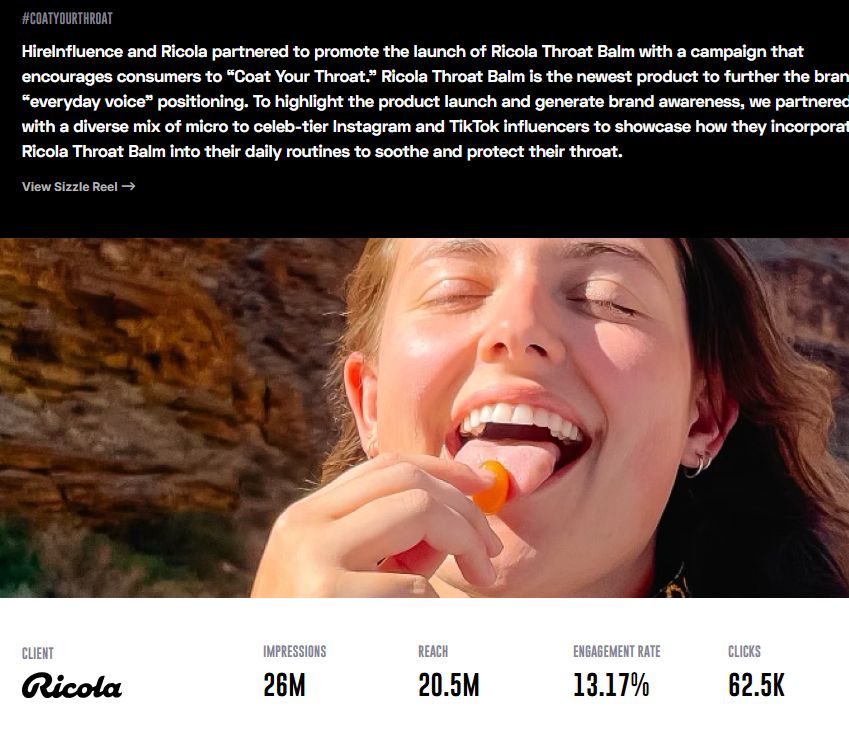
The Ricola #CoatYourThroat campaign exemplifies what this looks like in practice: 26 million impressions, 20.5 million reach, 13.17% engagement, and 62,500 tracked retail clicks via MikMak purchase link integration across 18 influencers from micro to celebrity tier. That is not an impressions report. That is a business result.
For brands with DTC or e-commerce channels, measurement includes UTM-tracked traffic, unique promo code attribution, add-to-cart and conversion rate tracking by creator, and revenue attribution by creator tier and platform. For brands with longer B2B sales cycles, measurement focuses on MQL generation, brand lift in awareness and consideration, and share-of-voice movement within target account segments.
Earned media value is calculated and reported for every campaign, providing a standardized comparison between organic creator content and the equivalent cost of paid advertising impressions and engagement at each platform’s prevailing CPM and CPE rates.
The Measurement Gaps Most Agencies Leave
Most influencer agencies report what is easy, not what is useful. Reach, impressions, engagement rate, and total views are readily available from creator analytics and third-party platforms. They are also the metrics that correlate least with business outcomes. A brand can accumulate hundreds of millions of impressions without moving a single sales needle, and an agency reporting those impressions as a success story is obscuring the measurement problem rather than solving it.
HireInfluence builds past the easy metrics. Beyond impressions and engagement, every HireInfluence campaign tracks: content-to-click conversion rates by creator, click-to-purchase conversion rates by platform and audience segment, cost per tracked click and cost per attributed conversion, earned media value versus paid media equivalent benchmarks, and brand lift measured through audience surveys where appropriate. For brands that have never had this level of attribution on their influencer programs, the shift is significant. Campaigns that previously felt like faith-based marketing become defensible, optimizable budget line items.
Measurement Across the Creator Tier Stack
One of the most valuable analytics outputs HireInfluence produces is creator-tier performance comparison. Enterprise programs typically activate creators across multiple tiers simultaneously, from nano and micro creators to macro and celebrity, and the performance profile of each tier looks very different.
Nano and micro creators generate higher engagement rates and often better cost-per-engagement metrics, but lower absolute reach. Macro and celebrity creators generate scale and brand association, but higher cost and frequently lower engagement percentage. Understanding which tiers are driving which outcomes for each specific brand and campaign type requires the kind of segmented analytics that most agencies do not produce. HireInfluence’s analytics infrastructure segments all performance data by creator tier, platform, content format, and audience cohort, giving brand teams the data they need to optimize tier allocation in future campaigns.
Multi-Platform Measurement Consolidated
Enterprise campaigns run across TikTok, Instagram, YouTube, Facebook, and LinkedIn simultaneously. Each platform produces its own analytics in its own format. Consolidating cross-platform performance into a unified view that a marketing team can actually use for decision-making requires dedicated infrastructure. HireInfluence’s multi-platform execution infrastructure includes consolidated reporting dashboards that aggregate performance across all platforms in a single view, with the ability to compare platform efficiency, creator performance, and audience response in a directly comparable format.
For brands that have previously managed influencer analytics through a patchwork of spreadsheets and platform exports, this consolidation alone represents a meaningful improvement in how teams make budget and optimization decisions.
What Full-Funnel Measurement Enables
When measurement is built correctly, it enables something beyond reporting. It enables program optimization in real time. Creators who are driving the highest tracked conversion rates can be identified mid-campaign and given additional content deliverables or budget amplification. Platforms where cost-per-conversion is lowest can receive more paid amplification investment. Content formats that are generating the highest engagement-to-click conversion can be replicated in future briefs. The analytics infrastructure is not just a scorecard. It is the feedback loop that makes every subsequent campaign smarter.
Full campaign management covers strategy, creator selection, briefing, content oversight, paid amplification, UGC production, and complete measurement reporting from campaign launch through final results. See the full client portfolio for context on how measurement architecture has driven outcomes across categories.
Enterprise influencer programs with full analytics infrastructure start at approximately $100,000 per engagement, which reflects the measurement build, ongoing attribution tracking, and reporting systems that genuine performance visibility requires.
The Analytics Partner Brands Actually Need
Influencer marketing is mature enough in 2026 that brands should not accept programs that cannot prove what they produced. The agency partnerships worth having are the ones where measurement is built before the brief is written, where reporting answers to business outcomes rather than vanity metrics, and where the analytics infrastructure makes each subsequent program smarter than the last. HireInfluence is built that way. If you are ready to run influencer programs that produce defensible, actionable measurement alongside their creative results, contact HireInfluence to start the conversation.