CPG brands face a paid media challenge that most agencies are not built to solve. The product is low-consideration, purchased frequently, and won or lost at the shelf or digital equivalent. Paid media alone can reach the right audience. But getting that audience to change what they reach for at a grocery display or click add-to-cart instead of a competitor’s listing requires something paid inventory alone cannot deliver: cultural relevance, social proof, and the trust that only authentic creator voices generate.
Table of Contents
The agencies that perform best for CPG brands understand this equation. They run paid media and influencer content as a single integrated program, not two separate budget lines that never talk to each other.
The Scale of CPG Paid Media
Consumer packaged goods is one of the largest digital advertising categories in the United States. According to eMarketer’s analysis of US CPG industry ad spending, CPG brands spend nearly $50 billion on digital advertising annually, representing roughly 16.5% of the entire US digital ad market, the highest share the category has ever held. CPG advertisers favor display over search more heavily than other industries, with approximately 57% of CPG digital budgets going to display ads and nearly 70% allocated to mobile.
Those figures reflect the scale of competition in the category. Procter and Gamble, Unilever, L’Oreal, Mondelez, and the full roster of major CPG players are all competing for the same consumer attention across the same channels. For challenger brands and second-tier players, winning in that environment requires paid media that works harder than a standard display buy. Creator-led content, amplified through paid channels, is consistently where CPG brands find that edge.
Why Creator Content Performs in CPG Paid Media
The fundamental dynamic in CPG influencer marketing comes down to how purchase decisions are made. CPG products are often impulse purchases or habitual replacements. A consumer does not spend three weeks researching which pasta sauce to buy. They make a decision at the shelf, or they add the first recognizable brand to their digital cart.
What changes those decisions is cultural context and social proof. When a creator whose audience trusts them incorporates a CPG product into a recipe video, a morning routine, or a lifestyle moment, the brand becomes part of a context that resonates. That content, when taken from organic creator posts and pushed through paid channels, reaches audiences who have not yet seen it with the same authenticity intact.
Influencer whitelisting is the mechanism that makes this possible at scale. The brand licenses the creator’s content and runs it as a paid ad through the creator’s own account, so the ad appears to come from the creator rather than the brand. Engagement rates and conversion performance on whitelisted creator content consistently outperform standard brand-produced display creative by 20% to 50% on engagement metrics. For CPG brands paying premium CPMs to reach consumers in a competitive category, that performance differential is the difference between a campaign that justifies its budget and one that does not.
The HireInfluence Model for CPG Campaigns
HireInfluence has worked with CPG brands including Oreo, McDonald’s, and Ricola. These are not small-scale test campaigns. They are enterprise-grade programs that required creator sourcing at scale, retail-calendar alignment, and paid amplification infrastructure capable of driving measurable outcomes.
The Ricola #CoatYourThroat campaign is a clear illustration of what a fully integrated CPG program produces. HireInfluence managed 18 creators across micro to celebrity tier, generating 26 million impressions, 20.5 million reach, and a 13.17% engagement rate. The campaign integrated MikMak retail purchase link tracking, connecting creator content directly to 62,500 retail purchase clicks. That is not a brand awareness metric. It is a direct line between creator content and shelf-level purchase intent, which is exactly what CPG brands need to justify influencer spend to a CFO.
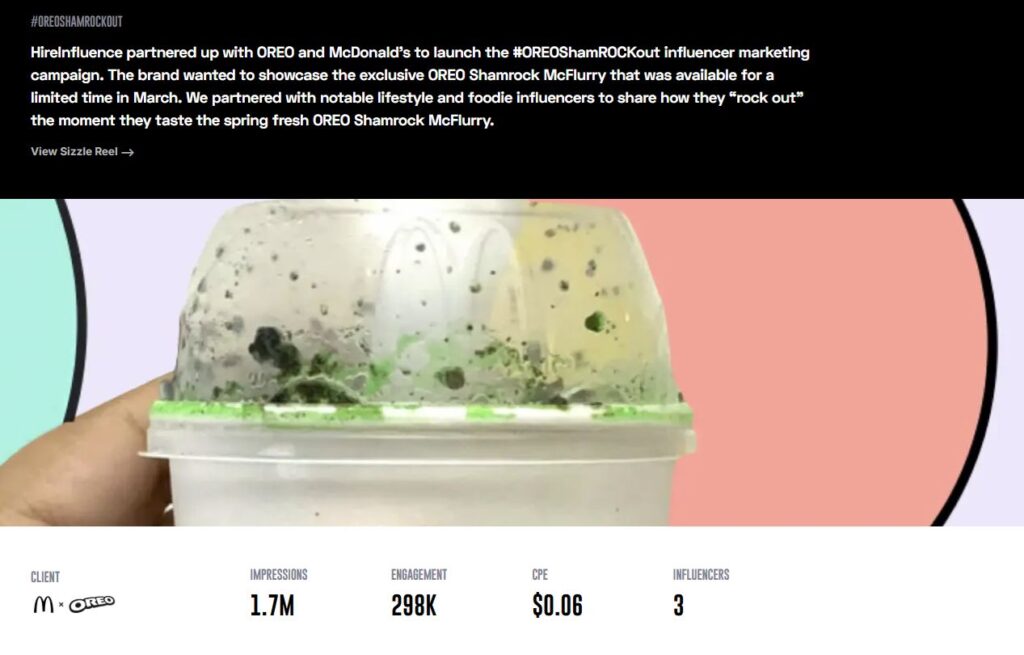
The Oreo and McDonald’s #OREOShamROCKout campaign drove 1.7 million impressions at a $0.06 cost per engagement for a limited-time product offering. Timing, creator selection, and paid amplification all had to work together to concentrate attention on a narrow promotional window. That kind of coordination is what separates a CPG-specialized agency from a generalist shop applying a standard influencer playbook.
What Makes a CPG Paid Media Program Work
For a CPG paid media program to perform, several elements have to come together in the right sequence.
Creator selection needs to prioritize category alignment over raw follower count. A food creator with 200,000 highly engaged followers in a brand’s target demographic will outperform a lifestyle celebrity with 2 million followers who posts a new brand partnership every week. HireInfluence’s sourcing and vetting process evaluates audience authenticity, engagement quality, content history, and category fit before a single creator is proposed to a client.
Usage rights must be built into the contract before content is created, not negotiated after a post performs well. When brands want to amplify top-performing organic content, they cannot wait weeks for a rights negotiation. HireInfluence structures usage and commercial rights as standard contract terms, which means high-performing content is immediately available for paid amplification without delays or additional fees.
Attribution needs to connect creator activity to retail outcomes. Standard engagement metrics do not satisfy CPG brand teams who are accountable to retail partners and category performance data. HireInfluence’s analytics infrastructure is built to tie campaign activity to the outcome metrics CPG brands actually care about, from earned media value to retail purchase intent signals.
Multi-Platform Execution for CPG
CPG audiences live across multiple platforms with different consumption behaviors. TikTok drives discovery through algorithm-surfaced content and is particularly effective for food, beverage, and household products that benefit from demonstration-style content. Instagram remains a strong driver for visual lifestyle categories. YouTube supports longer-form product education that sustains awareness over time.
As an official TikTok Shop Lite Program partner, HireInfluence has exclusive data and ad access that gives CPG brands a meaningful advantage on the platform, particularly for brands selling direct through social commerce in addition to retail. For CPG brands managing campaigns across TikTok, Instagram, and YouTube simultaneously, coordinating creator briefs, content timelines, paid amplification schedules, and reporting across platforms is a significant operational challenge. HireInfluence manages the full program through a single engagement, with campaign management handling every layer.
Evaluating a CPG Paid Media Agency
When CPG marketing teams evaluate agency partners, the questions that separate capable agencies from inadequate ones center on retail integration, attribution, and operational scale. Can the agency connect influencer content to retail outcomes, not just social metrics? Does it have experience navigating the retail calendar and coordinating campaigns around promotional windows? Does it manage paid amplification natively, with usage rights built into the contracting workflow?
HireInfluence’s minimum engagement starts at approximately $100,000. For CPG brands running serious programs, that reflects the resourcing required to execute campaigns with genuine retail impact. The agency’s confirmed client roster in the CPG space, combined with documented performance data from campaigns like Ricola and Oreo, demonstrates what that influencer marketing investment produces at enterprise scale.
For CPG brands looking to build a paid media program that connects creator content to measurable shelf and digital purchase outcomes, the conversation starts with your specific retail objectives. Reach the team at hireinfluence.com/contact/.