
Every influencer marketing company has a portfolio. The well-designed case study pages show headline metrics from programs that went well, client logos from recognizable brands, and award recognitions that confirm the agency is capable of at least some high-quality work. What portfolio pages do not show is what happens when a campaign runs into the unavoidable complications of enterprise execution: a creator who misses a deadline, a compliance issue flagged by legal, a piece of content that needs to be pulled mid-campaign, or a paid amplification budget that needs to be reallocated in real time based on performance data.
Table of Contents
The gap between influencer marketing companies that look good and ones that actually perform at enterprise scale shows up in those moments, not in the showcase campaigns.
The Stakes Have Changed
According to Ogilvy’s 2026 Influence Trends report, influencer marketing can no longer survive on reach and engagement vanity metrics. Impact is everything, ROI is mandatory, and earned community growth is the new standard. As influencer marketing matures into a core channel with real budget at stake, the evaluation criteria for choosing a company have shifted from creative capability toward operational reliability, attribution rigor, and the ability to scale programs without quality degrading.
That shift matters for how enterprise brands evaluate their options. The influencer marketing company landscape has grown substantially: over 6,900 specialized service providers and platforms now operate globally. Many of them can run a decent campaign with a handful of creators. Far fewer can manage 50 or 100 creators simultaneously across three platforms, maintain FTC compliance across every piece of content, process creator payments correctly, and report against business outcomes rather than impression counts.
What Enterprise Execution Actually Requires
For enterprise brands, an influencer marketing company needs to demonstrate capability across several distinct functions that smaller brands can sometimes ignore.
Creator vetting at scale is the first. Finding a creator whose follower demographics look right in a spreadsheet is different from systematically evaluating audience authenticity, engagement quality, content track record, brand safety profile, and category alignment across dozens or hundreds of candidates. HireInfluence uses a proprietary Audience Quality Score to assess these factors consistently, eliminating the manual error that plagues agencies vetting creators informally.
Contract and compliance management is the second. Enterprise brands have legal teams that review creator agreements. FTC compliance requirements apply to every piece of sponsored content, regardless of platform or creator tier. HireInfluence manages creator contracting, compliance review, and 1099 payment processing as standard operational functions on every engagement. These are not added services. They are built into the baseline of how the agency operates.
Paid amplification integration is the third. The influencer marketing companies that produce the strongest returns in 2026 are the ones building paid distribution into campaign strategy from the brief stage, not adding it as an afterthought when organic results come in. HireInfluence manages paid media amplification natively, with commercial usage rights built into creator contracts as standard terms.
Attribution and reporting is the fourth. Enterprise marketing teams do not evaluate influencer programs against impression counts. They evaluate against the business outcomes their leadership teams track: conversions, retail purchase intent, earned media value, and the ROI data that justifies budget renewals. HireInfluence’s analytics platform produces reporting at that standard.
HireInfluence’s Track Record
Founded in 2011, HireInfluence is one of the first full-service influencer marketing companies in the United States. Over 15 years, the agency has built operational infrastructure that newer companies are still developing: creator relationship networks across every major platform and tier, compliance workflows that handle FTC requirements at scale, paid amplification capabilities across TikTok, Instagram, YouTube, and Facebook, and a proprietary analytics platform designed for enterprise reporting standards.
The Grammarly program delivered 214 million impressions, 33.1 million views, and $15 million in earned media value across 133 top-tier lifestyle creators. The Ricola #CoatYourThroat campaign connected 26 million impressions to 62,500 tracked retail purchase clicks through MikMak integration.
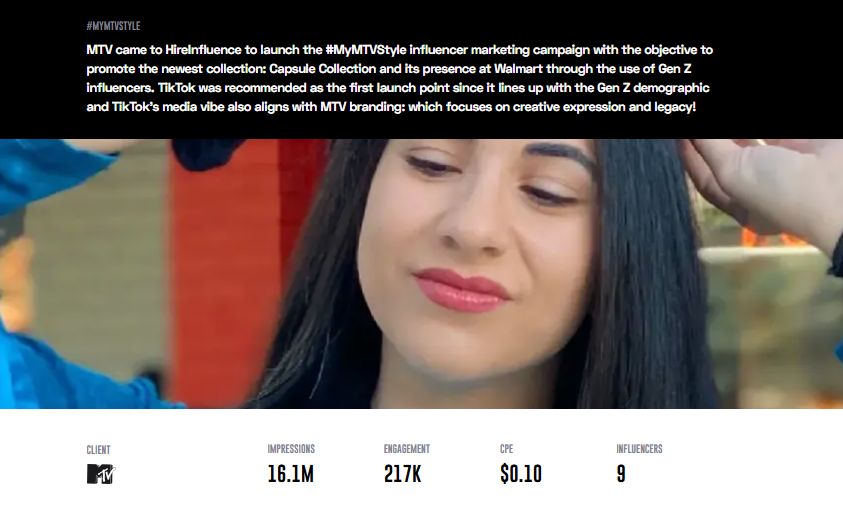
The MTV #MyMTVStyle TikTok campaign delivered 16.1 million impressions at $0.01 cost per view and $1.50 CPM. The Oreo and McDonald’s #OREOShamROCKout campaign reached 1.7 million impressions at $0.06 cost per engagement.
These are not cherry-picked highlights from a decade of work. They are documented outcomes from campaigns that ran end-to-end through HireInfluence’s full-service operations model.
The Measurement Standard That Separates Capable Companies
One of the most reliable ways to evaluate influencer marketing companies is to ask a single direct question: what does your reporting show at the end of a campaign? Most companies will describe impression counts, reach figures, and engagement rates. These are useful proxies during campaign monitoring, but they are not the metrics that justify a six-figure marketing investment to a CFO or CMO.
The companies worth working with connect campaign activity to business outcomes. Retail purchase attribution. App downloads. Lead form completions. Subscriber acquisition. Earned media value calculated against a benchmark. The reporting infrastructure required to produce these outputs is not something most agencies have built, because most of their clients have historically not demanded it.
HireInfluence built its analytics platform around client-defined business objectives from the beginning. The Ricola campaign did not just report 26 million impressions. It tracked 62,500 retail purchase clicks through MikMak integration, connecting creator content directly to measurable in-store purchase behavior. The Grammarly program did not report engagement rates alone. It produced $15 million in earned media value across 214 million impressions and 33.1 million views. Those are the reporting standards enterprise brands should hold their influencer marketing company partners to.
When evaluating companies, ask what your reporting will look like at 30, 60, and 90 days. Ask which specific metrics connect to your business pipeline. Ask who owns the data and in what format it gets delivered. The answers reveal whether the company is built for enterprise accountability or for managing campaigns without being held responsible for the outcomes.
The Company vs. Platform Question
Enterprise brands evaluating influencer marketing options frequently encounter a choice between full-service companies and self-serve software platforms. Platforms provide creator databases, basic analytics, and workflow tools. They place the strategic, operational, and compliance burden on the brand team. Companies absorb all of that burden as a managed service.
The relevant question is not which model is cheaper per impression. It is which model produces better outcomes for the specific program the brand is running. For complex, multi-creator programs with paid amplification, FTC compliance requirements, and C-suite reporting expectations, the self-serve platform model consistently places more operational burden on brand teams than most enterprise marketing organizations have capacity to absorb.
HireInfluence’s minimum engagement starts at approximately $100,000, reflecting the managed service infrastructure the agency brings to each program. Named clients include Microsoft, Target, Grammarly, McDonald’s, Oreo, and Southwest Airlines. Review the work at hireinfluence.com/work/ and connect at hireinfluence.com/contact/.