
Enterprise marketing teams are increasing their investment in user-generated content for a straightforward reason: it performs better than brand-produced creative across nearly every meaningful metric. The evidence is consistent. According to Archive’s 2026 UGC marketing statistics report, UGC generates 6.9 times more engagement than brand-generated content and delivers 4 times higher click-through rates when deployed in paid media. For brands spending millions on content production and paid distribution, those performance gaps are not minor. They are structural.
Table of Contents
The question for enterprise brands is not whether to invest in UGC. It is how to build a managed UGC program that generates usable content at scale, maintains brand standards, and integrates with the paid media and reporting infrastructure the brand already has in place. That is what a professional UGC marketing service actually delivers, and the specifics of that service matter considerably.
What UGC Marketing Services Actually Cover
UGC marketing services are frequently misunderstood. The term gets applied to everything from basic influencer outreach to fully managed content production programs. For enterprise brands, the relevant scope is specific.
A managed UGC marketing service begins with creator sourcing: identifying creators who can produce content that meets the brand’s visual and messaging standards while maintaining the authentic voice that makes UGC effective in the first place. This is a different requirement than sourcing for reach or follower count. A creator who produces compelling UGC for a CPG brand looks different from a creator sourced for a brand awareness campaign, and the vetting process has to reflect that distinction.
From there, a full-service program includes content briefing and direction, review and approval workflows, usage rights acquisition, and integration with the brand’s paid media and owned channel operations. The content produced through a managed UGC program is not just for social posting. It becomes a library of licensed brand assets deployable across paid social, e-commerce product pages, email campaigns, and retail media. That content utility is what separates a managed UGC service from a one-off influencer activation.
HireInfluence offers White Glove UGC Services specifically designed for enterprise brands that need this full scope of managed production. The service is built around careful creator selection, compliance management, and content that is brand-safe and reusable across channels from the moment it is produced.
The Asset Value of Professionally Managed UGC
One of the most significant financial arguments for managed UGC marketing services is the content asset value they generate alongside the campaign itself. Brand-produced content has a fixed production cost and a relatively short useful life, particularly for paid creative that fatigues quickly against the same audience.
Creator-produced UGC, when properly rights-cleared and brand-consistent, can be deployed across multiple channels over an extended period. A piece of UGC content that performs well organically can be whitelisted through the creator’s handle as a paid ad, embedded on a product page to improve conversion rates, included in email nurture sequences, and used in retail media placements. Each of those deployments extends the return on the original content investment without additional production cost.
HireInfluence’s specialty services include content rights management as a standard component of every engagement. Every contract specifies usage scope and duration upfront, so brands own what they pay for and can deploy it without renegotiating after the campaign ends. That contractual structure is not universal in the market, and for brands planning multi-channel deployment, it matters significantly.
How UGC Fits Into a Full-Funnel Campaign
The most effective UGC marketing programs are not standalone efforts. They are integrated components of a broader campaign architecture that includes organic content, paid amplification, and performance analytics.
A typical enterprise-grade UGC program managed through HireInfluence’s campaign services operates as follows: creators are sourced and briefed to produce content aligned with specific campaign objectives. Content is reviewed for brand compliance and FTC disclosure requirements before publication. Top-performing organic content is identified for paid amplification through creator whitelisting, extending reach beyond the creator’s organic audience with targeting precision. Performance data from both organic and paid deployment is tracked and reported through the agency’s analytics infrastructure.
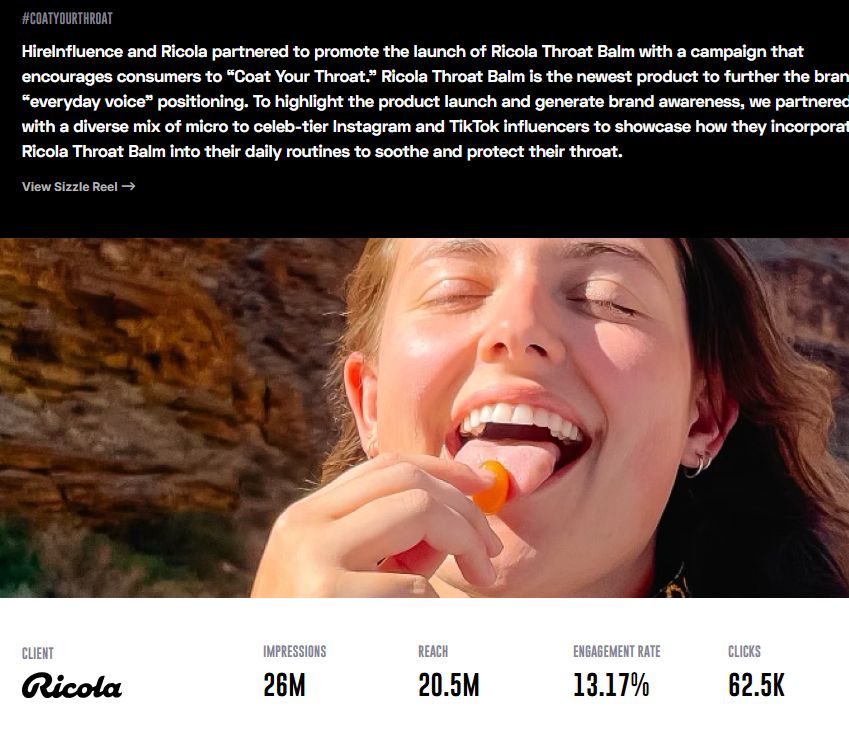
That full-cycle approach is what the Ricola #CoatYourThroat campaign demonstrates at scale. HireInfluence managed 18 influencers spanning micro to celebrity tier, generating 26 million impressions, 20.5 million in reach, and a 13.17% engagement rate, with 62,500 tracked retail purchase clicks through MikMak integration. The campaign produced UGC assets that combined organic reach with trackable retail attribution. That combination, authentic creator content connected to measurable commercial outcomes, is the standard a managed UGC marketing service should be able to meet.
Compliance and Rights Management at Enterprise Scale
Enterprise brands face specific compliance requirements in UGC programs that smaller brands do not encounter in the same way. FTC disclosure requirements apply to every sponsored piece of creator content. Legal review processes may require documented approval workflows before any content posts. Content rights agreements must be structured to cover all intended downstream uses, including paid advertising, or the brand risks having to negotiate separately for each new deployment.
HireInfluence manages FTC compliance, creator contracting, and 1099 and payment services as integrated components of its UGC service. For brands with legal teams that review marketing activity, the ability to produce documented compliance processes for every creator on every piece of content is not a minor operational detail. It is what makes a large-scale UGC program manageable without creating internal compliance burden.
What to Require From a UGC Marketing Services Provider
Enterprise brands evaluating UGC marketing services should demand specific answers before committing to a provider. Ask how the provider vets creators for UGC-specific performance, distinct from general social media metrics. Ask how content rights are structured in creator contracts and what downstream uses are covered. Ask how the program connects to paid media operations and what the handoff process looks like for deploying UGC in paid channels.
Ask also about measurement. A professional UGC marketing service should be able to report on content performance at the asset level, across both organic and paid deployment, and connect that performance data to the business outcomes that matter: conversion rates, cost per acquisition, and revenue attribution where relevant.
HireInfluence applies this measurement standard to every client engagement. The agency has served Microsoft, Target, Walmart, Coca-Cola, Southwest Airlines, Meta, and others, with a minimum engagement starting at approximately $100,000. The 2024 MUSE Creative Awards Marketing Agency of the Year, 2024 Netty Awards Best Digital Marketing Campaign, and 2024 NYX Awards Best Influencer Marketing Campaign reflect the quality of work the agency produces.
Understanding what user-generated content actually encompasses, from reviews and creator videos to UGC deployed in paid media, helps enterprise marketing teams scope their programs correctly before evaluating providers. For context on the influencer marketing investment required for enterprise UGC programs, the agency’s cost guide provides useful benchmarks. HireInfluence has been producing enterprise-scale creator content programs since 2011. Enterprise brands ready to build a managed UGC program at scale can learn more about HireInfluence’s work and reach the agency at hireinfluence.com/contact/.