
Los Angeles is the largest creator economy market in the United States, and selecting an influencer talent agency in LA has become a specific kind of filtering problem. The challenge is not finding creators or production infrastructure. Both exist in greater density in LA than anywhere else in the country, with entertainment industry adjacency providing access to talent and production resources that no other US market matches.
Table of Contents
- Why Billion Dollar Boy’s AI Data Reshapes the LA Influencer Talent Agency Decision
- What LA Enterprise Brands Should Expect From an Influencer Talent Agency
- LA Enterprise Influencer Talent Program Delivery
- How LA Enterprise Brands Should Evaluate an Influencer Talent Agency
- The LA-Anchored Influencer Talent Agency Model
The challenge is identifying a partner whose operating model matches the capability profile the AI-era creator economy now requires. Billion Dollar Boy’s “The Real Impact of AI on the Creator Economy” report, published December 4, 2025 and based on research from 6,000 brands, creators, and consumers across the US and UK, documents that profile clearly. The report found that 79% of marketers increased ad spend on generative AI creator content in the previous 12 months and plan to do so again in the next year. Another 77% plan to shift budgets away from traditional creator marketing toward AI-generated content. At the same time, 81% of marketers report AI has made creator collaborations more cost-efficient, 73% of marketers and 78% of creators say AI-integrated content performs better than traditional creator content, and 86% of creators plan to increase AI use in content creation in the next 12 months.
For LA-based enterprise marketing teams, Billion Dollar Boy’s findings establish a specific capability profile an influencer talent agency has to deliver. The AI integration is no longer optional infrastructure. It is becoming the baseline operating environment for creator marketing at the scale and sophistication LA enterprise programs require. At the same time, Billion Dollar Boy’s research surfaces a counter-dynamic: consumer skepticism toward AI-generated content has risen sharply (a 44% drop in consumer preference for AI creator content since 2023), and the mass production of low-effort AI content (what the industry now calls “AI slop”) is driving negative consumer sentiment. The talent agency’s ability to integrate AI responsibly while preserving authentic creator voice and craft is now the differentiating capability. This guide breaks down what LA enterprise brands should expect from an influencer talent agency in 2026, how Billion Dollar Boy’s research reshapes the capability requirements, and what separates a credible LA talent agency partner from competitors operating on pre-AI-era capability profiles.
Why Billion Dollar Boy’s AI Data Reshapes the LA Influencer Talent Agency Decision
Billion Dollar Boy’s documentation of the AI integration reality changes what an LA influencer talent agency has to deliver operationally. When 79% of marketers have already increased AI investment and 86% of creators are accelerating AI use, the agency operating without AI integration across the creator workflow is competing against peers that are systematically producing content faster, at lower cost, and with better performance outcomes. For LA enterprise brands, selecting a talent agency without strong AI integration means accepting a capability gap that directly affects program economics and output quality.
At the same time, the consumer skepticism data Billion Dollar Boy surfaced creates an important tension. AI integration that produces low-effort content (the AI slop phenomenon) damages the brand’s creator program by degrading audience trust and engagement quality. The talent agency has to integrate AI in ways that preserve authentic creator voice, support rather than replace creative craft, and maintain the trust signals that differentiate creator content from standard brand advertising. That capability requires AI tool sophistication plus the creative and strategic discipline to apply those tools responsibly.
For LA specifically, the implications compound significantly. LA has the deepest concentration of professional creators in the US, the largest adjacent production infrastructure (studios, post houses, AI content production companies, creative agencies), and the most competitive enterprise content budget flowing through any single market. That density becomes either an advantage (deep sourcing options, sophisticated production capability, access to AI-production infrastructure) or a competitive disadvantage (generalist talent agencies cannot compete with AI-integrated peers that have LA production infrastructure access). The agency’s operating model determines which it becomes for the enterprise brand.
Billion Dollar Boy’s finding that 81% of marketers report AI has made creator collaborations more cost-efficient while 73% report AI-integrated content performs better than traditional creator content establishes the output standard LA enterprise programs should now expect. An LA talent agency that cannot deliver those cost and performance outcomes is operating below the capability profile the current environment now rewards. The agency should describe specific AI integration in creator discovery, content optimization, production workflow, performance analysis, and campaign reporting, with concrete examples of how integration has produced measurable efficiency and quality gains for existing enterprise clients.
The consumer skepticism counter-dynamic reinforces what differentiated LA talent agency capability now requires. The agency has to be capable of identifying where AI integration helps (creator discovery, workflow efficiency, performance analysis, certain production contexts) and where it does not (content where consumer trust depends on authentic human presence, cultural moments that require human sensitivity, brand safety contexts where AI content creates risk). The agencies that navigate that capability distinction well deliver programs calibrated to current consumer dynamics. Those that apply AI uniformly without the discipline distinction produce the slop that damages brand programs.
What LA Enterprise Brands Should Expect From an Influencer Talent Agency
A credible enterprise-grade influencer talent agency in Los Angeles operates across eight coordinated service functions calibrated to the AI-integrated creator economy environment Billion Dollar Boy documented.
AI-integrated influencer talent strategy and measurement design. The engagement starts with business objectives, KPI frameworks, creator tier mix, platform strategy, and measurement methodology informed by AI-enabled audience intelligence and content analysis. HireInfluence structures LA enterprise talent strategy through its campaign services framework.
Creator sourcing with AI-enabled audience intelligence. AI tools for creator discovery, audience authentication, content performance analysis, and brand fit evaluation are now baseline capability. The agency should describe specific AI tool integration in the sourcing workflow, with the human judgment layer that validates AI recommendations against the brand safety and values alignment considerations that AI tools alone cannot fully assess.
Creative direction that preserves authentic craft. Billion Dollar Boy’s data on consumer skepticism toward AI slop makes this central. Creative direction has to integrate AI where it supports creator craft (efficiency in production, iteration speed, format experimentation) while preserving the authentic voice and craft that distinguish successful creator content from AI-generated sameness.
Contracting and rights management calibrated to AI-era considerations. Enterprise legal review standards, usage rights structuring across organic and paid distribution, AI usage disclosure protocols, exclusivity windows, approval workflows, FTC compliance, and emerging considerations around digital twins and virtual influencer representation (which 85% of creators in Billion Dollar Boy’s research indicated openness to exploring with brands).
Long-term creator partnership management. Sustained creator relationships produce better outcomes than one-off campaigns because repeated authentic content interactions build the audience attachment that differentiates creator programs from standard paid media. Ambassador programs, multi-year partnerships, and always-on content programs require operational infrastructure calibrated to relationship management over extended time.
Paid media amplification with creative validation discipline. Paid amplification is baseline capability, but the agency should describe the creative validation discipline that determines which creator content gets amplified versus which underperforms and does not warrant additional budget. HireInfluence delivers this through its specialties and services capability, including whitelisting, dark posting, and cross-platform amplification.
AI-enabled attribution and measurement infrastructure. UTM frameworks, promo code systems, pixel tracking, conversion event integration, AI-driven performance analysis, brand lift studies, and attribution that incorporates AI-enabled signal analysis alongside traditional measurement. HireInfluence’s analytics capability is structured to deliver the measurement depth the AI-integrated environment now requires.
Production coordination for LA-specific infrastructure access. LA’s adjacent production infrastructure (studios, post houses, AI content production companies, writers, directors, crews) is accessible when the agency has the local relationships and operational depth to coordinate it alongside creator partnerships. For enterprise programs requiring production quality at scale, that production infrastructure access is a genuine LA-specific capability.
LA Enterprise Influencer Talent Program Delivery
LA enterprise brands evaluating an influencer talent agency should look at programs that demonstrate what enterprise-scale delivery produces in the LA creator ecosystem.
The Grammarly engagement is a reference benchmark for LA-based technology, SaaS, and digital product brands. The program activated 133 creators across YouTube, TikTok, and Instagram, producing 214 million impressions, 33.1 million views, and $15 million in earned media value. Running 133 creators across three video-native platforms simultaneously requires the operational infrastructure that LA enterprise talent agency programs now demand. The work portfolio documents how the agency scales across talent program complexity.
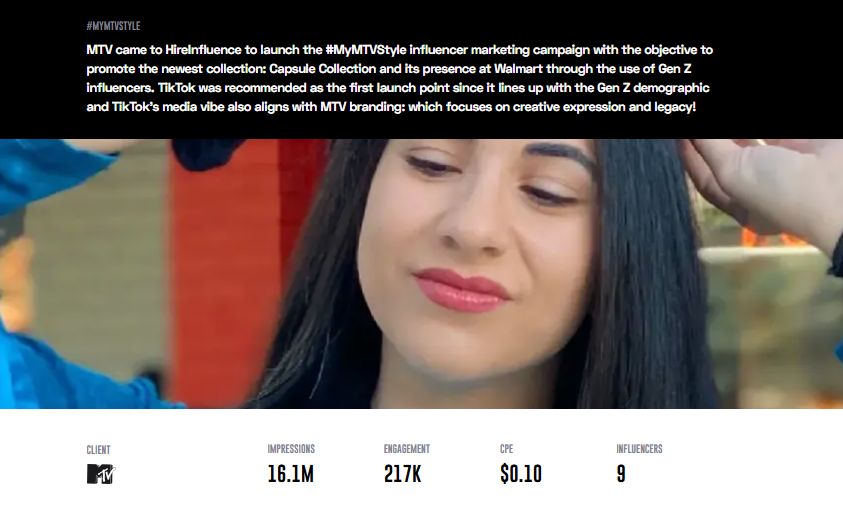
The MTV #MyMTVStyle TikTok campaign illustrates LA-relevant entertainment execution with platform-specific creative calibration. The program generated 16.1 million impressions at $0.01 CPV and $1.50 CPM with 216,600 engagements. For LA-based entertainment, media, and consumer brands benchmarking talent agency performance, those efficiency numbers are what enterprise finance teams use to compare creator spend against other paid media channels.
The Southwest Airlines #SouthwestSaysAloha campaign delivered 56 million impressions and 3 million engagements. For LA-based travel, hospitality, and consumer brands, those scale numbers demonstrate what enterprise talent programs produce when strategy, creative direction, and amplification are coordinated as a single system.
The Ricola #CoatYourThroat program shows how talent agency programs integrate with commerce attribution. The campaign drove 26 million impressions, 20.5 million reach, a 13.17% engagement rate across 18 creators spanning micro to celebrity tier, and 62,500 MikMak retail purchase clicks. The Ricola case study documents how the operational layers came together.
How LA Enterprise Brands Should Evaluate an Influencer Talent Agency
Five evaluation questions separate credible AI-era partners from pre-AI capability offerings for LA talent agency buyers.
First, ask about AI integration specifically. Billion Dollar Boy’s 79% marketer adoption data makes this central. The partner should describe exactly which AI tools integrate with which parts of the operational workflow (creator discovery, content optimization, performance analysis, campaign reporting), what specific efficiency and quality gains AI has produced in recent programs, and how AI output gets validated by human judgment.
Second, ask about responsible AI integration methodology. The consumer skepticism data makes this differentiating. The agency should describe how it determines where AI helps versus where it creates risk, with specific examples of programs where authentic creator craft was preserved against the AI slop risk.
Third, ask about LA-specific creator relationships in specific detail. The market depth makes direct relationships determinative for creator availability at key moments. A partner with genuine LA depth will describe specific creator tiers, categories, and long-term relationships where those connections are strongest.
Fourth, ask about long-term creator partnership infrastructure. The attention dynamics of current creator marketing reward sustained relationships over project-by-project activations. The agency should describe ambassador programs, exclusive partnerships, and multi-year content arrangements with specific examples of LA-based enterprise engagements.
Fifth, ask about LA production coordination capability. For enterprise programs requiring production quality at scale, access to LA’s adjacent production infrastructure is a genuine capability differentiator. The agency should describe specific production coordination across studios, post houses, writers, directors, and crews alongside creator partnerships.
The LA-Anchored Influencer Talent Agency Model
HireInfluence maintains a Los Angeles office alongside offices in Houston and The Woodlands, TX; Austin, TX; and New York, NY. The agency was founded in 2011 and is recognized as one of the first full-service influencer talent agencies in the United States. Fifteen years of LA operations has built the creator relationships, production infrastructure access, and category depth that distinguish a credible LA talent agency partner from newer entrants competing in the same market.
Engagements typically start at approximately $100,000, aligned with the enterprise delivery standard. The client roster includes Microsoft, Southwest Airlines, Target, Coca-Cola, Walmart, Meta, McDonald’s, Oreo, Grammarly, Ricola, and MTV. Award recognition across 2024 and 2026 includes the MUSE Creative Awards, Netty Awards, NYX Awards, Global Digital Excellence Awards, U.S. Agency Awards, and Vega Digital Awards. The agency is also an exclusive TikTok Shop Lite Program partner since July 2024, providing direct access to TikTok’s social commerce infrastructure for programs requiring conversion-measurable delivery.
Jason Pampell, Founder and CEO, launched HireInfluence in 2011 after managing content rights and strategic media partnerships for Forbes and Billboard. His 30+ years of leadership experience in sales, marketing, and team building for Fortune 1000 organizations shaped the service model the agency delivers. His approach to building the company informs how enterprise talent engagements are structured today.
For LA enterprise brands ready to evaluate what a full-service talent agency engagement calibrated to the AI-era creator economy should look like, the HireInfluence team handles initial conversations directly. Brands benchmarking pricing should reference the cost of influencer marketing guide for context on enterprise engagement costs. Those evaluating TikTok-focused structures should review the TikTok influencer marketing resource, and brands integrating creator content with broader UGC strategy should review the UGC overview.
Billion Dollar Boy’s research makes the AI-integration reality for LA talent agency capability clear. AI integration is baseline for content efficiency and quality, but responsible integration that preserves authentic creator craft is what differentiates partners winning in the current environment from those producing the AI slop that damages brand programs. For LA enterprise brands, the influencer talent agency decision is the decision about which partner has built the AI-integrated operating model calibrated to the authenticity requirements current consumer dynamics now enforce. The brands winning in the current LA market are working with partners that have both capability axes (AI sophistication plus creative craft discipline) calibrated correctly, not with agencies operating at only one axis or the other.