Entertainment marketing teams evaluating a social media influencer agency are operating in a category where social discovery has overtaken traditional discovery channels. SQ Magazine’s Media & Entertainment Industry Statistics 2026 report, updated March 17, 2026, documents the structural reality entertainment brands now face. The global media and entertainment industry is projected to reach $3,080.52 billion in 2026, up from $2,870.56 billion in 2025, and is forecast to grow to $4,146.36 billion by 2030 at a 7.7% CAGR. Daily US media consumption now averages 13.1 hours, up from the older 7.8-hour estimate, reflecting the fragmented attention environment entertainment brands compete in. Global advertising spend is expected to exceed $1 trillion in 2026 with digital taking 68.7% share. Creator and customer content’s share of social impact grew from 8% to 13% over two years, outpacing brand-produced content growth, and 43.8% of TikTok users made at least one purchase through the platform. Digital media revenue has reached $1.25 trillion, streaming revenue totals $277.25 billion, and the AI market within media and entertainment is on track to reach $85.36 billion by 2034 at a 26.5% CAGR.
Table of Contents
- Why SQ Magazine’s 2026 Entertainment Data Reshapes the Social Media Influencer Agency Decision
- What Entertainment Brands Should Expect From a Social Media Influencer Agency
- Entertainment Social Media Influencer Program Delivery
- How Entertainment Brands Should Evaluate a Social Media Influencer Agency
- The Social Media Influencer Agency Model for Entertainment Brands
For entertainment marketing teams operating streaming services, music labels, television networks, film studios, and entertainment publishers (excluding the gaming category covered by separate specialized agency infrastructure), SQ Magazine’s data establishes a specific capability profile a social media influencer agency has to deliver. The shift of discovery from linear and broadcast channels to social platforms means creator programs are no longer supplementary to awareness strategy. They are central to how audiences find new shows, artists, films, and entertainment properties. The 43.8% TikTok purchase conversion data reinforces that entertainment social media programs now have to connect to downstream outcomes (subscriptions, ticket purchases, album streams, merchandise) rather than operating purely at the awareness layer. This guide breaks down what entertainment brands should expect from a social media influencer agency in 2026, how SQ Magazine’s industry data reshapes the capability requirements, and what separates a partner built for current entertainment marketing dynamics from a generalist agency offering.
Why SQ Magazine’s 2026 Entertainment Data Reshapes the Social Media Influencer Agency Decision
SQ Magazine’s documentation of creator content share growing from 8% to 13% of social impact in two years, outpacing brand content, changes the structural logic of entertainment marketing. When creator content is systematically producing stronger audience response than brand-produced content, entertainment marketers have to shift program architecture toward creator-first models rather than continuing to treat creator activity as a supplementary extension of brand campaigns. An agency that operates on brand-content-first models with creator activity bolted on as amplification produces programs that underperform against the creator-native structure the data identifies as dominant.
For entertainment brands specifically, the 13.1-hour daily US media consumption data reinforces the fragmentation challenge. Entertainment audiences are distributing attention across streaming services, social platforms, music platforms, gaming platforms, and short-form content apps simultaneously. A creator program that concentrates on one platform or one content type misses the cross-platform attention pattern entertainment audiences actually exhibit. The social media influencer agency has to operate multi-platform programs (TikTok, Instagram, YouTube, short-form, long-form, audio, emerging platforms) with creative strategy calibrated to how each platform’s audience actually engages with entertainment content, not defaulting to a single format deployed across channels.
The 43.8% TikTok purchase conversion data is particularly consequential for entertainment marketing. Entertainment products (subscriptions, tickets, merchandise, music streaming, film rentals) now have direct commerce conversion paths on social platforms. The agency has to integrate social commerce infrastructure into creator programs (TikTok Shop for merchandise, platform-specific subscription conversion tracking, ticket platform integration, music streaming attribution). Entertainment social media influencer programs that generate audience awareness without capturing the commerce conversion opportunity leave measurable value unexecuted.
SQ Magazine’s finding on the creator economy exceeding $200 billion globally with U.S. creator economy exceeding $40 billion further reinforces the creator-first structural shift. Entertainment brands are operating in a content economy where creator-produced content volume matches or exceeds professional studio content volume on attention-competitive platforms. Audiences discovering entertainment content through creators have established parasocial relationships that shape discovery behavior in ways traditional media advertising cannot. The agency has to understand creator-audience dynamics at a sophistication level that exceeds standard brand campaign execution to produce entertainment marketing outcomes the current environment rewards.
The finding on 1.3 million global media and entertainment employment roles across leading countries reinforces the scale at which entertainment marketing operates. Professional production infrastructure is deep and sophisticated, which means creator content has to meet a quality standard calibrated to the audience’s existing expectations for entertainment content. An agency producing low-effort creator content competing against professional entertainment production produces outcomes that damage rather than support entertainment brand equity.
What Entertainment Brands Should Expect From a Social Media Influencer Agency
A credible social media influencer agency for entertainment brands operates across eight coordinated service functions calibrated to entertainment category dynamics.
Entertainment creator strategy and discovery-to-conversion measurement design. The engagement begins with business objectives (subscriber acquisition, ticket sales, album/single streams, merchandise conversion, fandom engagement, content discovery) and a measurement framework that connects creator activity to those outcomes across the full awareness-to-conversion funnel. HireInfluence structures entertainment creator strategy through dedicated campaign services calibrated to entertainment category KPIs.
Creator sourcing with entertainment category expertise. Streaming, music, TV, and film each have distinct creator ecosystems. Entertainment review creators, music discovery creators, film and TV commentary creators, fandom community creators, and general cultural creators all serve different entertainment marketing functions. The agency should describe specific sourcing infrastructure across entertainment creator categories with examples of entertainment-specific program execution.
Platform-native creative direction. Entertainment audiences have sophisticated pattern recognition for content that feels native to a platform versus content that feels ported from traditional marketing. TikTok audiences respond to TikTok-native formats, YouTube audiences respond to YouTube-native storytelling, Instagram audiences respond to Instagram-native visual and narrative conventions. The agency’s creative direction has to support platform-native authenticity while serving entertainment marketing objectives.
Contracting and rights management calibrated to entertainment use cases. Entertainment brands have complex rights structures (performer rights, music rights, scripted content rights, guild considerations, international distribution rights). Creator contracting has to integrate with existing entertainment rights frameworks, FTC compliance, exclusivity windows, and usage rights across organic and paid distribution.
Long-term creator partnership infrastructure for fandom building. Entertainment brands benefit disproportionately from sustained creator relationships because fandom builds through repeat authentic engagement rather than one-off activation. Ambassador programs, season-long creator partnerships tied to content release calendars, and always-on programs tied to content franchises require operational infrastructure calibrated to entertainment release rhythms.
Paid media amplification with entertainment conversion integration. Creator content performs best with paid amplification that incorporates entertainment-specific conversion infrastructure (subscription signup tracking, ticket platform integration, music streaming attribution, merchandise commerce). HireInfluence delivers paid amplification through its specialties and services capability, including whitelisting, dark posting, and cross-platform amplification.
Entertainment attribution infrastructure. Subscription conversion tracking, ticket platform integration, music streaming attribution, merchandise commerce measurement, and content discovery attribution. HireInfluence’s analytics capability is designed to deliver entertainment-specific attribution depth that connects creator activity to measurable entertainment business outcomes.
Cultural fluency with entertainment release calendars. Entertainment campaigns operate around specific release windows, premiere moments, award cycles, seasonal content calendars, and cultural moments that shape when creator activity has maximum impact. The agency’s ability to coordinate creator programs with entertainment release calendars is a meaningful differentiator.
Entertainment Social Media Influencer Program Delivery
Entertainment brands evaluating a social media influencer agency should look at programs that demonstrate enterprise-scale entertainment creator marketing delivery.
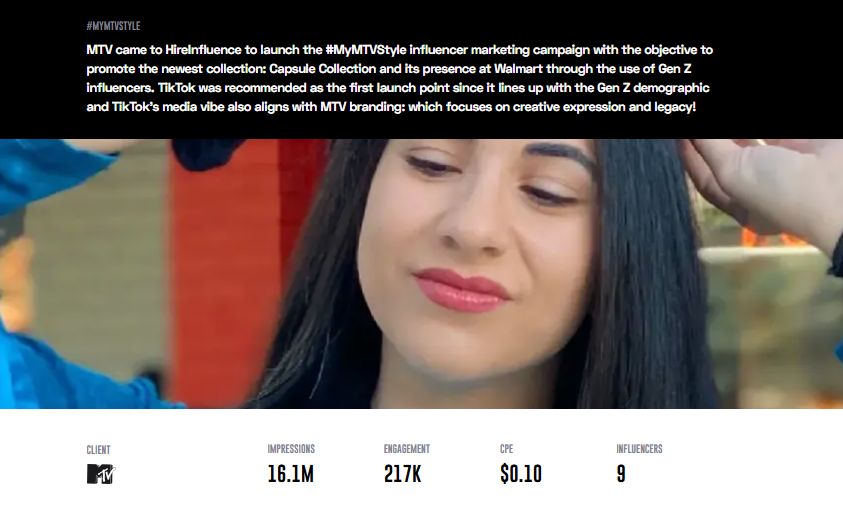
The MTV #MyMTVStyle TikTok campaign is a direct entertainment-category reference. The program generated 16.1 million impressions at $0.01 CPV and $1.50 CPM with 216,600 engagements. For entertainment brands benchmarking creator program performance, those efficiency figures establish what platform-native entertainment creator programs produce when creator selection, platform-specific content direction, and amplification are coordinated as a single system. The MTV engagement demonstrates how entertainment brands calibrate creator marketing to audience attention dynamics.
The Grammarly engagement demonstrates multi-platform scale relevant to entertainment brands running cross-platform campaigns. The program activated 133 creators across YouTube, TikTok, and Instagram, producing 214 million impressions, 33.1 million views, and $15 million in earned media value. Running 133 creators across three platforms simultaneously requires the operational infrastructure that entertainment marketing now demands for major content release windows. The work portfolio documents how the agency scales across program complexity.
The Southwest Airlines #SouthwestSaysAloha campaign delivered 56 million impressions and 3 million engagements through travel-adjacent entertainment content, demonstrating how creator programs build audience engagement at scale. For entertainment brands activating around destination content, travel content, or location-tied programming, the Southwest execution is a useful reference.
The Ricola #CoatYourThroat program demonstrates how creator programs integrate with commerce attribution. The campaign drove 26 million impressions, 20.5 million reach, a 13.17% engagement rate across 18 creators spanning micro to celebrity tier, and 62,500 MikMak retail purchase clicks. For entertainment brands selling tickets, merchandise, or subscription products, that commerce attribution capability is directly applicable. The Ricola case study documents the full program architecture.
How Entertainment Brands Should Evaluate a Social Media Influencer Agency
Five evaluation questions separate credible entertainment-category partners from generalist agency offerings.
First, ask about entertainment category expertise. Streaming, music, TV, and film have distinct creator ecosystems and audience dynamics. The agency should describe specific entertainment category experience with examples of programs calibrated to each sub-vertical, not generic entertainment category claims.
Second, ask about platform-native creative direction methodology. SQ Magazine’s data on creator content outperforming brand content makes this consequential. The agency should describe how creative direction supports platform-native authenticity while serving entertainment marketing objectives, with specific examples of programs that delivered against platform-specific audience behavior patterns.
Third, ask about entertainment attribution infrastructure. Subscription tracking, ticket platform integration, music streaming attribution, merchandise commerce measurement. A creator program that cannot connect to entertainment-specific conversion outcomes is not serving current enterprise entertainment marketing requirements.
Fourth, ask about release calendar coordination capability. Entertainment operates on specific promotional windows tied to content release cycles. The agency should describe how creator programs coordinate with release timing, with specific examples of programs executed against content launch windows.
Fifth, ask about fandom-building infrastructure. Entertainment creator programs benefit from sustained relationships that build audience attachment over time. The agency should describe ambassador programs, season-long partnerships, and always-on creator programs with specific examples of multi-touch entertainment engagements.
The Social Media Influencer Agency Model for Entertainment Brands
HireInfluence runs enterprise social media influencer programs for entertainment and entertainment-adjacent brands. The agency was founded in 2011 and maintains offices in Houston and The Woodlands, TX; Austin, TX; Los Angeles, CA; and New York, NY. That national footprint, combined with entertainment category depth built across more than a decade with brands including MTV, positions the agency to deliver creator programs calibrated to entertainment marketing requirements. The about section documents how the company operates.
Engagements typically start at approximately $100,000, aligned with the enterprise delivery standard. Confirmed clients include Microsoft, Southwest Airlines, Target, Coca-Cola, Walmart, Meta, McDonald’s, Oreo, Grammarly, Ricola, and MTV, with MTV representing direct entertainment category experience. Award recognition across 2024 and 2026 includes the MUSE Creative Awards, Netty Awards, NYX Awards, Global Digital Excellence Awards, U.S. Agency Awards, and Vega Digital Awards. The agency is also an exclusive TikTok Shop Lite Program partner since July 2024, providing direct access to TikTok’s commerce infrastructure for entertainment programs connecting content discovery to measurable conversion outcomes.
Jason Pampell, Founder and CEO, launched HireInfluence in 2011. Prior to founding the company, he managed content rights and strategic media partnerships for Forbes and Billboard. His 30+ years of leadership experience in sales, marketing, and team building for Fortune 1000 organizations shaped how the agency structures entertainment creator engagements today.
For entertainment brands ready to evaluate what a social media influencer engagement calibrated to current entertainment marketing dynamics should include, the HireInfluence team handles initial conversations directly through the contact page. Brands benchmarking pricing should reference the cost of influencer marketing guide for context on enterprise engagement costs. Those evaluating TikTok-focused strategies should review the TikTok influencer marketing resource, and brands integrating creator content with broader UGC strategy should review the UGC overview.
SQ Magazine’s entertainment industry data makes the operating environment direct. Creator content is outpacing brand content in audience impact, social platforms now drive discovery and conversion, entertainment audiences operate across 13.1 hours of daily media consumption with attention distributed across platforms, and entertainment social commerce on TikTok is producing 43.8% purchase conversion rates. The social media influencer agency decision for entertainment brands is the decision about which partner has built the capability profile the current environment now requires. The entertainment brands winning in the current market are working with partners calibrated to creator-first structural models, not those still operating on brand-content-first campaign frameworks from an earlier moment in the discipline.