CPG marketing teams evaluating a brand ambassador agency in 2026 are operating in a consumer environment where trust has become the primary growth driver. NielsenIQ’s “Consumer Outlook: Guide to 2026” report documents the structural reality CPG brands now face. Building trust will depend on striking the right balance: global scale paired with cultural fluency, technology that delivers both efficiency and empathy, and brand promises that map to continually evolving lifestyles. The companies that earn loyalty will be those that not only adapt to shoppers’ changing habits but are also able to prove that they understand what matters most to consumers. Commerce is undergoing transformation: consumers no longer shop channels but move across platforms, touchpoints, and moments. Around the globe, digital tools are revolutionizing CPG baskets as shoppers are no longer bound to one path. Discovery and purchase are increasingly disconnected, which changes how brands must think about visibility and conversion. Manufacturers and retailers must capture growth by expanding occasions and building volume both online and in-store, while giving consumers confidence, control, and a sense of simplicity across the journey. Signals once seen as outliers are quickly becoming mainstream forces reshaping global consumption. The companies that will win are those that anticipate these disruptions (health shifts, cost shocks, private label competition, and AI disruption) and turn them into engines of innovation, trust, and growth.
Table of Contents
For enterprise CPG marketing teams, NielsenIQ’s findings establish a specific shift in what a brand ambassador agency has to deliver for CPG brands. The trust-as-growth-driver thesis means ambassador programs now have to operate as trust-building infrastructure rather than product promotion channels. The disconnection between discovery and purchase means ambassador content has to work across multiple touchpoints in the shopper journey, with attribution that captures value beyond the immediate conversion window. The shift from channel-specific to path-agnostic shopping means ambassador programs have to support CPG brand visibility across the full retail and DTC ecosystem: grocery, club, mass, drug, specialty, convenience, DTC, social commerce, retail media, and in-store digital. This guide breaks down what enterprise CPG brands should expect from a brand ambassador agency in 2026, how NielsenIQ’s consumer framework reshapes the capability requirements, and what separates a credible CPG ambassador partner from a general-market agency offering.
Why NielsenIQ’s CPG Framework Reshapes the Brand Ambassador Agency Decision
NielsenIQ’s documentation that trust has become the defining variable for CPG growth changes the structural logic of ambassador marketing for the category. When consumers make purchase decisions based on which brands have earned their trust through demonstrated understanding of consumer priorities, ambassador programs have to function as trust-building infrastructure rather than repeated product promotion. The ambassador’s role is not to deliver branded messages but to demonstrate brand values through authentic product integration over sustained creator relationships. The agencies that operate ambassador programs as campaign extensions (with creators deployed for product launches or promotional moments) miss the trust-building structural requirement NielsenIQ identifies.
For CPG brands specifically, NielsenIQ’s documentation of the growing disconnect between discovery and purchase carries material implications. Creators now influence discovery moments that are separated in time and channel from the eventual purchase. A consumer might discover a CPG product through creator content on TikTok, research it on Reddit, check reviews on Amazon, compare prices on Google, and ultimately purchase at a club store or through DTC. The ambassador program has to support the brand’s visibility across that full path, which means creator content has to work across multiple platform contexts with attribution infrastructure that captures cross-channel influence rather than attributing conversion only to the final touch.
NielsenIQ’s finding on the global-scale-plus-cultural-fluency requirement reinforces what CPG ambassador programs have to deliver at creator selection. Generic national ambassador programs miss the cultural specificity that drives CPG category conversion in distinct audience segments. The agency has to source ambassadors whose audiences reflect the cultural contexts where the CPG brand competes, with sourcing methodology that evaluates creator-audience cultural alignment beyond generic demographic matching.
The NielsenIQ emphasis on anticipating disruptions (health shifts, cost shocks, private label competition, AI disruption) reinforces why sustained ambassador relationships outperform campaign-based approaches for CPG brands. When private label captures over 21% of dollar sales and 23% of unit sales, national CPG brands need ambassador programs that build durable audience attachment to brand value propositions that private label cannot easily replicate. One-off campaign activations produce short-term awareness but do not build the durable trust that protects against category disruption. Sustained ambassador programs build the compounding trust equity that becomes defensible brand infrastructure.
The finding that consumers are increasingly moving across platforms and touchpoints reinforces the cross-channel integration ambassador programs now require. CPG ambassador content has to flow across social platforms, retail partner channels, retail media networks, DTC commerce, in-store digital, and connected TV. The agency has to structure rights, content production, and distribution infrastructure that supports the full CPG path-to-purchase rather than concentrating on individual platform deployment.
What Enterprise CPG Brands Should Expect From a Brand Ambassador Agency
A credible brand ambassador agency for CPG brands operates across eight coordinated service functions calibrated to CPG category dynamics and the NielsenIQ consumer framework.
CPG ambassador strategy and shelf-velocity-connected measurement design. The engagement begins with business objectives tied to CPG-specific outcomes (shelf velocity at target retailers, category share growth, household penetration, brand trust metrics, DTC conversion, retention across purchase cycles) and measurement frameworks that connect ambassador activity to those outcomes. HireInfluence structures CPG ambassador strategy through dedicated campaign services built for enterprise CPG engagements.
Ambassador sourcing calibrated to CPG audience and cultural fluency. NielsenIQ’s global-scale-plus-cultural-fluency framing makes this central. The agency has to source ambassadors whose audiences reflect the specific CPG category buyer profiles and cultural contexts where the brand competes, with methodology that evaluates beyond generic demographic matching to include purchase behavior signals and cultural alignment indicators.
Creative direction that integrates products authentically across sustained creator relationships. CPG ambassador programs underperform when product integration reads as sponsored placement. The agency’s creative direction has to support authentic product integration over extended relationship cycles, with specific examples of CPG ambassador programs where creators sustained product integration across multiple content cycles without triggering audience sponsored-content fatigue.
Contracting and rights management calibrated to CPG distribution complexity. Rights structure has to cover grocery retailer in-store screens and digital channels, club retailer distribution, mass retailer integration, drug retail deployment, specialty retail, retail media networks, DTC commerce, connected TV, paid social, and organic distribution. Multi-channel rights negotiated at contract phase enable creator content to flow across the full CPG distribution footprint.
Long-term ambassador relationship management for CPG category cycles. CPG ambassador programs benefit from sustained relationships that span multiple product launches, seasonal cycles, category trends, and competitive windows. The agency should describe communication cadence systems, content calendar coordination across CPG retail calendar rhythms, performance review workflows, and compensation management infrastructure.
Paid amplification with CPG commerce integration. Ambassador content performs best when organic distribution pairs with paid amplification including retail media networks (Kroger Precision Marketing, Walmart Connect, Target Roundel, Amazon Advertising), TikTok Shop, Instagram Shopping, and connected TV integration. HireInfluence delivers paid amplification through its specialties and services capability.
CPG attribution infrastructure across retail and DTC channels. NielsenIQ’s data on the discovery-purchase disconnect makes this consequential. UTM frameworks, promo code systems, MikMak retail attribution, retail partner tracking, retail media integration, platform commerce measurement, and DTC conversion attribution. HireInfluence’s analytics capability is designed to deliver CPG-specific attribution depth.
Brand safety monitoring calibrated to CPG regulatory complexity. CPG brands operate across categories with varying regulatory requirements (food labeling, health claims, FDA oversight, state-level regulations). Ambassador content has to comply with the full regulatory stack across every deployment channel. The agency should describe compliance review infrastructure, FTC monitoring, category-specific regulatory screening, and crisis response protocols for CPG-specific scenarios.
CPG Brand Ambassador Program Delivery
CPG brands evaluating a brand ambassador agency should look at programs that demonstrate CPG-category ambassador program capability.
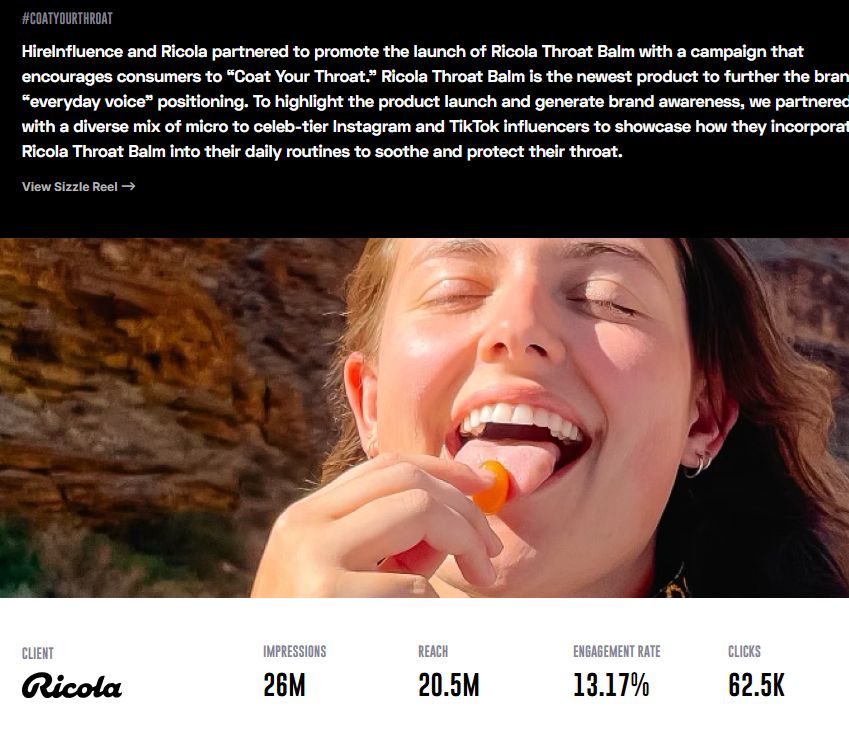
The Ricola #CoatYourThroat program is a direct CPG-category ambassador reference. The campaign activated 18 creators spanning micro to celebrity tier and delivered 26 million impressions, 20.5 million reach, a 13.17% engagement rate, and 62,500 MikMak retail purchase clicks. The MikMak integration is the specific capability CPG ambassador programs require: creator content connected directly to measurable retail purchase activity across the fragmented CPG retail footprint. The Ricola case study documents how creator tier selection, content strategy, and retail attribution came together.
The Oreo/McDonald’s #OREOShamROCKout campaign demonstrates CPG co-branded ambassador execution with commerce efficiency. The campaign delivered 1.7 million impressions at $0.06 CPE. That cost-per-engagement efficiency metric establishes what CPG enterprise finance teams use to compare ambassador program spend against alternative paid media investments.
The broader HireInfluence engagement with CPG brands including Coca-Cola, McDonald’s, Oreo, Ricola, and Walmart (for CPG product activations) demonstrates CPG category depth at the scale enterprise ambassador programs require. The work portfolio includes additional CPG case examples worth referencing for brand buyers evaluating agency CPG experience.
The Grammarly engagement demonstrates multi-platform ambassador program scale that translates to CPG programs requiring cross-channel creator deployment. The program activated 133 creators across YouTube, TikTok, and Instagram, producing 214 million impressions, 33.1 million views, and $15 million in earned media value. Running 133 creators across three platforms simultaneously requires operational infrastructure that CPG ambassador programs increasingly demand as rosters expand to match CPG brand portfolio complexity.
How Enterprise CPG Brands Should Evaluate a Brand Ambassador Agency
Five evaluation questions separate credible CPG ambassador partners from general-market agency offerings.
First, ask about CPG category depth specifically. Beverages, snacks, center-store grocery, frozen, dairy, meat alternatives, personal care, household, QSR-CPG crossover, and specialty CPG each have distinct audience dynamics and commerce behaviors. The agency should demonstrate direct CPG category experience with outcome data calibrated to specific CPG sub-category business objectives.
Second, ask about retail attribution infrastructure. NielsenIQ’s data on the discovery-purchase disconnect makes this consequential. MikMak integration, retail partner attribution, retail media network integration, promo code systems, and DTC conversion tracking. The agency should demonstrate commerce attribution capability that meets CPG enterprise finance scrutiny.
Third, ask about regulatory compliance infrastructure. CPG categories face varying regulatory requirements that ambassador content has to navigate. The agency should describe compliance review workflows, FTC monitoring, category-specific regulatory screening, and crisis response protocols with specific examples of CPG programs that demonstrated regulatory discipline.
Fourth, ask about long-term relationship management for CPG cycles. CPG ambassador programs benefit from sustained relationships that span multiple product launches and category cycles. The agency should describe ambassador program infrastructure with specific examples of multi-year CPG creator engagements.
Fifth, ask about cross-channel deployment capability. CPG ambassador content has to flow across retail partner channels, retail media networks, DTC commerce, connected TV, paid social, and organic distribution. The agency should describe rights structure, content production, and distribution infrastructure that supports the full CPG path-to-purchase.
The Brand Ambassador Agency Model for CPG Brands
HireInfluence runs enterprise brand ambassador programs for CPG brands across the category. The agency was founded in 2011 and maintains offices in Houston and The Woodlands, TX; Austin, TX; Los Angeles, CA; and New York, NY. That national footprint, combined with CPG category depth built across more than a decade, positions the agency to deliver ambassador programs calibrated to CPG business requirements and the consumer framework NielsenIQ documented. The about section documents how the company operates.
Engagements typically start at approximately $100,000, aligned with the enterprise delivery standard. Confirmed clients include Microsoft, Southwest Airlines, Target, Coca-Cola, Walmart, Meta, McDonald’s, Oreo, Grammarly, Ricola, and MTV, multiple of which are direct CPG engagements across beverages, snacks, QSR, and retail. Award recognition across 2024 and 2026 includes the MUSE Creative Awards, Netty Awards, NYX Awards, Global Digital Excellence Awards, U.S. Agency Awards (Digital Marketing Agency of the Year), and Vega Digital Awards. The agency is also an exclusive TikTok Shop Lite Program partner since July 2024, providing direct access to TikTok’s commerce infrastructure for CPG ambassador programs requiring conversion-measurable delivery.
Jason Pampell, Founder and CEO, launched HireInfluence in 2011. Prior to founding the company, he managed content rights and strategic media partnerships for Forbes and Billboard. His 30+ years of leadership experience in sales, marketing, and team building for Fortune 1000 organizations shaped how the agency structures CPG ambassador engagements today.
For CPG brands ready to evaluate what an ambassador engagement calibrated to current CPG consumer dynamics should include, the HireInfluence team handles initial conversations directly through the contact page. Brands benchmarking pricing should reference the cost of influencer marketing guide for context on enterprise engagement costs. Those evaluating TikTok-focused strategies should review the TikTok influencer marketing resource, and brands integrating ambassador programs with broader UGC strategy should review the UGC overview. CPG brands specifically benefit from reviewing the F&B influencer marketing resource for category-adjacent context.
NielsenIQ’s CPG consumer framework makes the operating environment direct. Trust has become the primary growth driver, discovery and purchase are increasingly disconnected across the shopper journey, consumers are moving across platforms and touchpoints rather than shopping single channels, and brands have to anticipate disruptions including health shifts, cost shocks, private label competition, and AI disruption. The brand ambassador agency decision for CPG enterprise brands is the decision about which partner has built the capability profile the CPG environment now requires. The CPG brands winning in 2026 are working with partners calibrated to trust-building sustained relationships, retail-connected attribution, cross-channel deployment infrastructure, and regulatory compliance discipline, not those still operating on campaign-extension ambassador models from an earlier moment in the category.