
Enterprise marketing teams evaluating a macro-influencer agency in 2026 are operating against an environment WARC’s Marketer’s Toolkit 2026 frames as “the creator gamble.” The report, published November 11, 2025 and now in its 15th year, surveyed more than 1,000 marketing executives globally using WARC’s proprietary GEISTE methodology covering government, economy, industry, society, technology, and environment macro trends. The report identifies five critical disruptive trends shaping 2026 marketing strategy, and the creator economy thesis is the most consequential for macro-tier execution. The headline finding: 61% of marketers plan to increase their investment in influencer/creator marketing in 2026, but creator ROI suffers high levels of volatility. Brands see influencers and creators as vital to achieving their goals but face real challenges demonstrating effectiveness within their marketing investments. WARC cites CreativeX analysis showing 45% of creator ad spend on Meta is wasted through poor creative practices, while Kantar research finds just 27% of creator content effectively links to sponsoring brands. The tension between reach, control, and authenticity is likely to come to a head in 2026. Marketer optimism is also down 11 points from last year, with only 54% of marketers expecting business to be better next year versus 65% in 2024. WARC’s recommendations: ensure marketing organizations are aligned on creator goals such as KPIs and measurement techniques, treat paid media formats and creative best practices as vital to amplify creator success, and build category intelligence and audience knowledge sharing between brands and creators.
Table of Contents
For enterprise marketing teams, WARC’s findings establish a specific shift in what a macro-influencer agency has to deliver. The “creator gamble” framing means macro execution has to balance the reach advantage macro creators provide against the volatility and waste that derail creator ROI without disciplined infrastructure. The 45% waste finding establishes that brands operating at macro tier without measurement, creative discipline, and amplification infrastructure are systematically underperforming. The 27% brand-alignment finding establishes that macro creator content frequently fails to deliver brand-building impact even when reach and engagement metrics look healthy. Wider industry data reinforces what WARC’s analysis maps: the macro tier is described as “essentially neutral” in terms of expansion intent versus contraction, with brands keeping macro as a “selective layer used for credibility moments, launches, or reach spikes” while shifting day-to-day execution toward smaller creators. This guide breaks down what enterprise brands should expect from a macro-influencer agency in 2026, how WARC’s creator gamble thesis reshapes the capability requirements, and what separates a credible macro-influencer agency from a general creator platform or traditional influencer firm.
Why WARC’s Creator Gamble Thesis Reshapes the Macro-Influencer Agency Decision
WARC’s documentation of creator ROI volatility changes the structural logic of how enterprise brands approach macro-tier execution. When the dominant industry narrative cites 45% wasted creator spend on Meta and only 27% of creator content effectively linking to sponsoring brands, the question for enterprise brands operating macro programs becomes whether the agency partner has built the capability infrastructure that lands them in the disciplined minority producing measurable impact rather than the majority generating activity without business outcomes. The macro-influencer agency that serves enterprise clients has to demonstrate measurement infrastructure, creative discipline, and amplification capability that converts macro reach into business outcomes rather than impressions volume.
For enterprise brands specifically, WARC’s emphasis on “reach, control, and authenticity tension coming to a head” carries direct strategic implications. Macro creators offer reach and audience scale beyond what nano and micro tiers can match, but the control trade-off (compared to brand-produced content) and authenticity trade-off (compared to nano and micro tiers) creates the volatility WARC identifies. The agency has to demonstrate program structures that capture the macro reach advantage while managing the control and authenticity tensions through creative direction, brand alignment briefing, and amplification design that extends macro content value across the broader marketing stack.
WARC’s recommendation that brands and creators should share category intelligence and audience knowledge to benefit business outcomes reinforces why macro-tier programs require deep agency-creator collaboration rather than transactional creator activation. The macro-influencer agency has to operate as the strategic layer between brand objectives and creator execution, translating brand category intelligence into creator briefs while feeding creator audience insights back into brand strategy. That capability profile distinguishes credible macro-influencer agencies from creator marketplaces that broker transactions without strategic depth.
The selective-layer positioning that industry data establishes (macro as the credibility, launch, and reach-spike tier within tiered enterprise programs) reinforces why macro execution has to align with specific high-stakes use cases. Macro creators are the right tier for product launches, brand repositioning, mainstream awareness moments, and credibility-building activations within tiered enterprise approaches. The agency has to demonstrate macro selection methodology calibrated to those specific use cases rather than treating macro as default activation.
WARC’s marketer optimism decline (down 11 points to 54% expecting better business in 2026) reinforces why macro investment justification has to operate at higher rigor than in prior cycles. Enterprise CFOs scrutinizing creator marketing spend in the current environment require attribution infrastructure, comparison benchmarks against alternative paid media investments, and clear demonstration of incremental brand and business impact. The agency has to demonstrate measurement capability calibrated to the scrutiny standard enterprise marketers face.
What Enterprise Brands Should Expect From a Macro-Influencer Agency
A credible macro-influencer agency operates across eight coordinated service functions calibrated to macro-tier execution dynamics.
Macro program strategy and disciplined measurement design. The engagement begins with business objectives tied to outcomes that suit macro execution (mainstream awareness moments, product launches, brand repositioning, credibility-building activations, reach spikes within tiered programs) and measurement frameworks calibrated to those objectives at the rigor enterprise CFOs now require. HireInfluence structures macro-influencer strategy through dedicated campaign services built for enterprise programs.
Macro creator selection calibrated to brand-alignment depth. WARC’s 27% brand-alignment finding makes selection rigor central. The agency has to evaluate macro creators for genuine brand affinity, audience authenticity, content track record, and predictive alignment with brand category positioning beyond surface follower count and demographic matching.
Creative direction that preserves authenticity within brand guardrails. WARC’s tension between reach, control, and authenticity makes creative direction consequential. The agency has to operate creative direction methodology that establishes brand guardrails creators can work within authentically, with specific examples of macro programs that sustained brand alignment while preserving creator voice.
Contracting and rights management at macro-tier complexity. Macro creators carry rights structures, exclusivity demands, and approval requirements distinct from smaller tiers. The agency has to operate contracting infrastructure that supports macro-tier complexity: usage rights for paid amplification, exclusivity windows, content approval workflows, and category exclusivity provisions.
Paid amplification with macro creator integration. WARC explicitly identifies paid amplification as vital for macro success. Macro creator content delivers maximum value when paired with disciplined paid amplification (whitelisting, dark posting, retail media integration, connected TV extension). HireInfluence delivers paid amplification through its specialties and services capability, including whitelisting, dark posting, and cross-platform amplification.
Brand safety and crisis response infrastructure. Macro creators carry concentrated brand-association risk that nano and micro tiers distribute across creator rosters. A single macro creator controversy can damage brand equity in ways no micro program can. The agency has to operate brand safety screening, monitoring, and crisis response infrastructure that protects brand equity at macro-tier exposure.
Tiered program orchestration capability. Macro execution increasingly operates within tiered enterprise programs combining macro reach with mid-tier authenticity and micro/nano engagement depth. The agency has to demonstrate tiered program orchestration capability with specific examples of macro creator partnerships integrated across tiered enterprise activations.
Macro program attribution at enterprise rigor. WARC’s marketer optimism decline reinforces why attribution matters more in 2026. The agency has to demonstrate attribution infrastructure capturing brand lift, awareness impact, consideration shift, conversion attribution, and competitive benchmarking. HireInfluence’s analytics capability is designed to deliver macro program attribution depth.
Macro Program Delivery
Enterprise brands evaluating a macro-influencer agency should look at programs that demonstrate macro-tier execution depth at the disciplined standard WARC’s data identifies as differentiating.
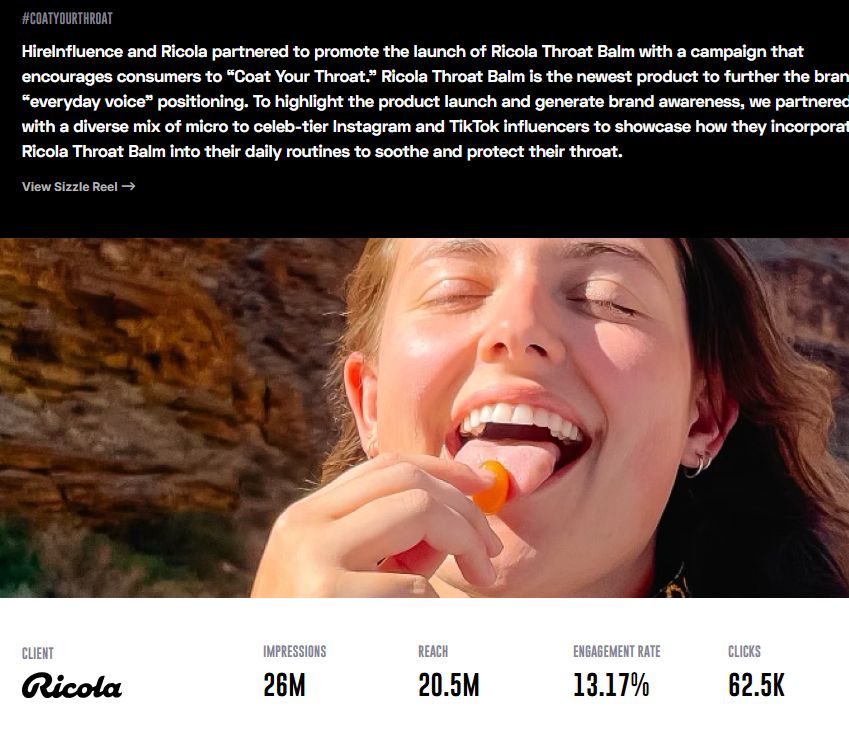
The Ricola #CoatYourThroat program demonstrates macro-tier execution within tiered program orchestration. The campaign activated 18 creators spanning micro to celebrity tier, with macro creators contributing the reach and credibility layer that drove the program’s 26 million impressions and 20.5 million reach. The 13.17% engagement rate (which sits well above macro-tier benchmarks) reflects the program orchestration discipline that combines macro reach with smaller-tier engagement depth. The 62,500 MikMak retail purchase clicks document the conversion attribution macro-inclusive programs produce when measurement infrastructure is in place. The Ricola case study documents the full program architecture.
The Grammarly engagement demonstrates multi-platform macro program execution at scale. The program activated 133 creators across YouTube, TikTok, and Instagram, producing 214 million impressions, 33.1 million views, and $15 million in earned media value. Running 133 creators across three platforms with attention to macro creator integration alongside smaller-tier execution requires the operational infrastructure macro-inclusive enterprise programs now require.
The Southwest Airlines #SouthwestSaysAloha campaign offers reach-tier reference relevant to macro execution. The program generated 56 million impressions and 3 million engagements, demonstrating the awareness scale macro-inclusive programs produce when creator selection, production direction, and amplification align. The work portfolio documents how the agency scales across program complexity.
How Enterprise Brands Should Evaluate a Macro-Influencer Agency
Five evaluation questions separate credible macro-influencer agencies from general-market creator platforms.
First, ask about brand-alignment selection methodology. WARC’s 27% brand-alignment finding makes this consequential. The agency should describe how macro creators are evaluated for genuine brand affinity beyond demographic matching, with specific examples of macro creator selection that demonstrated outsized brand-alignment value.
Second, ask about creative direction methodology balancing authenticity with brand guardrails. WARC’s reach-control-authenticity tension makes this differentiating. The agency should describe creative direction methodology with specific examples of macro programs that sustained both creator authenticity and brand alignment.
Third, ask about paid amplification integration. WARC explicitly identifies paid amplification as vital. The agency should describe whitelisting, dark posting, retail media integration, and cross-platform amplification capability with specific examples of macro creator content amplified across the broader marketing stack.
Fourth, ask about brand safety and crisis response infrastructure. Macro creators carry concentrated brand-association risk. The agency should describe brand safety screening, monitoring, and crisis response infrastructure with specific examples of brand safety management at macro-tier exposure.
Fifth, ask about attribution infrastructure at enterprise rigor. The agency should describe attribution capability for capturing brand lift, awareness impact, consideration shift, and conversion attribution with specific examples of macro programs that demonstrated measurable business outcomes at the rigor enterprise CFOs require.
The Macro-Influencer Agency Model
HireInfluence runs enterprise macro-influencer programs across consumer categories. The agency was founded in 2011 and maintains offices in Houston and The Woodlands, TX; Austin, TX; Los Angeles, CA; and New York, NY. That national footprint, combined with macro program depth built across more than a decade, positions the agency to deliver programs calibrated to the disciplined macro execution WARC’s data establishes as differentiating. The about section documents how the company operates.
Engagements typically start at approximately $100,000, aligned with the enterprise delivery standard. Confirmed clients include Microsoft, Southwest Airlines, Target, Coca-Cola, Walmart, Meta, McDonald’s, Oreo, Grammarly, Ricola, and MTV. Award recognition across 2024 and 2026 includes the MUSE Creative Awards, Netty Awards, NYX Awards, Global Digital Excellence Awards, U.S. Agency Awards (Digital Marketing Agency of the Year), and Vega Digital Awards. The agency is also an exclusive TikTok Shop Lite Program partner since July 2024, providing direct access to TikTok’s commerce infrastructure for macro programs connecting content to measurable conversion outcomes.
Jason Pampell, Founder and CEO, launched HireInfluence in 2011. Prior to founding the company, he managed content rights and strategic media partnerships for Forbes and Billboard. His 30+ years of leadership experience in sales, marketing, and team building for Fortune 1000 organizations shaped how the agency structures macro-influencer engagements today.
For enterprise brands ready to evaluate what a macro-influencer engagement calibrated to current creator gamble dynamics should include, the HireInfluence team handles initial conversations directly through the contact page. Brands benchmarking pricing should reference the cost of influencer marketing guide for context on enterprise engagement costs. Those evaluating TikTok-focused strategies should review the TikTok influencer marketing resource, and brands wanting context on UGC strategy fundamentals should review the UGC overview.
WARC’s Marketer’s Toolkit 2026 makes the operating environment direct. 61% of marketers plan to increase creator marketing investment in 2026, but creator ROI suffers high volatility, 45% of creator ad spend on Meta is wasted through poor creative practices, only 27% of creator content effectively links to sponsoring brands, and marketer optimism is down 11 points. The macro-influencer agency decision for enterprise brands is the decision about which partner has built the capability profile the disciplined macro execution environment now requires. The brands winning in 2026 are working with partners calibrated to brand-alignment selection, creative direction balancing authenticity with brand guardrails, paid amplification integration, brand safety infrastructure, and attribution at enterprise rigor, not those still operating on transactional macro activation models from an earlier moment in the discipline.