
Most brands hire an influencer campaign management agency expecting sales to move within a week, then read the first quiet report as proof the channel does not work. The data says otherwise about how quickly a single post converts: in one 2026 study of more than a thousand consumers and hundreds of creators, only 12% said they would buy from a single exposure to a creator. Engagement can appear within days, and profile visits and clicks tick up almost immediately, but awareness, trust, and revenue move on a slower clock measured in months. The first 90 days are a foundation phase, a period for testing creators, sharpening messaging, and building the baseline that later results are read against, not a window in which a mature return should already be visible. Judging influencer marketing on week one sales is measuring a compounding channel with a stopwatch built for paid search.
Table of Contents
Why the First Quarter Rewards Patience, Not Panic
Immediacy and permanence are unrelated properties. A campaign can produce an immediate spike in attention that fades within a week, and it can build a permanent lift in trust that shows almost nothing in its opening days. The two are decided by different mechanisms, so a brand that reads early quiet as failure is often watching the durable result form before it becomes visible in a report.
The core misread comes from treating influencer marketing like a paid media buy. Paid media reaches an audience and returns a number the same day, because attention is exactly what the money bought. Influencer marketing earns trust with that audience instead, and trust does not settle on a fixed schedule. A brand that expects the paid search response curve from a trust building channel will always feel disappointed at the 30 day mark.
A first campaign moves through phases, and each one takes time that cannot be skipped. The opening weeks go to strategy, goal setting, and choosing creator niches. The next stretch goes to outreach, negotiation, and briefing. Only then does content go live, and only after that does an audience begin to respond. Compressing this sequence does not speed up results, it just produces a weaker foundation that underperforms for the rest of the run.
Engagement leads and sales lag, and confusing the two causes brands to quit too early. Likes, saves, shares, and comments show up quickly because they cost an audience nothing. A purchase asks for a decision, and decisions from creator content usually arrive after several exposures rather than the first one. A report that shows strong engagement and thin sales in month one is not a failing campaign, it is a campaign at the stage where the leading indicators arrive before the lagging ones.
The single exposure problem sits underneath all of it. When only a small share of an audience will act on one encounter with a creator, the path to conversion runs through repetition, and repetition takes weeks to accumulate. A brand that funds one round of posts and waits for sales has bought a fraction of the exposures the math actually requires. Sustained presence is not a luxury in the first quarter, it is the mechanism by which results appear at all. A brand that treats repetition as optional is not running a lean program, it is running an incomplete one, and the thin results that follow are a direct consequence of the missing exposures rather than a verdict on the channel.
Stopping after a single round is the most common and most expensive mistake in the opening months. The first campaign generates the data that tells a brand which creators, formats, and messages are worth repeating, and that data is worthless if the program ends before it can be applied. The value of influencer marketing compounds when a brand reinvests in what worked, which is impossible if the first quiet report ends the effort.
Category and buying cycle change the timeline, and a good plan accounts for that. A low consideration purchase in beauty or food can convert faster, while a considered purchase or a longer sales cycle stretches the window before revenue appears. Setting a single universal expectation across every product ignores how differently audiences move from awareness to purchase, and it sets a brand up to misjudge a campaign that is actually on track.
Measurement is what turns the first quarter from a leap of faith into a plan. A baseline established in the opening weeks, using promo codes, tracked links, and post purchase signals, is what lets a brand read later performance honestly rather than guessing. The foundation phase is not only about content, it is about building the instrumentation that makes the next quarter legible. Without a baseline, every later number floats free of context, and a brand cannot tell an improving program from a stagnant one. With a baseline, the same numbers become a story about direction, which is what turns a marketing team from anxious to patient. A brand that commits past 90 days with that instrumentation in place is the one that sees the channel become reliable, because it can finally read the results the way the channel actually produces them.
What Enterprise Brands Should Expect From an Influencer Campaign Management Partner
A phased plan with staged expectations. The first quarter cannot be sold as an instant result if it is going to be managed honestly. The agency has to lay out the opening months in phases in the campaign plan, so a brand knows what each stage is meant to produce rather than expecting revenue from week one.
Early metrics separated from late ones. Reading the wrong number at the wrong time causes brands to quit. The agency has to track engagement and clicks as early signals while holding sales and return to a later clock, so a strong start is not mistaken for a weak one.
Fast creator testing. The opening weeks are worth more as a test than as a performance. The agency has to treat the first round as an experiment that keeps the creators who resonate and drops the ones who do not, turning early spend into a sharper roster.
A content engine that builds a library. Early assets should make later months cheaper. The agency has to turn user-generated content from the first rounds into a library the brand can reuse, so the cost of content falls as the program matures.
Messaging that sharpens with data. The first message is a hypothesis, not a conclusion. The agency has to refine the message as early results come in, because the version that converts in month three is usually not the version that launched in week one.
Platform aware pacing. Different surfaces produce signal at different speeds. The agency has to pace the program to each channel, since a TikTok campaign tends to show engagement faster than a longer cycle format, and the calendar should reflect that.
Coverage across formats as the program matures. A first quarter should expand deliberately. The agency has to move into each specialized format as the baseline forms, rather than launching everything at once and learning nothing clean from any of it.
A baseline built for later measurement. The foundation is instrumentation as much as content. The agency has to establish the metrics through campaign analytics that the next quarter’s results will be read against, so growth can be proven rather than assumed.
Program Delivery Across a Campaign’s First Quarter
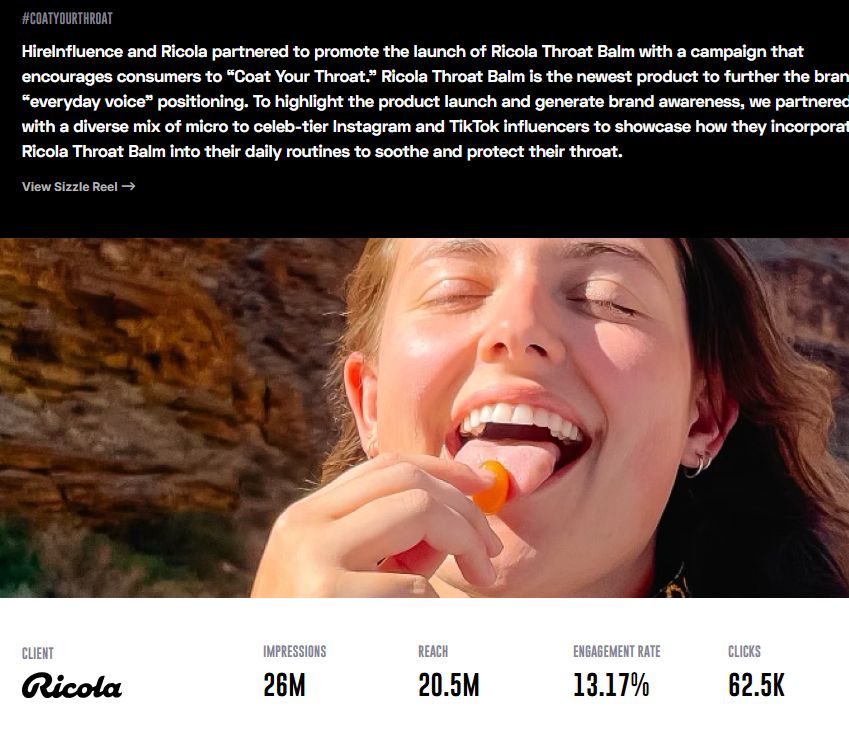
Execution over a first quarter is where the foundation either forms or stalls, because the early rounds are what later performance is built on. A program that placed content with 133 creators and reached 214 million impressions did not arrive at that scale in week one; it was built through rounds of testing and expansion. The Ricola program grew to 20.5 million reach as the roster and the messaging were refined across the run rather than fixed on day one. Early rounds surfaced which creators drove genuine response and which formats travelled, and those findings were fed back into the next wave instead of being logged and forgotten.
That feedback loop is the quiet engine of a first quarter, and it is why the strongest months in a program are almost never its first ones. Programs across the agency’s portfolio treat the opening quarter as the phase that earns the later return, so early quiet is read as foundation rather than failure, and the reporting is framed around what each stage was built to prove.
How to Evaluate an Influencer Campaign Management Agency
First, ask how the first 90 days are structured. The agency should describe a phased plan with different goals for each stage, because a partner promising immediate sales is either misreading the channel or overselling it.
Second, ask which metrics are read early and which are read late. The agency should hold engagement and clicks as early signals while giving revenue a longer runway, so the program is not judged on the wrong clock.
Third, ask how creators are tested in the opening weeks. The agency should treat the first round as a test that keeps the creators who resonate and drops the rest, rather than locking the full roster before any data exists.
Fourth, ask how early content is reused. The agency should build a library from the first rounds that makes later months cheaper and faster, so the investment keeps paying after the content is made.
Fifth, ask how the timeline maps to budget. The agency should tie the phases to a clear cost structure, so a brand can see what the first quarter buys before the return arrives.
The HireInfluence Model for Campaign Management
HireInfluence was founded in 2011 and works from offices in Houston, The Woodlands, Austin, Los Angeles, and New York, with a team of more than 25 people spread across more than 10 states and a six figure engagement floor. Campaigns for Grammarly, MTV, McDonald’s, Target, Meta, and Southwest Airlines have run through a model that treats the first quarter as a foundation to build on rather than a window for instant returns. The agency was named Marketing Agency of the Year at the 2024 MUSE Creative Awards and Digital Marketing Agency of the Year at the 2026 U.S. Agency Awards, and it has been a TikTok Shop Lite partner since July 2024, which keeps its pacing current with how quickly each platform actually produces signal.
Jason Pampell, the founder and chief executive, priced content rights, licensing, and media partnerships at Forbes and Billboard before 2011, where a media relationship rarely paid on its first placement and instead proved its worth across a full run. That understanding that value accrues over a series rather than a single insertion carries directly into how the agency sets expectations for a campaign’s opening quarter. Brands can reach the team through the contact page or learn more about the firm on the about page.
The research on how audiences act on creator content points to a single lesson: a lone exposure rarely moves a buyer, and results build as trust accumulates across repeated touchpoints. An agency that plans the first 90 days as a foundation gives a brand the patience the channel rewards, which is the difference between abandoning a program early and letting it compound.