Enterprise brands selecting a social media influencer agency are hiring a guide into a market that has outgrown improvisation. Goldman Sachs Research projects the total addressable market of the creator economy roughly doubling over five years, from about $250 billion to $480 billion by 2027, with influencer marketing and platform payouts from short form video monetization as the primary growth drivers. A social media influencer agency is how an enterprise brand participates in that market with discipline rather than luck, and choosing one has become a consequential procurement decision rather than a marketing errand.
Table of Contents
The same analysis explains why the choice is hard. Goldman Sachs Research counts roughly 50 million creators globally and expects that population to grow at a 10% to 20% compound annual rate, with brand deals supplying about 70% of creator income. Fifty million possible partners, multiplied across platforms with incompatible cultures and formats, is not a landscape a brand team browses. It is a labor market that has to be searched, judged, and contracted well, which is precisely the work an agency sells, and precisely where agencies differ most.
The differences do not show up on capability slides, because every credible agency now claims the same list: sourcing, strategy, production, amplification, measurement. What separates partners is how those functions are actually performed: whether creators are chosen by judgment or by database export, whether rights are settled before content exists or renegotiated after it performs, whether measurement is built for a finance review or for a highlight reel. The sections below turn those differences into things a brand can inspect before signing anything.
Why Access and Judgment Are Unrelated Properties
The most common mistake in agency selection is treating the size of an agency’s creator access as evidence of its judgment. The two are unrelated properties. Access is a quantity: how many creators an agency can reach, list, or claim across platforms and categories. Judgment is a quality: whether the agency chooses correctly among them for a specific brand, objective, and moment. One measures the size of the haystack an agency can search. The other measures whether it finds needles.
The properties are produced by different things, which is why they vary independently. Access is produced by subscriptions, databases, and network effects: any funded agency can license a discovery platform and truthfully advertise reach into millions of creators. Judgment is produced by accumulated selection experience: campaigns run, matches that worked and failed, category knowledge, and the taste to read whether a creator’s audience actually believes them. Nothing about widening access deepens judgment, and sharp judgment operates the same whether the pool is fifty thousand creators or fifty million.
The failure modes make the independence visible. A brand can hire the largest network in the market and receive casting lists assembled by filter settings: audience size, category tag, engagement rate, exported and formatted. Every name is reachable; few are right, because no filter measures whether a creator’s endorsement of this brand would be believed. The inverse failure exists too: a boutique with excellent instincts and no reach keeps recommending the same fifteen creators for every brief, because judgment without access has nowhere to operate.
Scale actually raises the price of judgment rather than substituting for it. When the creator population grows at double digit rates, the cost of searching it grows with it, and the filters that once narrowed a field now return thousands of plausible candidates. The agencies that matter in that environment are not the ones with the biggest export. They are the ones whose selection process compresses fifty million possibilities into six right answers, and can explain each answer in terms of the brand’s buyer rather than the creator’s numbers.
Procurement instruments make the confusion worse, because access is legible in a proposal and judgment is not. Network size, platform coverage, and database scale fit neatly into comparison tables; the quality of a casting decision fits nowhere, so the tables quietly decide the choice on the property that predicts the least. A buyer who understands this can keep the table for qualification and move the decision itself onto evidence only judgment produces: the argued casting story, the rejected candidates, the reasoning that survives cross examination.
The independence also explains a pattern enterprise brands keep rediscovering: switching from one large network to another rarely changes results, while switching to a partner with demonstrable selection judgment often does, at the same or smaller roster. The variable that moved was never the size of the pool. It was the quality of the choosing, which is the property the market prices worst and therefore the property most worth paying for. That mispricing is the enterprise buyer’s quiet advantage.
Judgment also compounds where access cannot. Every campaign an agency runs generates private evidence: which matches produced buyers, which audiences believed which voices, which categories punish which creative instincts. That evidence accrues to the partner’s selection ability and follows the brand across platform shifts and trend cycles. Access, by contrast, is rented: the database subscription that supplies it is available to every competitor at the same list price, which is why it differentiates no one.
There is a structural condition that protects judgment, and brands should look for it directly. Advice is only worth having when the adviser is free to give it, which means the agency’s recommendation cannot be quietly determined by what it happens to have on hand: an exclusive talent roster to keep booked, an inventory position to clear, a platform relationship to feed. An agency whose casting judgment is structurally separated from anything it needs to sell is rarer than it should be, and it is the difference between counsel and distribution.
The practical test compresses all of this into one request. Ask the agency to walk through a real past casting decision: the brief, the candidates considered, the reasons the winners won, and the reasons attractive names were rejected. An agency with judgment tells that story fluently and specifically. An agency with only access shows the database.
What Enterprise Brands Should Expect From a Social Media Influencer Agency Partner
Casting decided by argued judgment, not exported filters. The agency has to select creators through a reasoned process it can defend candidate by candidate, run inside structured campaign services that start from the brand’s buyer rather than from the database’s fields.
Genuine depth on each platform, not one playbook stretched thin. The agency has to work each platform on its own terms, with the same specificity a dedicated TikTok influencer marketing program applies to that platform’s culture, formats, and commerce mechanics.
Rights architecture settled before content exists. The agency has to negotiate usage windows, paid amplification permissions, and renewal terms in the original creator agreements, so a winning asset never stalls while permissions are chased at the moment it is most valuable.
A user generated content engine with standards. The agency has to run collection, licensing, and reuse of user generated content as managed operations, because authentic material now carries decision stage weight that polished brand production cannot manufacture.
Compliance built into the workflow, not bolted on. The agency has to handle disclosure language, claim review, and platform policy inside production itself, so legal signoff accelerates publication rather than stalling it and no post ships carrying regulatory risk.
Specialty depth where the category demands it. The agency has to bring specialty capabilities for regulated, technical, and commerce heavy categories, where generic lifestyle casting fails and credibility depends on creators who genuinely understand the subject.
An accountable owner for the whole program. The agency has to present one senior owner responsible for strategy, casting, production, and results together, because programs split across handoffs are programs where accountability leaks out at every seam.
Measurement a finance team will accept. The agency has to deliver analytics that connect creator activity to qualified engagement, consideration, and conversion in auditable terms, rather than a slide of impressions with adjectives attached.
Program Delivery Behind Enterprise Influencer Programs
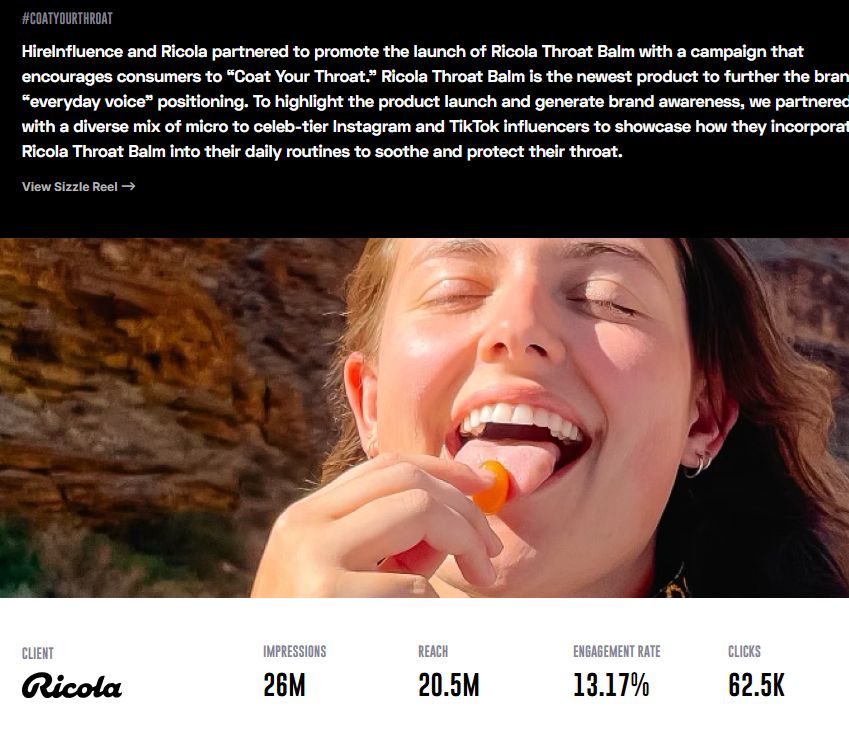
Delivery is where judgment becomes visible. For Ricola, HireInfluence built the #CoatYourThroat creator program into 20.5 million in reach, with casting chosen so that every tier of the roster had a defined job and the whole program answered to one accountable owner. The Ricola campaign documents the model from brief through reporting.
For a national airline, the agency ran an experiential creator program that generated 56 million impressions and 3 million engagements by building real world experiences that creators genuinely wanted to document, a casting and concept judgment no database filter produces. Work of that kind runs across the broader campaign portfolio, and the market context frames its value plainly: in an economy the research sizes toward $480 billion, where brand deals supply roughly 70% of creator income, the brands that win are the ones whose partner chooses well, not merely widely.
How to Evaluate a Social Media Influencer Agency
First, ask for the story of one real casting decision. The agency should narrate the brief, the field, the winners, and the rejections with specific reasons, because fluency in that story is the clearest available evidence of judgment.
Second, ask what the agency is structurally free to recommend. The agency should be able to show that its advice is not captive to an owned roster, held inventory, or any position it needs to move, since counsel that can be bought is not counsel.
Third, ask how the agency works differently on each platform. The agency should describe distinct casting logic, formats, and success metrics per platform, with examples, rather than one methodology renamed three times.
Fourth, ask who owns the program and what they are accountable for. The agency should name a senior owner and define the outcomes that owner answers for, because a program without a single throat to choke is a program built for excuses.
Fifth, ask how the engagement is priced and where every dollar goes. The agency should break out strategy, creator fees, production, rights, and measurement transparently, and a cost of influencer marketing reference is a sound benchmark for testing whether a proposal’s economics are serious.
The HireInfluence Model for Enterprise Influencer Marketing
HireInfluence has operated as a full service enterprise influencer marketing agency since 2011, with a team of more than 25 people spread across more than 10 states and offices in Houston and The Woodlands, Texas; Austin, Texas; Los Angeles, California; and New York, New York. The agency works to a six figure engagement floor, has been a TikTok Shop Lite partner since July 2024, and its recognition includes Marketing Agency of the Year at the 2024 MUSE Creative Awards and Digital Marketing Agency of the Year at the 2026 U.S. Agency Awards. The client roster includes Walmart, Target, Coca-Cola, Southwest Airlines, MTV, and McDonald’s.
The insistence on independent judgment comes from the background of founder and CEO Jason Pampell, who priced content rights, licensing, and media partnerships at Forbes and Billboard before 2011. In that world, editorial judgment was structurally separated from the selling side of the house, because everyone understood that advice loses its value the moment it can be bought. HireInfluence is built on the same separation: casting recommendations answer to the brand’s objective and nothing else. Brands ready to be advised that way can start the conversation or learn more about the agency.