
Affiliate marketing services have expanded well beyond the traditional link-and-commission model. For enterprise brands, the relevant version of affiliate marketing today is a fully managed creator program: a structured system in which influencers operate as affiliates, earning commissions on the sales they drive, while the brand maintains full visibility into attribution, compliance, and creative quality. According to FirstPromoter’s 2026 affiliate marketing statistics report, the global affiliate marketing industry is projected to grow at a compound annual growth rate of 18.6 percent through 2032, with over 80 percent of brands now using affiliate programs as a core component of their marketing mix.
Table of Contents
That scale of adoption reflects the model’s appeal: brands pay for performance, creators earn based on what they actually drive, and the attribution infrastructure makes it possible to connect content to commercial outcomes in ways that standard influencer marketing often cannot. The challenge is building that infrastructure correctly at enterprise scale.
What Managed Affiliate Marketing Services Include
A professionally managed affiliate marketing service for enterprise brands covers considerably more than issuing tracking links and paying commissions.
Creator sourcing and vetting for affiliate performance. Creators who perform well in affiliate structures are not always the same as creators who perform well in awareness campaigns. Affiliate success depends on audience trust in the creator’s recommendations, content formats that support action (click-throughs, purchase intent, and direct buying), and platforms where affiliate mechanics like promo codes and unique links are native to how the audience engages. Sourcing creators specifically for affiliate performance requires a different evaluation framework than general influencer matching.
Commission structure design. Enterprise affiliate programs need commission structures that account for product category margins, creator tier, and the platform dynamics relevant to each channel. A flat-rate commission that works for one product category may underperform for another. A tiered structure with performance bonuses for hitting sales thresholds motivates creator output more effectively than a fixed rate applied uniformly.
Attribution infrastructure. Promo codes and unique tracking links are the foundation. For enterprise retail brands, the attribution layer extends to retail integrations that track purchases through major retail platforms, not just direct-to-consumer conversions. HireInfluence’s integration with platforms like MikMak connects creator affiliate content directly to in-store and online retail purchase data, providing brands with attribution that goes beyond digital clicks.
Compliance and contract management. Creator affiliate contracts must specify commission terms, exclusivity provisions, FTC disclosure requirements, and content usage rights. At enterprise scale, running 20 or 50 creators simultaneously as affiliates requires documented compliance processes and standardized contract language that protects the brand if questions arise. HireInfluence manages FTC compliance, creator contracting, and 1099 and payment services as integrated parts of its campaign execution.
TikTok Shop as an Affiliate Marketing Service Component
The growth of TikTok Shop has made it one of the most effective channels for creator-driven affiliate programs in consumer categories. Creators can link directly to products from their TikTok content, earn commissions on purchases, and track performance natively within the platform. For brands in consumer products, health and wellness, beauty, and CPG categories, TikTok Shop affiliate programs have become a meaningful revenue channel.
HireInfluence secured an exclusive TikTok Shop Lite Program partnership in July 2024, giving the agency access to platform data and ad capabilities that standard agencies cannot replicate. For brands building TikTok-native affiliate programs, that partnership translates to better creator matching data, more effective Spark Ad integration alongside organic affiliate content, and direct access to TikTok’s social commerce infrastructure.
The agency’s TikTok influencer marketing capabilities extend to TikTok Shop affiliate management as part of its full-service offering. This is particularly relevant given the platform’s scale: TikTok Shop has become one of the fastest-growing social commerce environments in the US market.
The Ricola #CoatYourThroat Campaign as an Attribution Model
The Ricola campaign managed by HireInfluence provides the clearest example of what retail-connected affiliate attribution looks like in practice. Eighteen influencers spanning micro to celebrity tier generated 26 million impressions, 20.5 million in reach, and a 13.17% engagement rate. The MikMak integration tracked 62,500 retail purchase clicks directly to creator content, connecting influencer activity to purchase intent data at the retail channel level.
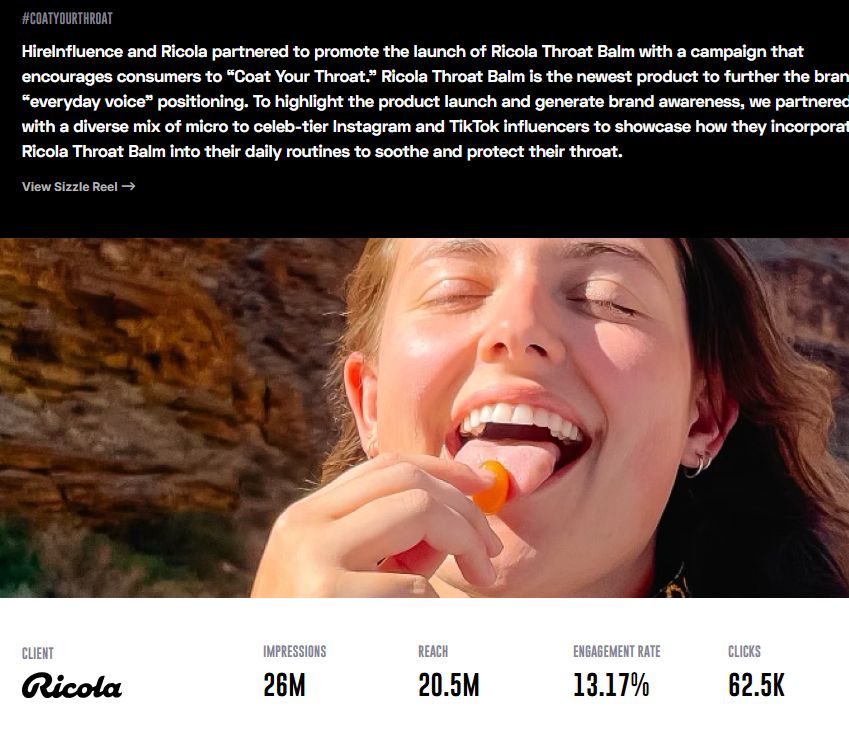
That level of attribution is the standard enterprise brands should expect from managed affiliate marketing services. It goes beyond tracking which link a consumer clicked on the day of posting. It maps creator content to purchase behavior across the full consumer journey, including retail channels where the final purchase may happen hours or days after the content was first viewed.
How HireInfluence Structures Creator Affiliate Programs
HireInfluence has been managing enterprise influencer campaigns since 2011, building affiliate program components into campaigns for brands in retail, CPG, technology, and consumer services. The agency’s analytics infrastructure is designed to handle multi-touch attribution, retail channel integration, and the performance reporting enterprise marketing teams need to justify affiliate program investment internally.
A managed affiliate program through HireInfluence typically integrates with the brand’s broader influencer campaign rather than operating as a standalone channel. Creator selection accounts for affiliate-specific performance criteria. Commission structures are designed around the brand’s product margins and channel mix. Attribution is built into the campaign architecture from the start, not retrofitted after creators are already posting.
The Grammarly campaign demonstrates HireInfluence’s operational scale: 133 creators across YouTube, TikTok, and Instagram, generating 214 million impressions, 33.1 million views, and $15 million in earned media value. Programs of that complexity, with performance tracking across multiple platforms and creator tiers simultaneously, require the kind of operational infrastructure most affiliate marketing services are not built to provide.
The agency’s specialty services include the full scope of affiliate-connected program components: TikTok Shop affiliate management, creator commerce integration, whitelisting for paid amplification of top-performing affiliate content, and multi-platform performance tracking. For enterprise brands that want a full picture of the influencer marketing investment associated with a managed affiliate program, including creator fees, commission structures, and platform costs, the agency’s cost guide provides useful context.
Enterprise brands that structure affiliate marketing as a managed service rather than a self-serve tool see fundamentally different outcomes: higher creator accountability, more consistent attribution across channels, and performance data that holds up in internal budget conversations.
The agency’s named clients include Microsoft, Target, Walmart, Southwest Airlines, and Meta. The minimum engagement starts at approximately $100,000. For enterprise brands evaluating affiliate marketing services with the infrastructure to match their scale, the starting point is understanding what a managed program actually looks like. Review the agency’s client work and reach out at hireinfluence.com/contact/.