
A CPG influencer marketing agency specializes in running creator-led campaigns for consumer packaged goods brands, where the stakes are different from most other categories. CPG products live or die on shelf velocity, retailer relationships, and the ability to reach consumers at the right moment in their purchase cycle. Influencer marketing in this space needs to account for multi-retailer coordination, compliance requirements, high-volume content production, and the kind of authentic product integration that actually moves units. This guide covers what separates a genuine CPG specialist from a generalist agency, and what to look for when you are evaluating your options.
Table of Contents
Why CPG Is a Distinct Influencer Marketing Category
Not every category presents the same challenges for influencer marketing. Fashion and tech brands can often run a relatively straightforward product seeding or launch campaign and generate meaningful results. CPG is more complicated.
Here is why. CPG products are typically low-consideration purchases made frequently, often in a physical retail environment. The influencer’s job is not just to generate awareness. It is to create a moment of cultural relevance that changes what a consumer reaches for at the shelf. That requires a different kind of content strategy, a different approach to creator selection, and a much tighter integration between the influencer campaign and the broader retail and paid media activation.
According to Zappi’s analysis of the CPG influencer marketing space, CPG brands are now among the fastest-growing users of influencer marketing globally, driven by the fact that products like snacks and personal care items are inherently social and tied to culture in ways that make them well-suited for creator-led storytelling. A viral recipe using a specific ingredient, a beauty routine featuring a household brand, or a food challenge built around a seasonal product can generate immediate sales spikes in a way that traditional advertising rarely achieves at the same cost.
The Specific Challenges CPG Brands Face
If you are a CPG marketing team evaluating influencer agencies, a few challenges come up consistently.
Multi-retailer coordination. A campaign for a CPG product sold at Target, Walmart, and Kroger simultaneously requires coordination across retail partners, promotional timing, and in some cases retailer-specific creative. An agency that has not run CPG campaigns before will not understand this layer of complexity.
Compliance and claims. CPG brands in food, beverage, and personal care categories face specific regulatory constraints on what can and cannot be said in sponsored content. FTC disclosure is a baseline. For food brands, nutrition claims and comparative statements require legal review. An agency that does not build compliance review into its standard process is a liability.
Volume and consistency. A single CPG campaign often requires content across multiple platforms, multiple creator tiers, and multiple product SKUs simultaneously. The operational requirements are significant. An agency built for high-touch boutique campaigns will struggle here.
Connecting influencer content to retail outcomes. Proving that influencer activity drove measurable sales lift is one of the hardest measurement problems in marketing. CPG brands need an agency with analytics infrastructure that goes beyond standard engagement metrics, tracking earned media value and, where possible, sales attribution through retailer data and conversion tracking.
What a Specialist CPG Influencer Agency Brings
The agencies that do CPG influencer marketing well share a few common traits.
They understand the retail calendar. CPG campaigns are often built around seasonal moments, product launches, and promotional windows that are tied to retail partner plans. An agency that treats CPG like any other vertical will miss those timing dependencies entirely.
They have experience with compliance review at scale. Not a token legal check. A genuine content auditing process that reviews every piece of creator content before it goes live, with clear guidelines built into the influencer brief from the start.
They can execute across creator tiers simultaneously. CPG campaigns often work best with a mix of macro-influencers for reach and micro-influencers for authentic product integration in specific communities. Managing both tiers under the same campaign umbrella, with consistent brand standards, requires operational depth that not all agencies have.
They integrate paid amplification from day one. The best-performing creator content in a CPG campaign should be amplified through paid channels to extend its shelf life beyond the organic post window. This is not an afterthought. It should be built into the campaign plan from the start.
HireInfluence’s CPG Track Record
HireInfluence has run influencer campaigns for some of the most recognized CPG brands in the world. The #CoatYourThroat campaign for Ricola is a strong example of what CPG influencer marketing looks like when the execution is right.
The campaign launched Ricola Throat Balm through 18 vetted influencers spanning micro to celebrity tier, recruited from travel, fitness, and cinema categories. Rather than targeting only people with existing throat or wellness interest, the strategy positioned the product around everyday voice use, which opened the creative territory considerably and made the content feel natural rather than medicinal.
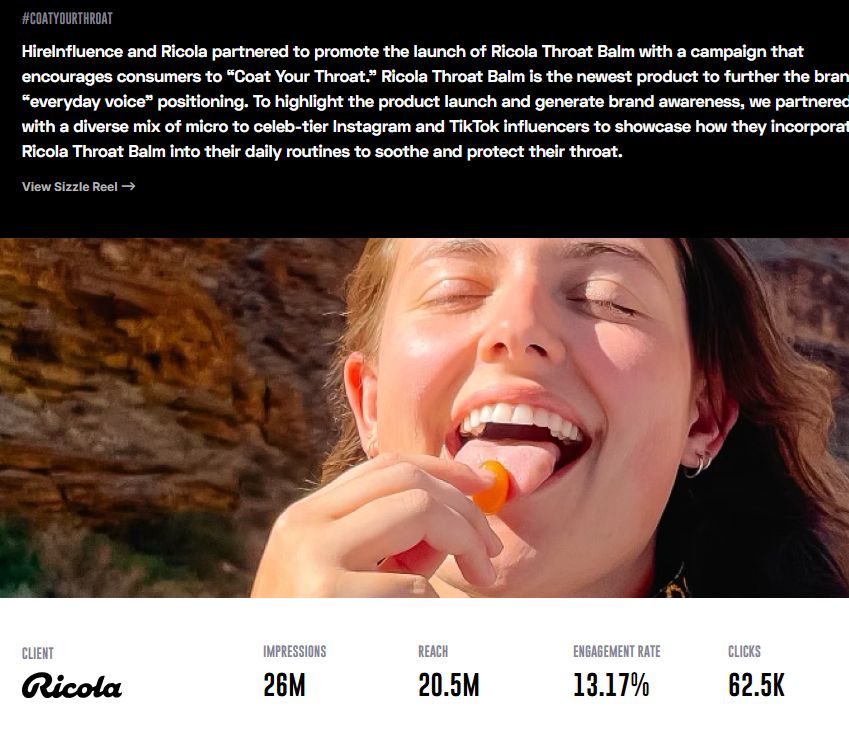
Influencers directed followers to purchase through a custom mikmak retail link, integrating commerce directly into the content. The results surpassed initial targets: 26 million impressions, 20.5 million reach, a 13.17% engagement rate, and over 23 million video views across Instagram Stories, Reels, and TikTok.
That kind of outcome does not happen without disciplined creator curation, a strong strategic brief, multi-platform execution, and a retail-purchase integration built into the campaign from the start. Those are exactly the operational elements that separate CPG-capable agencies from generalist influencer shops.
How to Evaluate Your Options
When you are comparing CPG influencer agencies, a few questions cut through the noise quickly.
Ask whether they have run campaigns for brands sold in major retail chains. Ask how they handle FTC compliance and content review. Ask what their process is for connecting influencer performance to retail outcomes. And ask whether paid amplification is integrated into their standard campaign model or treated as an add-on.
The answers to those four questions will tell you whether an agency actually understands the CPG environment or whether they are applying a generalist influencer playbook to a category that requires something more specific.
If you are evaluating agencies for a CPG influencer campaign, the HireInfluence campaigns team works with CPG brands on a project basis. You can also explore their influencer tier specialties to understand how creator selection strategy varies by campaign objective, or reach out directly to start a conversation about your specific campaign goals.