
Creator marketing and consumer packaged goods have become deeply intertwined. Circana’s 14th annual 2025 U.S. CPG Growth Leaders Report, released April 9, 2026 and analyzing more than 700 manufacturers with annual sales ranging from $100 million to $8 billion or more, identified the specific strategies driving top-performing CPG brands in the current market. Cara Loeys, vice president and industry advisor for Circana, summarized the finding directly: “When you look at this year’s biggest success stories, technology sits at the center. We see top brands teaming up with AI partners to speed up how they research, create and sell, staying ahead of the rapidly evolving and increasingly informed wants of today’s consumer. Furthermore, leading companies are adopting social-first marketing and community-driven models to forge better relationships with younger households.” Circana’s data also documented that retail food and beverage sales grew 3% in 2025, non-food CPG growth slowed to 2%, and the brands winning in the current environment are those offering rich consumer bonds, true authenticity, relentless value, rewritten occasions, and continuous discovery.
Table of Contents
- Why Circana’s Findings Change the CPG Creator Marketing Agency Decision
- What Enterprise CPG Brands Should Expect From a Creator Marketing Agency
- Enterprise CPG Creator Marketing Delivery in Practice
- How Enterprise CPG Brands Should Evaluate a Creator Marketing Agency
- The Creator Marketing Agency Model for CPG Brands
For CPG marketing teams evaluating a creator marketing agency, those Circana findings establish a specific capability profile. Creator marketing for CPG brands is not generic content production adapted for consumer goods. It is community-driven, social-first content that builds relationships with the consumer segments (particularly younger households) that Circana’s growth leaders are prioritizing. The creator marketing agency has to deliver that capability as a consolidated service, not as sourcing plus production plus amplification plus analytics delivered separately. This guide breaks down what enterprise CPG brands should expect from a creator marketing agency, how the shift toward social-first community models changes the buying decision, and what separates a partner built for CPG growth dynamics from a generalist creator marketing offering.
Why Circana’s Findings Change the CPG Creator Marketing Agency Decision
Circana’s framing of the five strategies driving 2025 growth leaders (rich consumer bonds, true authenticity, relentless value, rewritten occasions, continuous discovery) maps directly to what creator marketing has to deliver operationally. Rich consumer bonds mean creator partnerships have to be structured as sustained relationships, not project-by-project activations. True authenticity means creator content has to feel native to the creator’s voice, not scripted brand content adapted for creator distribution. Relentless value means creator content has to connect to measurable consumer outcomes (purchase activity, retail lift, commerce conversion), not organic reach metrics alone. Rewritten occasions mean creator programs have to introduce new consumption contexts and product use cases through authentic creator storytelling. Continuous discovery means creator marketing has to operate on always-on cadences rather than seasonal campaign bursts.
For CPG marketing teams, those operational requirements reshape what the creator marketing agency has to deliver. A partner that runs one-off creator campaigns with organic reach metrics as the primary measurement cannot deliver the rich consumer bond that Circana’s growth leaders are building. A partner without the attribution infrastructure to connect creator content to retail or commerce outcomes cannot demonstrate the relentless value CPG finance teams now expect. A partner without the creative direction capability to support authentic creator voice cannot produce the content that builds the true authenticity Circana identified as a growth driver.
Cara Loeys’s specific mention that leading companies “are adopting social-first marketing and community-driven models” is particularly consequential for the creator marketing agency decision. The CPG brands winning in Circana’s rankings (Red Bull North America, Unilever, Kimberly-Clark, L’Oréal, The Coca-Cola Company in the $8 billion-plus tier; Chobani, Celsius, BellRing Brands, Georgia-Pacific, Driscoll’s in the $2.5 billion-$8 billion tier) are category leaders specifically because they have built community-driven creator marketing programs rather than treating creator content as supplementary brand marketing. The creator marketing agency supporting CPG enterprise programs has to be built for that community-driven model, not retrofitted from traditional agency infrastructure.
What Enterprise CPG Brands Should Expect From a Creator Marketing Agency
A credible creator marketing agency for CPG brands operates across eight coordinated service functions calibrated specifically to CPG category dynamics and Circana’s growth leader profile.
CPG creator marketing strategy and measurement design. The engagement begins with business objectives tied to CPG-specific outcomes (shelf velocity, retail partner visibility, commerce conversion, trial generation, community building) and a measurement framework that connects creator activity to those outcomes. HireInfluence structures CPG creator marketing strategy through dedicated campaign services built for enterprise CPG engagements.
Creator sourcing calibrated to CPG category dynamics. Not every creator produces strong CPG content. The creator marketing agency has to source from creators with proven capability in food, beverage, beauty, personal care, and household goods categories, with audience demographics that match the specific younger household segments Circana’s growth leaders are prioritizing. The agency’s experience in food and beverage specifically is worth reviewing through its food and beverage creator capability for context on how category specialization shapes creator selection.
Creative direction supporting authentic creator voice. Circana’s finding that true authenticity drives growth means the agency’s creative direction cannot override creator voice. The agency has to develop creative approaches that give creators clear product positioning and objectives while preserving the authentic voice that builds the consumer relationships Circana identified as the central growth driver.
Long-term creator partnership management. Rich consumer bonds and continuous discovery both require sustained creator relationships rather than project-by-project campaigns. Ambassador programs, long-term partnership structures, and always-on content programs all require the operational infrastructure to manage creator relationships across extended time.
Contracting and rights management calibrated to CPG usage. Video rights structure for CPG programs has to cover retail partner distribution (in-store screens, retailer digital channels, retail media networks) alongside standard social, paid, and owned channel usage. Multi-channel rights negotiated at the contract phase are what enable creator content to flow across the full CPG distribution footprint.
AI-integrated workflows. Circana specifically identified AI partnership as a growth driver for 2025 winners. The creator marketing agency should describe how AI tools support creator discovery, content optimization, performance analysis, and campaign reporting across the operational workflow.
Commerce-connected attribution infrastructure. UTM frameworks, promo code systems, pixel tracking, conversion event integration, retail commerce measurement (MikMak, retail partner tracking), and platform commerce integration (TikTok Shop, Instagram Shopping). HireInfluence’s analytics capability is designed to give enterprise CPG clients the attribution depth that connects creator content to the retail and commerce outcomes Circana’s growth framework requires.
Paid media amplification with retail media integration. Creator content performs best when organic distribution is paired with paid amplification on platforms with commerce infrastructure. HireInfluence covers this through its specialties and services capability, including whitelisting, dark posting, cross-platform paid amplification, and retail media coordination for brands where creator content flows into retail media networks.
Enterprise CPG Creator Marketing Delivery in Practice
CPG brands evaluating a creator marketing agency should look at programs that demonstrate what enterprise-scale CPG creator marketing produces.
The Ricola #CoatYourThroat program is the reference benchmark for CPG creator marketing. The campaign drove 26 million impressions, 20.5 million reach, a 13.17% engagement rate across 18 creators spanning micro to celebrity tier, and 62,500 MikMak retail purchase clicks. The MikMak integration is the specific capability that Circana’s growth framework points to: creator content connected directly to measurable retail purchase activity, with the commerce attribution that CPG finance teams require for continued investment. The Ricola case study documents how creator tier selection, content strategy, and retail attribution came together in a single program.
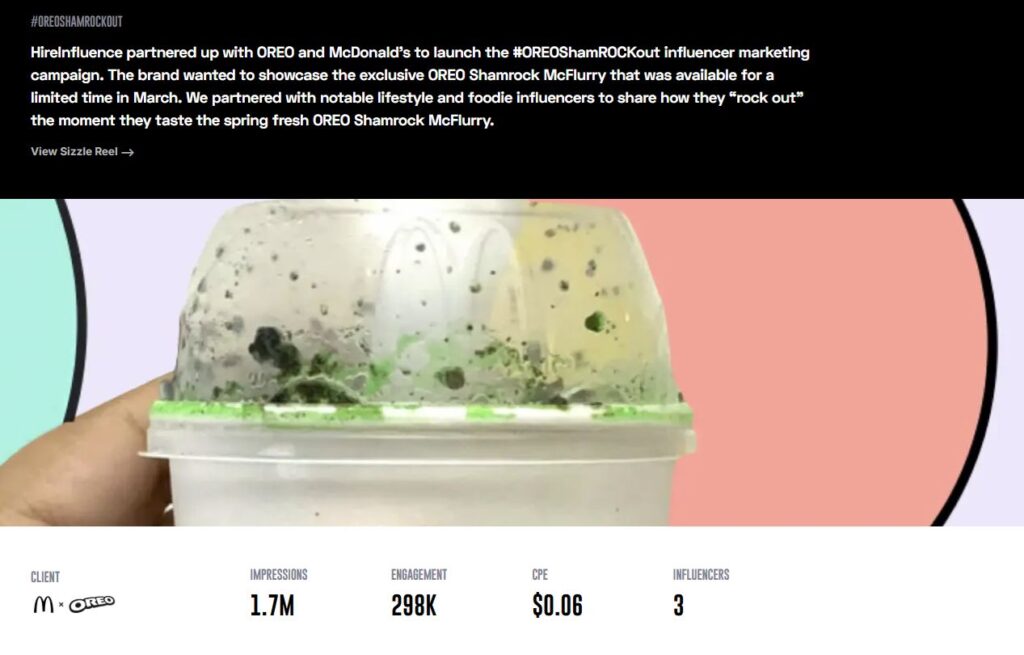
The Oreo/McDonald’s #OREOShamROCKout campaign delivered 1.7 million impressions at $0.06 CPE. That efficiency metric is what CPG enterprise finance teams use to compare creator marketing spend against other paid media investments, and it sets a baseline for what CPG creator marketing programs should produce when creator selection, creative strategy, and paid amplification are coordinated as a single system.
The broader HireInfluence engagement with CPG-adjacent brands including Coca-Cola, Walmart (for CPG product activations), Target (for CPG product activations), and Oreo demonstrates the category depth that enterprise CPG creator marketing programs require. The work portfolio documents additional case examples across CPG-relevant categories.
How Enterprise CPG Brands Should Evaluate a Creator Marketing Agency
Five evaluation questions separate credible CPG creator marketing partners from generalist agency offerings.
First, ask about long-term creator partnership infrastructure. Circana’s rich consumer bonds and continuous discovery growth drivers both require sustained creator relationships. The agency should describe how ambassador programs, long-term partnership structures, and always-on content programs are designed, managed, and measured, with specific examples of multi-year creator engagements for CPG clients.
Second, ask about commerce attribution methodology. MikMak integration, retail partner tracking, TikTok Shop infrastructure, Instagram Shopping integration, and retail media network connectivity. A CPG creator marketing program that cannot connect to commerce outcomes is not serving the measurement standards Circana’s data shows are now enterprise baseline.
Third, ask about AI integration. Cara Loeys specifically identified AI partnership as central to 2025 growth leader success. The agency should describe specific AI tool integration in creator discovery, content optimization, performance analysis, and campaign reporting.
Fourth, ask about CPG category experience specifically. Generalist creator marketing agencies may have strong operational capability without the category-specific understanding CPG programs require. The agency should demonstrate direct experience with food, beverage, beauty, personal care, or household goods brands, with campaign outcomes calibrated to CPG business objectives.
Fifth, ask about retail calendar alignment. CPG campaigns are often built around seasonal moments, product launches, and promotional windows that are tied to retail partner plans. An agency that treats CPG creator marketing like any other vertical will miss those timing dependencies entirely.
The Creator Marketing Agency Model for CPG Brands
HireInfluence runs enterprise creator marketing programs for CPG-adjacent brands across the category. The agency was founded in 2011 and maintains offices in Houston and The Woodlands, TX; Austin, TX; Los Angeles, CA; and New York, NY. That national footprint, combined with CPG category depth built across more than a decade, positions the agency to deliver creator marketing programs calibrated specifically to CPG business requirements and the growth leader profile Circana documented.
Engagements typically start at approximately $100,000, aligned with the enterprise delivery standard that CPG creator marketing programs require. Confirmed clients include Microsoft, Southwest Airlines, Target, Coca-Cola, Walmart, Meta, McDonald’s, Oreo, Grammarly, Ricola, and MTV, multiple of which are CPG-category engagements. Award recognition across 2024 and 2026 includes the MUSE Creative Awards, Netty Awards, NYX Awards, Global Digital Excellence Awards, U.S. Agency Awards, and Vega Digital Awards. The agency is also an exclusive TikTok Shop Lite Program partner since July 2024, providing direct access to TikTok’s commerce infrastructure for CPG creator marketing programs that need to connect to measurable commerce outcomes.
Jason Pampell, Founder and CEO, launched HireInfluence in 2011 after managing content rights and strategic media partnerships for Forbes and Billboard. His 30+ years of leadership experience in sales, marketing, and team building for Fortune 1000 organizations informs how the agency structures CPG creator marketing engagements. His approach to building the agency shaped how enterprise creator marketing programs get delivered for CPG clients today.
For enterprise CPG brands ready to evaluate what a creator marketing engagement calibrated to Circana’s growth leader profile should include, the HireInfluence team handles initial conversations directly through its contact page. Brands benchmarking pricing should reference the cost of influencer marketing guide for context on enterprise engagement costs.
Circana’s data makes the growth environment for CPG creator marketing clear. Rich consumer bonds, true authenticity, community-driven models, AI integration, and social-first strategies are the drivers separating growth leaders from the rest of the category. The creator marketing agency decision for CPG enterprise brands is the decision about which partner can deliver that capability profile as a consolidated service rather than as separate operational layers. The brands winning in the current CPG environment are working with partners built for the creator marketing model Circana’s growth leaders are using, not generalist agency infrastructure adapted for the category after the fact.