
Retail marketing teams evaluating a creator marketing agency face a paradox that the broader consumer research is now documenting clearly. According to McKinsey’s State of the Consumer 2025 report, based on survey data from 2,838 consumers across China, Germany, the United Kingdom, and the United States collected April-May 2025, consumers are spending more time on social media than ever before while simultaneously ranking social media as their least-trusted source when making buying decisions. US consumers in 2025 report over three hours more free time per week than they did in 2019, and they allocate nearly 90% of that time to solo activities including social media. At the same time, social media use for product research rose to 32% on average, up from 27% in 2023. Yet consumers in Europe and the United States report that social media influences them least in brand and product recommendations while family and friends influence them most.
Table of Contents
- Why McKinsey’s Trust Data Reshapes the Retail Creator Marketing Agency Decision
- What Enterprise Retail Brands Should Expect From a Creator Marketing Agency
- What Enterprise Retail Creator Marketing Delivery Produces
- How Enterprise Retail Brands Should Evaluate a Creator Marketing Agency
- The Creator Marketing Agency Model for Retail Brands
For retail marketing teams, those data points establish a specific capability profile the creator marketing agency has to deliver. Creator marketing for retail brands cannot rely on organic reach metrics or follower counts to justify enterprise spend. The trust gap McKinsey documented means creator selection, audience validation, content authenticity, and commerce attribution all have to be calibrated to the specific consumer behaviors retail brands are trying to influence. A partner that treats creators as distribution channels without accounting for the trust dynamics McKinsey surfaced cannot deliver the retail outcomes current measurement standards require. This guide breaks down what enterprise retail brands should expect from a creator marketing agency, how the consumer research environment reshapes the capability requirements, and what separates a partner built for retail commerce outcomes from a generalist creator marketing offering.
Why McKinsey’s Trust Data Reshapes the Retail Creator Marketing Agency Decision
McKinsey’s finding that consumers use social media for product research while distrusting it as an information source is not a contradiction. It is a structural feature of how retail purchase decisions now get made. Consumers browse creator content to discover products, research features, and see products in use contexts. Then they validate what they saw through other sources (family, friends, reviews, retailer pages) before making a purchase decision. A creator marketing agency serving retail brands has to understand that sequence and structure programs that perform at each step, not just at the discovery phase.
For enterprise retail brands, the implications change what “creator marketing” has to deliver operationally. Creator content has to be authentic enough that audiences actually pay attention in a scrolling environment where McKinsey’s data shows consumers spend increasing solo time. Creator selection has to filter for audiences where trust alignment matters more than raw follower count. Content strategy has to support the research phase of purchase decisions, which means creator programs should produce demonstration content, use-case content, and comparison content rather than pure awareness content. And attribution infrastructure has to connect creator discovery to downstream commerce validation, because retail finance teams need to see the full consumer journey from initial creator exposure through final purchase.
McKinsey’s data also documented category-specific variation that matters for retail creator marketing. In the travel category, 38% of US survey respondents rank influencers they follow among their top three trusted sources. In the snack category, only 13% do the same. That variation means creator marketing capability profile has to be calibrated to the specific retail category and consumer behavior pattern. Generalist creator marketing applied across all retail verticals will underperform category-specific creator marketing that accounts for how trust actually operates in the target consumer segment.
The broader McKinsey finding on consumer convenience expectations compounds the retail-specific requirements. Food delivery rose from 9% of global food service spending in 2019 to 21% in 2024. Over 90% of Chinese and US consumers in McKinsey’s survey shopped at an online-only retailer in the previous month. Grocery delivery usage reached nearly 40% of German, UK, and US surveyed consumers. That bring-it-to-me consumer mindset means retail creator marketing has to support frictionless paths from creator content to purchase, which requires integrated commerce infrastructure, not organic creator content treated as a separate layer from commerce operations.
What Enterprise Retail Brands Should Expect From a Creator Marketing Agency
A credible creator marketing agency for retail brands operates across eight coordinated service functions calibrated specifically to retail commerce dynamics and the consumer research environment McKinsey documented.
Retail creator marketing strategy and commerce attribution design. The engagement begins with business objectives tied to retail outcomes (e-commerce conversion, in-store traffic, retail partner co-marketing, loyalty engagement, basket size) and a measurement framework that connects creator activity to those outcomes. HireInfluence structures retail creator marketing through dedicated campaign services built for enterprise retail engagements.
Creator sourcing calibrated to retail trust dynamics. McKinsey’s data on category-specific trust variation means the agency has to source creators based on audience trust alignment with the specific retail category, not just follower count or engagement rate. A credible agency runs tier-matched sourcing with audience authenticity analysis, category fit screening, and trust signal validation built into the discovery workflow.
Creative direction supporting authentic creator voice. Creator content has to perform in an environment where McKinsey’s data shows consumers are increasingly skeptical of social media as an information source. The agency’s creative direction has to preserve authentic creator voice while delivering clear product positioning, because scripted-sounding brand content fails the authenticity threshold consumers now apply.
Contracting and rights management calibrated to retail usage. Rights structure has to cover retail partner distribution (in-store screens, retailer digital channels, retail media networks) alongside standard social, paid, and owned channel usage. Multi-channel rights negotiated at the contract phase are what enable creator content to flow across the full retail distribution footprint without repeated creator compensation.
Long-term creator partnership management. McKinsey’s consumer research environment rewards sustained creator relationships over one-off campaigns because trust is built through repeated authentic exposure, not single sponsored posts. Ambassador programs, exclusive partnerships, and multi-year content programs all require operational infrastructure calibrated to relationship management over extended time.
Paid media amplification with commerce integration. Creator content performs best when organic distribution is paired with paid amplification on platforms with commerce infrastructure. HireInfluence delivers this through its specialties and services capability, including whitelisting, dark posting, and cross-platform paid amplification across Meta, TikTok, YouTube, and emerging platforms. For retail brands specifically, paid amplification integrated with TikTok Shop, Instagram Shopping, and retail media networks is what connects creator content to measurable commerce outcomes.
Commerce-connected attribution infrastructure. UTM frameworks, promo code systems, pixel tracking, conversion event integration, platform commerce measurement (TikTok Shop, Instagram Shopping, YouTube Shopping), retail partner commerce tracking, and retail media network attribution. HireInfluence’s analytics capability is designed to give enterprise retail clients the attribution depth that connects creator content to measurable sales outcomes.
Cross-channel content lifecycle management. Creator content produced through retail creator programs should flow across paid social, retail media networks, CTV, email, retailer digital channels, in-store screens, and owned channels without separate production cycles.
What Enterprise Retail Creator Marketing Delivery Produces
Enterprise retail brands evaluating a creator marketing agency should look at programs that demonstrate what creator-connected retail delivery actually produces.
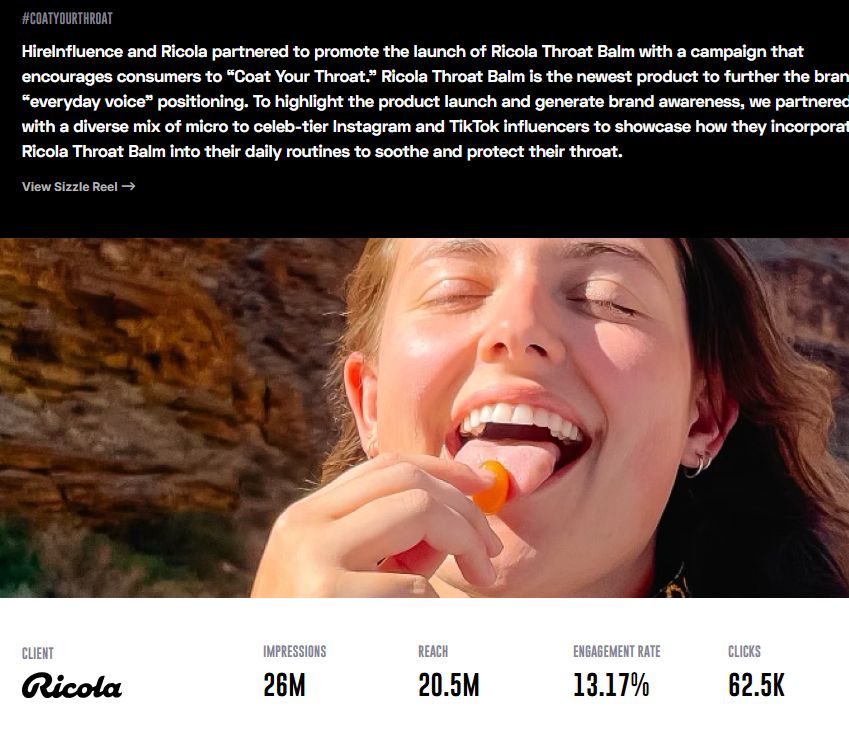
The Ricola #CoatYourThroat program is the reference benchmark for retail-connected creator marketing. The campaign drove 26 million impressions, 20.5 million reach, a 13.17% engagement rate across 18 creators spanning micro to celebrity tier, and 62,500 MikMak retail purchase clicks. The MikMak integration is the specific capability retail brands need to see demonstrated: creator content connected directly to trackable retail purchase activity, with the commerce attribution retail finance teams require. The Ricola case study documents how creator tier selection, content strategy, and retail attribution came together in a single program architecture.
The Grammarly engagement demonstrates multi-platform scale. The program activated 133 creators across YouTube, TikTok, and Instagram, producing 214 million impressions, 33.1 million views, and $15 million in earned media value. For retail brands running multi-platform creator marketing programs, the Grammarly scale numbers establish what enterprise delivery produces when creator sourcing, production direction, and amplification are coordinated as a single system.
HireInfluence’s engagement with retail and retail-adjacent brands including Walmart, Target, and Coca-Cola demonstrates the retail category depth enterprise creator marketing programs require. The imPress Nails campaign at New York Fashion Week shows how creator marketing adapts to retail-adjacent brand moments, with luxury-aligned creator selection and direct-to-website CTAs structured to convert attention into purchase activity. The work portfolio documents additional retail-relevant case examples.
The MTV #MyMTVStyle TikTok campaign generated 16.1 million impressions at $0.01 CPV and $1.50 CPM with 216,600 engagements. Those efficiency numbers are what retail enterprise finance teams benchmark when comparing creator marketing spend against other paid media channels.
How Enterprise Retail Brands Should Evaluate a Creator Marketing Agency
Five evaluation questions separate credible retail creator marketing partners from generalist agency offerings.
First, ask about category-specific trust calibration. McKinsey’s category trust variation (38% in travel vs 13% in snack) makes this consequential. The agency should describe how creator sourcing, audience validation, and content strategy calibrate specifically to the retail category, not as generic creator sourcing applied across verticals.
Second, ask about commerce attribution methodology. MikMak integration, retail partner tracking, TikTok Shop infrastructure, Instagram Shopping connectivity, and retail media network measurement. A retail creator marketing program that cannot connect to commerce outcomes is not serving enterprise retail finance requirements.
Third, ask about long-term creator partnership infrastructure. McKinsey’s consumer research environment rewards sustained creator relationships. The agency should describe how ambassador programs, long-term partnerships, and always-on content programs are structured, managed, and measured with specific examples of multi-year retail engagements.
Fourth, ask about retail category experience specifically. Fashion, beauty, home, grocery, electronics, and specialty retail all have distinct audience dynamics and commerce behaviors. The agency should demonstrate direct experience in the specific retail categories the brand operates in.
Fifth, ask about retail calendar alignment. Retail operates on specific promotional windows (back-to-school, holiday, summer, spring reset) that shape when creator activity has maximum impact. An agency without retail calendar coordination will miss those timing dependencies.
The Creator Marketing Agency Model for Retail Brands
HireInfluence runs enterprise creator marketing programs for retail and retail-adjacent brands across multiple categories. The agency was founded in 2011 and maintains offices in Houston and The Woodlands, TX; Austin, TX; Los Angeles, CA; and New York, NY. That national footprint, combined with retail category depth built across more than a decade, positions the agency to deliver creator marketing programs calibrated to retail commerce requirements.
Engagements typically start at approximately $100,000, aligned with the enterprise delivery standard. Confirmed clients include Microsoft, Southwest Airlines, Target, Coca-Cola, Walmart, Meta, McDonald’s, Oreo, Grammarly, Ricola, and MTV, multiple of which are direct retail engagements or retail-adjacent programs. Award recognition across 2024 and 2026 includes the MUSE Creative Awards, Netty Awards, NYX Awards, Global Digital Excellence Awards, U.S. Agency Awards, and Vega Digital Awards. The agency is also an exclusive TikTok Shop Lite Program partner since July 2024, providing direct access to TikTok’s commerce infrastructure for retail creator marketing programs that need to connect to platform commerce outcomes.
Jason Pampell, Founder and CEO, launched HireInfluence in 2011 after managing content rights and strategic media partnerships for Forbes and Billboard. His 30+ years of leadership experience in sales, marketing, and team building for Fortune 1000 organizations informs how the agency structures retail creator marketing engagements. His approach to building the agency shaped how enterprise creator marketing programs get delivered for retail clients today.
For enterprise retail brands ready to evaluate what a creator marketing engagement connected to retail commerce outcomes should include, the HireInfluence team handles initial conversations directly. Brands benchmarking pricing should reference the cost of influencer marketing guide for context on enterprise engagement costs. Those evaluating TikTok-focused strategies should review the TikTok influencer marketing resource, and brands integrating creator content with broader UGC strategy should review the UGC overview.
McKinsey’s State of the Consumer 2025 data clarifies the operating environment for retail creator marketing. Consumers are spending more time on social media while applying greater trust scrutiny to what they see there. Creator marketing that succeeds in this environment requires category-specific trust calibration, authentic creator voice, long-term relationship structures, and commerce attribution that connects creator activity to measurable retail outcomes. The creator marketing agency decision for retail enterprise brands is the decision about which partner has built the operating infrastructure for that environment rather than operating on capability profiles calibrated to a different moment in the consumer research landscape.