
The way enterprise brands think about media has shifted. Creators are no longer a supplemental channel sitting alongside paid search, display, and broadcast. For a growing number of Fortune 500 and large national brands, influencer media has become a primary distribution vehicle — one that delivers reach, trust, and conversion data that traditional media placements cannot match.
Table of Contents
The 2026 Creator Economy Report from The Influencer Marketing Factory, which analyzed 5 million creator accounts across Instagram, TikTok, and YouTube alongside a survey of 1,000 US-based creators conducted in January 2026, documents this structural shift with precision. The report’s central finding is blunt: creators are no longer competing with traditional media, they are the media. Among surveyed audiences, 56% of Gen Z consider creator content more relevant than television or film, and 41% use social platforms as their primary search engine. For enterprise brands trying to reach those consumers, the implication is direct. The channel where attention lives is not a television spot or a display ad. It is a creator’s feed.
What Enterprise Influencer Media Means
Enterprise influencer media refers to the use of creator-driven content as a managed, performance-tracked media channel within a large organization’s overall marketing mix. It differs from traditional influencer marketing in the same way that a managed media buy differs from a one-off placement. The program is built with defined objectives, audience targeting parameters, platform allocation, content formats, measurement frameworks, and attribution systems — not executed as a series of individual creator activations without connecting infrastructure.
For enterprise brands, this distinction matters because the accountability standards applied to other media channels are now being applied to creator programs. A VP of Marketing at a national consumer brand who can show channel-level ROI for paid search, display, and social advertising is increasingly expected to show the same for influencer. That expectation changes what enterprise influencer media has to deliver. Reach and engagement are starting metrics. The deliverable is business outcome data that holds up in a quarterly review.
The agencies that can operate in this environment are not the ones with the largest creator databases. They are the ones that have built the attribution infrastructure, the compliance workflows, and the reporting architecture to connect creator content activity to actual commercial outcomes.
The Creator Media Landscape at Enterprise Scale
The 2026 Creator Economy Report findings provide useful context for enterprise media planning. The largest audience segment across YouTube, TikTok, and Instagram is now the 25-to-34 age group — the cohort that carries significant consumer spending power and is simultaneously resistant to traditional advertising formats. TikTok maintains the most consistent engagement rates across creator audience sizes, making it the most reliable platform for broad-reach enterprise programs. YouTube serves the longer consideration cycle, with creator content generating sustained views and purchase influence well beyond the original publish date.
These platform dynamics shape how enterprise influencer media programs should be structured. TikTok functions as the discovery and awareness layer, reaching audiences who are not yet familiar with the brand through algorithmic recommendation. Instagram drives consideration and supports paid amplification through whitelisting. YouTube builds category credibility through long-form creator content that outlasts any individual campaign window.
HireInfluence has built its full-service operation around exactly this multi-platform structure. The agency’s specialty services cover program execution across all three platforms with content strategies optimized for each channel rather than repurposed from one to another. As an official TikTok Shop Lite Program partner since July 2024, the agency brings exclusive TikTok access — direct platform data, premium ad placement, and alpha and beta feature opportunities — that standard agencies cannot offer.
How HireInfluence Structures Enterprise Influencer Media Programs
Enterprise influencer media programs built by HireInfluence share a structure that differs materially from how most agencies run creator campaigns. Every engagement begins with a strategy session that defines campaign objectives, target audience profiles, platform priorities, creator tier mix, content format guidance, paid amplification structure, and measurement framework before a single creator is identified. This sequence matters. Strategy-first programs produce measurably better results than programs built around creator availability.
The campaign execution services cover the full operational stack: creator sourcing and vetting using manual validation processes that go beyond standard database searches, contract negotiation with commercial usage rights built in from the start, content briefing and review, FTC compliance management, influencer payment and 1099 processing, and cross-platform performance tracking consolidated through the agency’s proprietary analytics infrastructure.
Paid amplification is a native capability rather than an add-on. High-performing organic creator content can be whitelisted and run through paid social channels, extending reach dramatically while preserving the authenticity signal that makes creator content outperform standard brand ads. For enterprise brands with paid social teams running alongside their influencer programs, HireInfluence manages this integration end to end.
Verified Enterprise Media Results
The campaign outcomes in HireInfluence’s portfolio reflect what enterprise influencer media produces when the program architecture is in place. The Grammarly campaign represents enterprise media at scale: 133 creators across YouTube, TikTok, and Instagram, generating 214 million impressions, 33.1 million views, and $15 million in earned media value. The EMV figure is a media equivalency calculation — what that reach and engagement would have cost through traditional paid media channels. The comparison is instructive for enterprise media planners evaluating creator spend against alternative placements.
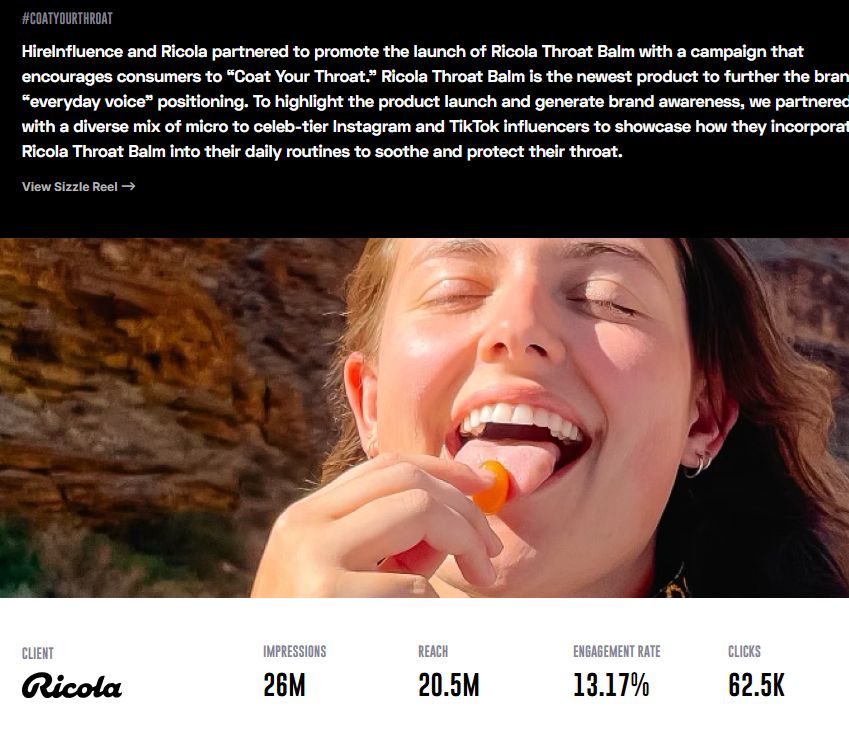
The Ricola #CoatYourThroat campaign demonstrates attribution at the purchase level. The program ran 18 influencers spanning micro to celebrity tier, generating 26 million impressions and a 13.17% engagement rate, with 62,500 retail purchase clicks tracked through MikMak integration. For an enterprise brand managing media budgets with CFO oversight, that direct line between creator content and retail behavior is the kind of measurement that justifies continued and expanding investment.
The Southwest Airlines #SouthwestSaysAloha program generated 56 million impressions and 3 million engagements from travel influencer content tied to new route launches. The MTV #MyMTVStyle TikTok campaign reached 16.1 million impressions at $0.01 cost per view — a CPV that compares favorably against almost any traditional media placement reaching an equivalent youth demographic. These results are not marketing estimates. They are documented outcomes from managed programs run end to end by HireInfluence for enterprise clients.
Building an Enterprise Influencer Media Program
Enterprise brands evaluating whether to build or expand an influencer media program face a set of questions that go beyond creator selection. The infrastructure questions are more consequential.
How does the program connect to existing marketing measurement systems? An enterprise influencer media program that produces a standalone PDF report separate from all other channel data is not operating as a media channel. It is operating as an experiment. The program has to feed into the same attribution and reporting frameworks that govern paid search, display, and social advertising.
How are usage rights managed at scale? Creator content that performs well organically is most valuable when amplified through paid channels. That amplification requires usage rights secured at the contracting stage. Enterprise programs running dozens of creators simultaneously cannot renegotiate rights after content is live without significant delay and added cost. HireInfluence structures commercial usage rights as a standard contract term on every engagement.
What is the compliance architecture? Enterprise brands in regulated categories — consumer health, financial services, food and beverage, automotive — face FTC compliance requirements that cannot be managed through a briefing call. Every creator posting on behalf of the brand needs disclosure language verified before content goes live. HireInfluence manages this in-house as part of the campaign workflow, which removes the compliance risk from the brand’s internal team while ensuring consistency across the entire creator roster.
For enterprise marketing teams ready to treat influencer as a managed media channel with the accountability standards that label demands, HireInfluence is the agency built for that program. The agency’s minimum engagement is approximately $100,000. To start the conversation about building an enterprise influencer media program, contact the team at hireinfluence.com/contact/ or review confirmed client work and results at the about page.