A live brand activation without influencers is a moment. A live brand activation with the right influencers is a content engine. The difference matters enormously for enterprise brands that are investing serious money in experiential marketing and need those activations to generate returns that extend well beyond the event itself.
Table of Contents
According to G2’s 2025 experiential marketing research, 74% of Fortune 1000 marketers expect to increase their experiential marketing spending this year. Within that, 46% of brands actively target media and influencers as a primary audience for their events. That figure is telling. The most sophisticated enterprise marketers are not just building experiences for consumers in the room. They are building experiences designed to be captured, shared, and amplified by creators whose audiences will never set foot at the event.
That is experiential influencer marketing. And most agencies can do one part of it well. Very few can do both.
What Experiential Influencer Marketing Actually Means
The term covers a range of activation types, but the underlying principle is consistent: bring influencers into a live, in-person brand experience and structure that experience so it generates social content that extends the campaign’s reach far beyond its physical footprint.
That might look like a product launch event where invited creators document the reveal and share it with their audiences in real time. It might be an on-site brand promotion at a major cultural moment, like a fashion week activation or a trade show presence, where influencers embedded in the experience give their followers an inside view. It might be a consumer-facing experiential installation designed to be discovered, experienced, and shared, with influencers seeded into the environment to generate the initial wave of content.
What all of these have in common is complexity. You are simultaneously producing a physical experience and managing an influencer campaign, and the two need to work together seamlessly. The event brief and the creative brief are the same brief. The on-site logistics and the content strategy are the same program. An agency that has never run an experiential activation will fumble the logistics. An agency that has never run an influencer campaign will fumble the content. You need an agency that has done both at enterprise scale.
HireInfluence offers experiential ideation, fulfillment, and on-site brand promotion as named services, alongside full-service influencer campaign management. That is not a common combination in this industry. See the full scope of HireInfluence’s campaign capabilities.
The imPress Nails NYFW Activation
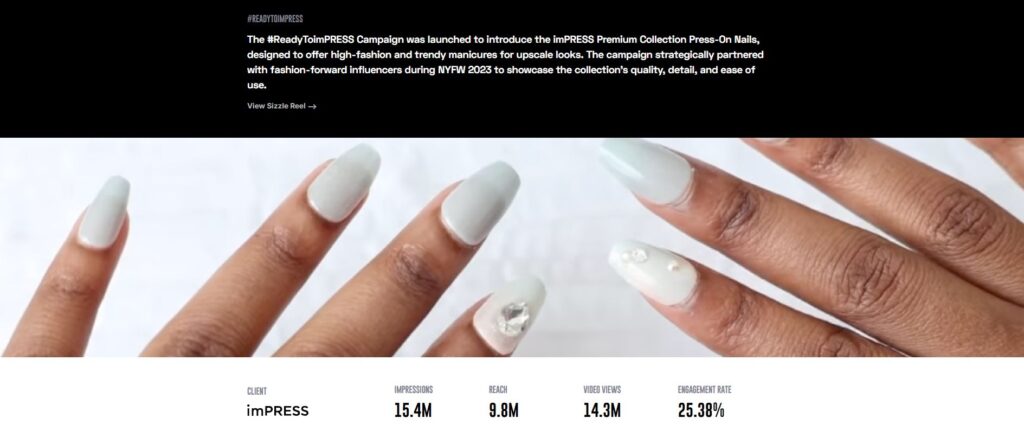
HireInfluence’s work with imPress Nails at New York Fashion Week is a direct example of how experiential and influencer work together when both are planned as a unified program.
The activation placed imPress Nails at one of the most photographed and creator-saturated events on the fashion calendar. HireInfluence partnered with luxury fashion influencers whose audiences aligned with the imPress brand identity, embedded them in the Fashion Week experience, and structured the activation around driving direct sales through creator content with clear calls to action back to the imPress website.
That kind of program requires knowing which creators belong at a Fashion Week activation, how to structure their involvement so the content feels native to the environment rather than staged, and how to tie the social output back to commercial outcomes. These are not problems you solve on the fly. They require deliberate campaign architecture built before anyone sets foot at the venue.
Why Most Events Leave Content on the Table
Enterprise brands spend significant budget on experiential marketing. Product launches, trade shows, pop-ups, brand anniversaries, partnership events, cultural sponsorships. The investment in producing a great live experience is real. The content return on that investment is often a fraction of what it could be.
The reasons vary but tend to cluster around a few consistent failures. Influencer selection is treated as an afterthought rather than a program input. Creators are invited to events without clear briefs, so what they post is unpredictable. There is no structure for how influencer content connects to the brand’s broader campaign objectives. The event happens, a handful of posts go up, and two weeks later the activation is forgotten by everyone who wasn’t in the room.
The brands that get maximum value from experiential influencer programs treat the influencer content strategy as a first-order concern, not a bonus on top of the event itself. That means selecting creators before the event is designed, briefing them with specific content objectives, building the physical activation around moments that will translate well to video and photo content, and having a plan for how the content gets amplified after the event through paid media, UGC repurposing, and owned channels.
HireInfluence’s paid media amplification capabilities mean the content generated at a live activation does not just live and die in a creator’s organic feed. High-performing influencer content from an event can be whitelisted and run as paid social, dramatically extending its reach and shelf life. See how HireInfluence approaches multi-service campaign integration.
Creator Selection for Experiential Work
Not every influencer who performs well in a standard campaign will perform well in an experiential context. Live activation requires a different creator profile.
Creators who work well in experiential settings tend to be comfortable producing content in uncontrolled environments, capable of generating engaging material without the setup time that studio-style content allows, and skilled at communicating brand experience rather than just product features. For premium or luxury activations, brand alignment matters more than it does in a standard digital campaign. A creator whose aesthetic, audience, and personal brand do not fit the activation environment will produce content that looks out of place, which undermines the activation’s impact regardless of their follower count.
For events with media or press components, the creator mix often needs to include both social influencers and traditional media personalities. Managing those two groups simultaneously, with different expectations, different deliverable structures, and different content rights considerations, adds another layer of operational complexity that an experienced agency handles as a matter of course.
HireInfluence’s talent sourcing and placement capabilities cover this full range. See the client results that reflect this work.
On-Site Logistics Are Not Optional
Running an influencer program at a live event requires logistical capabilities that most digital-only agencies do not have. Getting the right creators credentialed, briefed, and on-site at the right time is one layer. Ensuring the physical activation space is optimized for content creation, that lighting, staging, and flow support the content objectives rather than fighting against them, is another.
For brands running activations at venues they do not control, like trade show floors, fashion week venues, or sponsored cultural events, the constraints are real and require advance planning. The agency needs to understand the environment before the activation is designed, not after. HireInfluence’s experiential ideation and fulfillment service encompasses this production dimension, not just the influencer placement layer on top of it.
FTC compliance applies here exactly as it does in any other influencer context. Creators attending brand-hosted events and producing content about the experience are in a paid partnership context that requires proper disclosure. At scale, across many creators at a single activation, that compliance management needs to be systematic, not creator-dependent.
Measurement After the Event
One of the persistent challenges in experiential marketing is proving ROI. G2’s research found that 39% of marketers struggle specifically with demonstrating return on investment for experiential programs. Tying influencer content output from a live activation to commercial outcomes helps close that gap.
HireInfluence’s analytics capabilities build measurement infrastructure into every program, including experiential ones. That means tracked links in influencer content, dedicated landing pages tied to activation-specific calls to action, and aggregate reporting that connects the content generated at an event to downstream traffic, conversions, and revenue. See how HireInfluence approaches campaign analytics.
For enterprise brands that need to defend experiential marketing budgets internally, having real performance data tied to creator-amplified activation content is not a nice-to-have. It is how the program justifies itself.
What Enterprise Brands Should Look For
When evaluating an agency for experiential influencer work, a few specific questions are worth asking directly.
Have you produced live activations, not just influencer campaigns that happened at events? The distinction matters. Producing a physical brand experience is a different capability than attaching an influencer to someone else’s event.
How do you connect on-site influencer content to your paid media infrastructure? The content produced at a live activation should have a life beyond the creator’s organic post. If the agency cannot answer this question clearly, the program is leaving reach and performance on the table.
How do you manage creator logistics and compliance at live events? The answer should be specific and process-driven, not general.
HireInfluence’s minimum engagement is approximately $100,000. For enterprise brands planning product launches, cultural activations, on-site brand promotions, or any program where live experience and creator content need to work as a unified strategy, that investment level reflects what it actually takes to build a program that performs at scale.
To explore what an experiential influencer program looks like for your brand, contact HireInfluence here. For a full overview of HireInfluence’s campaign services, visit the campaigns page.