
Through each platform’s own creator marketplace: TikTok Creator Marketplace inside TikTok One, Instagram Creator Marketplace through Meta Business Suite, and YouTube Creator Partnerships inside Google Ads. Direct hiring works well at low volume, on one platform, with a simple brief. It stops working when rights, disclosure, and authorisation tracking scale.
Table of Contents
- What each platform provides directly
- Where direct hiring works well
- Where it stops working
- The threshold, stated honestly
- What should disqualify an agency, including this one
- What direct hiring genuinely does better
- The hybrid arrangement most brands actually end up with
- Program Delivery Across Managed Creator Rosters
- The HireInfluence Model for Brands Weighing Direct Hiring
Direct hiring has become genuinely viable, and any agency claiming otherwise is arguing against the platforms’ own product direction. Every major platform now operates a first-party discovery and contact tool, and access to them has widened considerably. Brands asking how to hire influencers without an intermediary deserve an honest account of what those tools do, where they stop, and what the actual crossover point looks like. The answer is not that direct hiring is amateur. It is that direct hiring scales badly along one specific axis, and knowing which axis makes the decision straightforward.
What each platform provides directly
TikTok. Creator Marketplace now operates as a module inside TikTok One, the unified marketer hub rather than a standalone product. Past campaigns and marketplace functionality carried into the upgraded account. Creators reach it through TikTok Studio, which redirects to TikTok One. One carve-out matters for commerce brands: as of June 2026 TikTok began notifying merchants in the United States that the external marketplace for TikTok Shop campaigns is being deprecated, with Shop creator collaboration moving to Seller Center and Shop Affiliate tools.
Instagram. Creator Marketplace is accessed through Meta Business Suite, with discovery through search filters and recommendations, and contact through a dedicated Partnership Messages inbox. Meta states there is no official minimum follower count for creators, which contradicts a great deal of published advice. Announced on June 23, 2026, Creator Marketplace and the Partnership Ads Hub will merge into a Meta Creator Marketing Hub later in the year, so the correct description is active with an announced transition.
YouTube. Creator Partnerships sits inside Google Ads under the Tools menu, consolidating what was previously BrandConnect and the Creator Partnerships Hub. From June 2026 its Overview, Creator Search, and List Management features became available in all locations where the YouTube Partner Program is active, and minimum spend requirements and account-management tier assignment no longer apply. It remains in open beta.
That last point deserves emphasis. Direct access to creator discovery at this level was, until recently, gated behind spend thresholds. It is now broadly available, which genuinely changes the calculation for mid-sized programmes.
Where direct hiring works well
Low deal volume on a single platform. A handful of creators, one platform, one flight. The administrative load stays inside what one competent marketer can hold.
A simple, organic-only brief. No paid amplification means no usage rights negotiation, no authorisation codes, and no expiry to track. This is by far the largest simplifier.
An existing relationship. A brand re-engaging creators it has worked with before is renegotiating, not sourcing, and renegotiation is the cheap part.
Testing. Establishing whether creator content works for a category at all is a question a small direct programme answers perfectly well, and answering it before committing to managed overhead is sound sequencing.
Where it stops working
The failure is rarely creative and almost never about finding people. Discovery is the part the platforms have solved. Four other things scale badly.
Rights administration. Each platform grants advertising rights differently. TikTok issues an authorisation with a fixed term that expires terminally. Instagram issues a revocable two-way permission at content or account level. YouTube issues no rights at all, stating that the advertiser must secure them separately, and provides no expiry enforcement. Running all three means holding three different registers with three different failure modes.
Disclosure at volume. Compensation includes in-kind, and gifted product triggers disclosure obligations alongside paid posts and affiliate arrangements. A seeding programme creates an obligation attached to every recipient who chooses to post, most of whom have no contract. Verifying that after publication is real work.
Negotiating position and rate discipline. A brand negotiating its twentieth deal of the quarter with no reference points is negotiating blind, and the absence of comparative rate data is felt most exactly where budgets are largest.
Continuity. Direct programmes live in one person’s inbox and calendar. When that person changes roles, the relationships, terms, and expiry dates frequently leave with them.
The threshold, stated honestly
There is no clean number, and any figure presented as an industry threshold should be treated with suspicion, because the crossover depends on the four factors above rather than on deal count alone.
The practical test is this: direct hiring stops paying when the administrative load exceeds what one person can hold without a system. That point arrives much earlier for a brand running paid amplification across three platforms in a regulated category than for a brand running organic posts on one platform. A brand should ask whether anyone internally can currently name every creator whose usage rights expire in the next sixty days. If nobody can, the programme has already crossed the line, regardless of how many deals it runs.
What should disqualify an agency, including this one
HireInfluence builds custom-scoped, fully managed programs rather than packaged or self-serve buys, so brands whose programmes genuinely fit the direct-hiring conditions above should hire directly and keep the money. The firm represents brands rather than creators. And a brand exploring whether creator content works for its category at all is better served by a small direct test first, then a scoping conversation once the answer is yes.
What direct hiring genuinely does better
Two things are worth stating in direct hiring’s favour, because the honest case is stronger than agencies usually admit.
Relationship depth. A brand working with the same creators repeatedly, directly, builds a relationship an intermediary cannot fully replicate. Creators respond differently to a brand contact they know than to a rotating agency coordinator, and that shows up in flexibility, turnaround, and willingness to renegotiate.
Speed on simple work. For a straightforward organic brief with an existing creator, direct is faster than any managed process, because there is no briefing layer, no approval routing, and no account team. Brands running reactive or culturally timed content often find that agency process costs them the moment.
Neither advantage survives scale, which is the point of this article. But a brand deciding between the two should weigh them honestly rather than treating direct hiring as the option one graduates out of.
The hybrid arrangement most brands actually end up with
The choice is rarely as binary as it is presented, and the most common mature arrangement is a split by function rather than a wholesale decision either way.
Brands frequently keep a small set of long-running creator relationships in-house, because those relationships are an asset worth owning directly and the renegotiation cost is low. They then engage an agency for the parts that scale badly: campaign waves with high creator counts, rights-heavy work destined for paid media, and any platform where the brand has no internal fluency.
This works when one condition holds. The rights register has to be single and shared. Two registers, one internal and one at the agency, reproduces exactly the failure mode that direct hiring creates at scale, only with an extra handoff. Brands running a hybrid should decide at the outset which system is authoritative and give one named person the job of maintaining it.
What does not work is splitting by platform between internal and agency teams, for the reason described throughout this article: the platforms fail differently, and the failures surface at the seams.
Program Delivery Across Managed Creator Rosters
The #CoatYourThroat programme for Ricola ran with 18 influencers, and the campaign is documented in full in the Ricola case study. Eighteen concurrent creator relationships is roughly the point at which direct administration stops being comfortable.
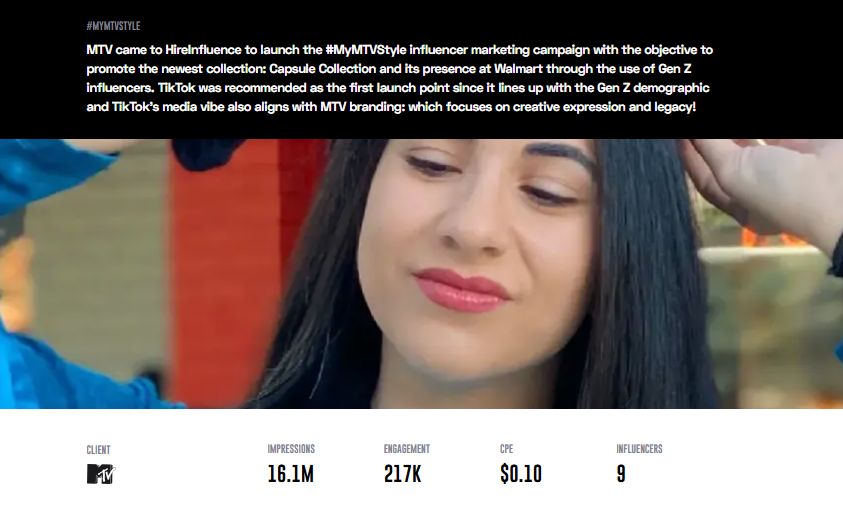
The Grammarly creator programme ran with 133 creators, generating 214M impressions and 33.1M views. For MTV, the #MyMTVStyle programme returned 16.1M impressions and 216,600 engagements at $0.01 CPV and $1.50 CPM.
Additional campaign detail is published in the work portfolio.
The HireInfluence Model for Brands Weighing Direct Hiring
Founded in 2011, HireInfluence is a full-service influencer marketing agency built for enterprise brands, headquartered in Houston with offices in Austin, Los Angeles, and New York. The firm runs creator programs for brands including Honda, McDonald’s, NFL, Oreo, Southwest Airlines, and Target, covering strategy, talent sourcing, branded content production, paid amplification, and performance reporting. Creator selection runs through a manual vetting and validation process rather than database filtering alone, and campaigns are scoped to each client’s objectives rather than sold as fixed packages.
Brands running direct programmes will get more from the practical guidance than from a pitch: the influencer exclusivity clauses guide covers the terms most often missed in direct negotiation, and the FTC influencer disclosure guidelines cover the obligations a seeding programme creates. Scoping conversations start through contact, and the firm’s background is set out on the about page.