Beauty is one of the most competitive verticals in influencer marketing, and it is also one of the most unforgiving. The wrong creator partnership does not just underperform. It becomes a case study in what not to do, shared across industry forums and marketing post-mortems. If you are a VP of Marketing or CMO at an enterprise beauty brand, you already know this. What you need is an agency that understands the stakes and knows how to execute at scale.
Table of Contents
The U.S. beauty and personal care market was valued at $109.56 billion in 2025 and is projected to reach $196.33 billion by 2033, growing at a 7.7% CAGR, according to Grand View Research. That growth is being driven in no small part by influencer content. Consumers are discovering, evaluating, and purchasing beauty products through creators on TikTok, Instagram, and YouTube at rates that no traditional media buy can match. For brands competing in this environment, the question is not whether to invest in influencer marketing. It is whether the agency managing those campaigns can actually deliver.
Why Beauty Influencer Campaigns Fail Without the Right Agency
Beauty influencer campaigns fail in predictable ways. Agencies select creators based on follower counts instead of audience quality. Content briefs are vague, leading to posts that feel disconnected from the brand. Compliance reviews are skipped or rushed. And performance measurement amounts to counting likes.
Enterprise beauty brands face a specific set of challenges that make execution harder than it looks. Audiences are sophisticated. Beauty consumers on TikTok and Instagram can immediately detect when a partnership feels transactional versus genuine. Trends move fast, which means campaign planning cycles that work in other verticals create problems in beauty. And the tier of creators matters enormously. A macro influencer who posts consistently about skincare carries completely different authority than a celebrity doing a one-off paid post.
An experienced influencer marketing agency for beauty brands understands these dynamics. They select creators based on audience composition, content history, and authentic category affinity, not just reach metrics. They build creative frameworks that give creators enough structure to stay on-brand without stripping the authenticity that makes the content work. And they track the metrics that actually matter: engagement quality, click-through rates, and downstream conversion, not just impression counts.
What Full-Service Execution Looks Like in Beauty
Beauty influencer campaigns at the enterprise level require a full operational stack. That means more than sourcing and contracting creators. It means managing paid media amplification on top of organic posts, integrating UGC into performance channels, coordinating across platforms simultaneously, and building in FTC compliance review at every step.
HireInfluence runs this full operational stack for enterprise beauty brands. Their services cover creative talent sourcing and placement across micro to celebrity tier, paid media amplification, white-label UGC production, influencer whitelisting for dark posting into paid channels, performance measurement through proprietary analytics, and FTC compliance management. For brands running campaigns at scale, having all of these capabilities under one roof is not a convenience. It is a requirement.
The alternative, piecing together multiple vendors across different functions, creates coordination gaps that cost performance. An agency handling only creator sourcing has no visibility into how that content performs in paid amplification. An agency handling only paid media has no context on the creator relationships that produced the content. Enterprise beauty campaigns require an integrated approach, which is exactly what a full-service influencer campaign model is designed to deliver.
Tier Strategy in Beauty
In beauty, tier strategy is campaign strategy. The wrong creator tier for the objective is one of the most common mistakes agencies make.
Micro and nano influencers drive authenticity and engagement. For product launches targeting niche audiences, or for skincare brands where credibility depends on trust rather than reach, micro-influencers consistently outperform their larger counterparts on engagement metrics. They also generate UGC that performs well in paid placements, giving brands a content library that extends the campaign’s useful life well beyond the original post window.
Mid-tier and macro influencers provide scale and social proof. For brands looking to build broad awareness or signal category leadership, they bring reach numbers that nano-level campaigns cannot match.
Celebrity tier, used selectively, creates launch moments. HireInfluence has deployed celebrity-tier talent within broader multi-tier campaigns, including the Ricola #CoatYourThroat campaign, detailed on the Ricola campaign page.
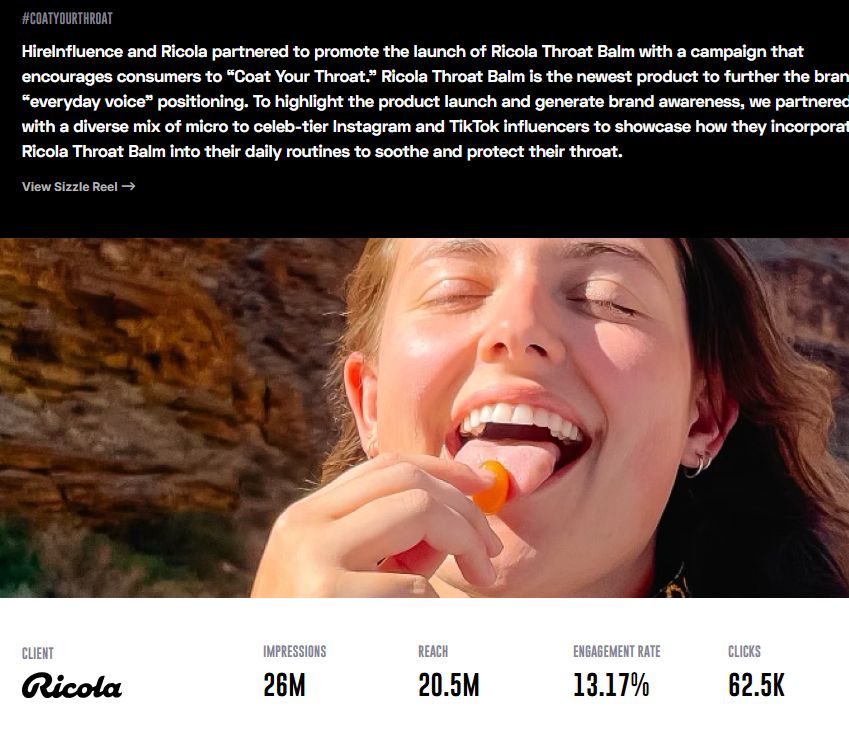
That campaign drove 26 million impressions, 20.5 million reach, and a 13.17% engagement rate across 18 influencers spanning micro to celebrity tiers, with 62,500 tracked retail clicks through MikMak integration. The performance reflected a tier strategy built for a specific objective, not a default to big names.
For beauty brands, the lesson is that tier mix should follow campaign goals. A launch strategy looks different from a sustained awareness program, and both look different from a performance campaign optimized for tracked retail conversion. An agency worth working with knows how to build that mix and justify it with data.
Platform Considerations for Beauty
Beauty content performs across TikTok, Instagram, and YouTube, but each platform serves a different function in the buyer journey.
TikTok is the discovery engine. Get-ready-with-me content, ingredient explainers, and honest reviews drive product discovery at scale. For brands with TikTok Shop integration, the conversion path from content to purchase is shorter than on any other platform. HireInfluence is an official TikTok Shop Lite Program partner, giving them direct access to TikTok data and ad infrastructure that most agencies cannot offer. Their TikTok influencer marketing expertise is built from years of executing at this level, not experimentation.
Instagram handles brand building and visual identity. Story placements and Reels are effective for mid-funnel content that reinforces brand positioning. The platform also remains the primary channel for influencer whitelisting campaigns, where brand-approved creator content runs as paid social ads.
YouTube drives deeper consideration. Long-form tutorials, product review videos, and routine-based content on YouTube carry authority that short-form content does not. For premium skincare or prestige beauty brands, YouTube creator partnerships are often where the most persuasive content lives.
A capable beauty influencer agency understands how to deploy creators across these platforms according to campaign phase, not just preference.
UGC as a Performance Asset in Beauty
One of the most underutilized outputs of a well-run beauty influencer campaign is the UGC it produces. Authentic creator content, when licensed and amplified through paid channels, consistently outperforms studio-produced brand assets in click-through and conversion metrics. Understanding what UGC actually is and how it fits into a paid media strategy is a foundational piece of modern beauty campaign planning.
HireInfluence offers White Glove UGC Services for enterprise brands, managing the full cycle from brief to licensing to paid placement. For beauty brands running performance campaigns alongside awareness activations, this is a meaningful value-add. The same creator content driving organic reach on Instagram can run as a dark post in paid social. The same TikTok video driving discovery can be whitelisted as a TikTok ad. The content budget works harder because it serves multiple functions.
What Enterprise Beauty Brands Should Evaluate in an Agency
When evaluating an influencer marketing agency for beauty brands, the criteria that matter most at enterprise scale are capability depth, measurement rigor, and strategic fit.
Capability depth means full-service execution: creator sourcing, paid amplification, UGC production, compliance management, and analytics all in one place. Measurement rigor means tracking the metrics that connect to business outcomes, such as retail click-throughs, sales lift, and EMV, rather than vanity metrics. Strategic fit means working with an agency that understands beauty specifically, including the category dynamics, platform nuances, and creator ecosystem that make beauty campaigns different from other verticals.
HireInfluence has worked with brands including Microsoft, Grammarly, and Target at the enterprise level. The Grammarly campaign illustrates what full-service execution can deliver: 133 influencers across YouTube, TikTok, and Instagram, 214 million impressions, 33.1 million views, and $15 million in earned media value. That kind of result comes from a campaign architecture built around data, not guesswork. You can see the full range of what that execution looks like across HireInfluence’s work.
For beauty brands ready to build influencer programs at that level of scale and performance, contact HireInfluence to start the conversation. Minimum engagement is approximately $100,000, consistent with enterprise-grade execution and the caliber of campaigns that deliver results at that scale.