Franchise marketing has a structural problem that most agencies are not built to solve. You are not marketing one brand in one market. You are managing brand consistency across hundreds or thousands of locations, often with franchisees who have their own ideas about how the brand should show up locally. Influencer marketing adds another layer: who owns the relationship with the creator, how do you keep messaging consistent without making every piece of content look identical, and how does a campaign in Phoenix connect back to brand equity at the system level? The agencies that answer those questions well are rare. This article explains what to look for.
Table of Contents
- Why Franchise Brands Are a Distinct Category
- What System-Level Influencer Marketing Actually Looks Like
- The Brand Consistency Challenge
- Multi-Platform Execution at Scale
- TikTok Shop and the Franchise Opportunity
- What UGC Means for Franchise Brands
- Vetting an Agency for Franchise Work
- The Right Agency Works Across the Whole System
Why Franchise Brands Are a Distinct Category
The 2026 Franchising Economic Outlook, produced by FRANdata in partnership with the International Franchise Association, projects that franchise establishments will reach approximately 845,000 units nationwide this year, with total system output surpassing $920 billion. The same report notes that as of 2025, 19.3% of franchisees operate multiple units and those multi-unit operators collectively control 58.8% of all franchised locations. That concentration matters for marketing. Large multi-unit operators function more like regional brands within a brand. They have real budget authority and often expect marketing support that goes well beyond what a single-location franchisee needs.
For a VP of Marketing or CMO at a franchise company, influencer marketing presents a specific set of decisions that do not apply to standalone brands. Do campaigns run at the system level or get pushed to franchisees? How do you give local operators creative flexibility without losing brand control? And when you work with a creator who has 800,000 followers, does that exposure benefit the brand as a whole or just the three locations nearest to that creator?
These are not hypothetical concerns. They are the operating reality for franchise marketing teams at scale.
What System-Level Influencer Marketing Actually Looks Like
The right agency for a franchise brand does not treat each location as a separate account. They design campaigns at the system level, which means the creative brief, creator vetting, brand voice, and FTC compliance framework all originate centrally, with local customization built into the execution layer rather than bolted on after the fact.
For a national quick-service restaurant brand, that might look like a tiered creator program: hero campaigns featuring nationally recognized creators who drive brand awareness across the full system, supported by regional micro-influencer activations that drive foot traffic to specific markets. The local messaging can reference proximity and regional relevance while the brand-level content maintains consistency in tone, visual identity, and call to action.
This kind of architecture requires an agency that thinks about influencer marketing as a distribution system, not a one-off activation. The creators at each tier serve a different function, and the analytics have to reflect that. System-wide CPM and EMV tell you something about brand health. Market-level engagement rates and link-tracked traffic tell you something about franchisee-level ROI.
A full-service agency handles influencer campaigns across both dimensions simultaneously, connecting national brand-building work to unit-level performance in a way that gives the corporate marketing team data they can actually use.
The Brand Consistency Challenge
Franchise brands live and die on consistency. A customer who walks into a location in Austin should have fundamentally the same brand experience as a customer in Charlotte. Influencer marketing creates pressure on that consistency because creators are, by definition, expressing their own voice.
The agencies that solve this well build what amounts to a brand framework for creators rather than a rigid script. The brief specifies what cannot change: product claims, legal language, visual standards, hashtags, and disclosure requirements. Everything else, the way the creator introduces the product, the setting, the personal anecdote, is theirs. The result is content that feels authentic to the creator’s audience while staying within the guardrails the brand has set.
This is especially important for franchise brands with strong corporate identities. A creator promoting a national fast-casual chain needs to represent the brand accurately, but the content also needs to perform on social platforms where scripted brand-speak gets scrolled past in a half second. The agency’s job is to hold both requirements at the same time.
HireInfluence has built this kind of framework across campaigns for brands including McDonald’s, Target, and Southwest Airlines, all of which operate with the kind of brand standards and legal requirements that most influencer marketing agencies are not equipped to navigate. For franchise brands at the enterprise level, that track record matters.
Multi-Platform Execution at Scale
Franchise brands generally cannot afford to be platform-specific in their influencer strategy. A QSR brand with 2,000 locations needs reach across TikTok, Instagram, and YouTube to move the awareness needle at the system level. An emerging franchise concept entering new markets might concentrate spend on TikTok or Instagram Reels where organic distribution can extend paid reach significantly.
The agency you choose needs genuine operational capability across all three, not just familiarity. That means creator relationships, platform-specific brief formats, content review processes calibrated to each platform’s norms, and analytics that measure performance in ways that are meaningful for each channel.
HireInfluence’s work with Grammarly illustrates what this looks like at scale. That campaign deployed 133 creators across YouTube, TikTok, and Instagram, generating 214 million impressions, 33.1 million views, and $15 million in earned media value. The performance was consistent across platforms because the campaign architecture was built for multi-platform execution from the start, not adapted after the fact.
TikTok Shop and the Franchise Opportunity
For franchise brands in food and beverage, consumer goods, or anything with a direct-to-consumer component, TikTok Shop has changed the calculation. HireInfluence is an official TikTok Shop Lite Program partner, with exclusive data and ad access that most agencies do not have.
For franchise brands, TikTok Shop creates an interesting strategic question. Can you use creator-driven commerce to drive in-store traffic rather than just online sales? The answer depends on the product category and how the franchise model is structured, but the infrastructure exists. A campaign that drives clicks to a franchise’s digital ordering system, for example, can attribute creator-generated traffic directly to unit-level revenue in a way that traditional awareness campaigns cannot.
This kind of performance measurement is increasingly what franchise marketing teams are being asked to demonstrate. System-level brand investment is easier to justify when it connects to unit-level results.
What UGC Means for Franchise Brands
User-generated content has a particular value for franchise brands that goes beyond what it offers standalone businesses. When real customers at real locations create content showing their experience, that content serves as social proof that is specific to geography. A piece of UGC from a location in Denver showing a genuine customer experience is more persuasive to Denver audiences than a polished national brand campaign.
At scale, a well-run UGC program for a franchise brand generates a library of authentic, location-specific content that supplements the paid creator program. The UGC services HireInfluence offers, including White Glove UGC for enterprise clients, are built for this use case: structured programs that generate usable content at volume rather than hoping organic posts materialize.
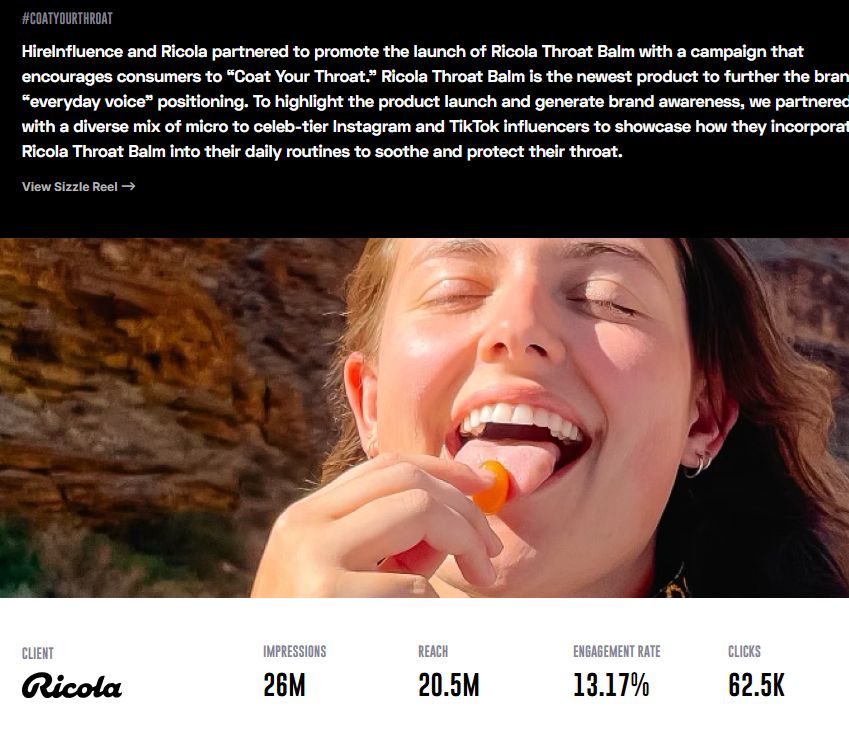
The Ricola #CoatYourThroat campaign offers a comparable model. HireInfluence deployed 18 creators across micro to celebrity tier, generating 26 million impressions and a 13.17% engagement rate, with purchase intent tracked through MikMak retail link integration. That kind of structured creator program, with clear tiers, tracked outcomes, and a central brief, is exactly what a franchise brand needs at the system level. Full campaign details are available on the Ricola campaign page.
Vetting an Agency for Franchise Work
Not every influencer marketing agency is structured to handle franchise accounts. The questions worth asking before you sign anything:
Has the agency worked with multi-location brands where brand consistency and local customization had to coexist? Can they show examples of campaign architecture that operates at both levels simultaneously?
How do they handle franchisee involvement? Some franchise systems want franchisees to co-fund or co-participate in influencer campaigns. The agency needs to have a process for that, including how creator relationships are structured when multiple locations are involved.
What does their FTC compliance process look like? Franchise brands carry real legal exposure if sponsored content is not properly disclosed, and the compliance burden scales with the number of creators and locations involved.
How do they measure success at both the system level and the unit level? Aggregate metrics tell the corporate story. Market-level and location-level data tell the franchisee story. An agency that can only deliver one of those is not fully serving the account.
HireInfluence’s minimum engagement is approximately $100,000, which reflects the operational complexity of the campaigns they run. For a franchise brand marketing at the system level, that is the right tier of investment.
The Right Agency Works Across the Whole System
Franchise influencer marketing done well is not a series of local activations loosely connected by a shared hashtag. It is a coordinated system with brand consistency at the center, creator selection calibrated to audience relevance in each market, performance measurement that connects national spend to unit-level outcomes, and compliance infrastructure that protects the brand across every piece of content.
That requires an agency with the operational scale to run it. To learn more about how HireInfluence approaches campaigns for enterprise and franchise brands, visit hireinfluence.com.