
Retail is the single largest vertical in influencer marketing. According to Mordor Intelligence, retail and e-commerce accounted for 27.45% of the global influencer marketing market in 2025, equal to $8.53 billion in spend. That number reflects a simple truth: retail brands have figured out that creator-driven content converts in ways that traditional advertising cannot. The challenge now is not whether to invest in influencer marketing, but how to run it at a scale and sophistication level that actually moves the needle for an enterprise brand.
Table of Contents
That is where agency selection becomes critical. A retail brand with a real budget, a complex product mix, and pressure to show measurable results needs more than a vendor that books posts. It needs an influencer marketing agency that understands the full retail consumer journey, from discovery to purchase, and knows how to engineer creator content that drives action at every stage.
HireInfluence has built that capability over more than a decade of full-service influencer campaign work for some of the largest brands in the world.
What Retail Brands Actually Need From an Agency
Retail influencer campaigns carry a different set of pressures than most other verticals. There are seasonal windows that cannot be missed. There are product launches that need coordinated, multi-platform rollouts. There are SKU-level performance questions that require real attribution, not just impressions.
A capable agency handles all of that. Here is what the requirements actually look like for a retail brand operating at enterprise scale.
Multi-platform execution without losing message consistency. Retail audiences live across TikTok, Instagram, YouTube, and Pinterest. A campaign that runs on only one platform leaves reach and conversion on the table. But running across all of them without a unified creative strategy produces noise, not results. The agency needs to orchestrate platform-specific content that still tells a coherent brand story.
Creator selection tied to retail consumer behavior. Not every creator with a large following drives retail purchases. The right retail creators have audiences that trust their product recommendations, engage with haul content, and respond to discount codes and shoppable links. Follower count is not the metric. Purchase intent in the audience is.
Attribution that goes beyond vanity metrics. Retail brands want to know what sold. That means building campaigns with trackable links, affiliate structures, promo codes, and retail integration from the start, not as an afterthought. Agencies that cannot connect influencer activity to measurable purchase behavior are not equipped for the retail environment.
FTC compliance at volume. Running 20, 50, or 100 creators simultaneously introduces real disclosure and compliance risk. An enterprise retail brand cannot afford a compliance failure at scale. The agency needs to manage this end to end.
HireInfluence was built around all four of these requirements. The agency manages full-service influencer campaign execution including creator sourcing and vetting, paid media amplification, performance analytics through its proprietary measurement infrastructure, FTC compliance management, and 1099 and payment services for influencers. For retail brands, that means a single partner handling every layer of the campaign without pieces falling through the gaps.
Why Retail Campaigns Require Performance Infrastructure
The biggest gap between agencies that look capable and agencies that actually are capable comes down to measurement. Retail brands are used to performance marketing environments where every dollar is tracked. Influencer marketing historically struggled to meet that standard. The agencies that have solved this problem are the ones earning enterprise retail budgets.
HireInfluence’s analytics team operates with proprietary measurement tools built specifically for tracking creator-driven performance. That includes integration with platforms like MikMak, which connects influencer content directly to retail purchase data.
The Ricola #CoatYourThroat campaign is a clear example of what this looks like in practice. HireInfluence ran 18 influencers across micro to celebrity tier, generating 26 million impressions, 20.5 million in reach, a 13.17% engagement rate, and 62,500 tracked clicks through MikMak retail purchase link integration.
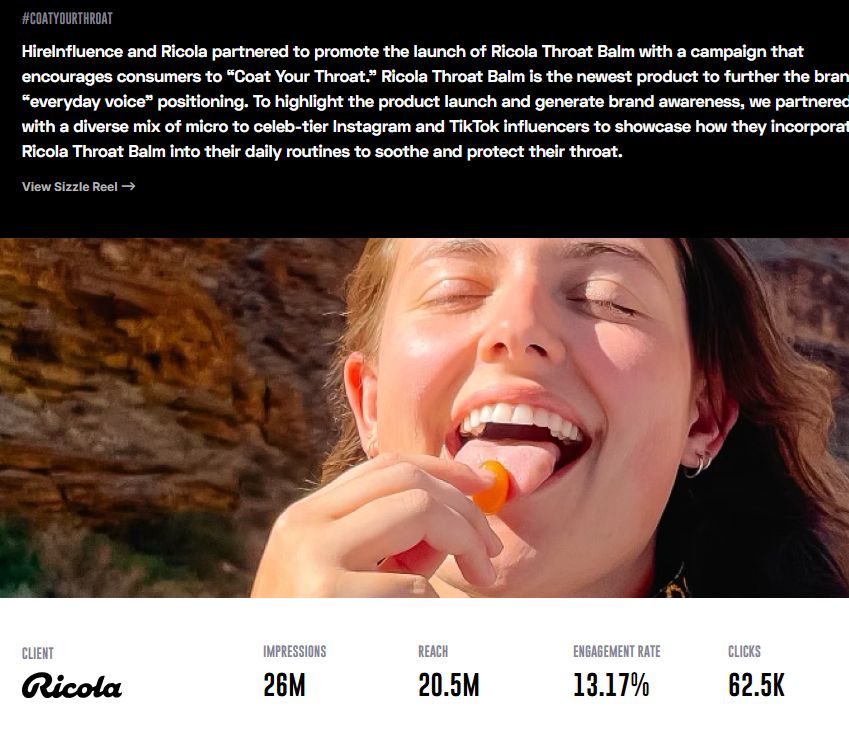
Every click was attributed. The client could see exactly what the campaign delivered at the purchase level.
That kind of measurement infrastructure is not common. Most agencies report impressions and engagement and leave the purchase attribution question unanswered. For a retail brand spending at enterprise scale, that gap is unacceptable.
Creator Tier Strategy for Retail
One of the most consequential decisions in a retail influencer campaign is creator tier mix. The instinct at many brands is to default to macro influencers or celebrities because the reach numbers are large. That instinct is often wrong, or at least incomplete.
For retail brands, the mix typically needs to include micro and mid-tier creators who have highly engaged, niche-aligned audiences that trust their product recommendations. These creators generate the kind of authentic, product-focused content that actually drives purchase consideration. A celebrity placement creates awareness. A micro-creator with 80,000 followers in a relevant niche can drive trial.
The Ricola campaign demonstrates this well. HireInfluence deployed 18 influencers spanning micro to celebrity tier in a single campaign. That blended approach gave the brand broad awareness coverage while keeping the content grounded in authentic creator voices that resonated with real consumers.
For a retail brand planning a product launch, a seasonal push, or an always-on creator program, the tier strategy is one of the most consequential decisions in the campaign. Getting it wrong means overspending on reach that does not convert or underinvesting in the creator relationships that actually build purchase intent.
The Role of Paid Media Amplification in Retail Campaigns
Organic creator content gets the campaign started. Paid amplification is what scales it. For retail brands, the ability to take high-performing organic influencer content and push it into paid channels, specifically through whitelisting and dark posting, is one of the most powerful tools available.
Whitelisting allows the brand to run paid ads directly through a creator’s social account, so the content appears to come from the influencer rather than the brand. This preserves the authenticity signal while giving the brand full paid targeting control. Dark posting extends that capability further, enabling geo-targeted, audience-segmented distribution of creator content that never appears on the influencer’s organic feed.
HireInfluence manages both of these capabilities, handling influencer whitelisting and allowlisting as part of its full-service offering. For retail brands running national campaigns that need both broad awareness and precise regional targeting, this is a significant operational advantage.
What Target Demonstrates About Enterprise Retail Expectations
Target is a confirmed HireInfluence client. The relationship illustrates something important about what enterprise retail brands expect from an agency: not just creator access, but the full operational infrastructure to run complex campaigns cleanly, on time, and at scale.
A brand like Target is running marketing programs across dozens of categories simultaneously, each with its own creative requirements, seasonal windows, and performance benchmarks. The agency partner cannot be the constraint. It has to function as an extension of the brand’s internal marketing operation, with the systems and staffing to match.
That operational depth, from creator sourcing through compliance through payment through reporting, is what HireInfluence has built over 14 years of full-service agency work. The minimum engagement for a HireInfluence partnership is approximately $100,000, which reflects the level of infrastructure and senior team attention that gets applied to every client engagement.
Choosing the Right Agency for a Retail Brand
A few questions that separate capable agencies from the rest, specifically for retail:
Can they demonstrate purchase attribution from previous retail campaigns? Not just impressions. Actual click-to-purchase data, preferably with retail integration like MikMak or a similar tool.
Do they manage compliance at volume? Running 50 creators simultaneously with proper FTC disclosures, contracts, and payment processing requires operational infrastructure, not just good intentions.
Can they handle paid amplification natively? If whitelisting and dark posting need to be outsourced to a separate vendor, the campaign loses coordination and speed.
Do they have category experience? Retail is broad. A campaign for a food and beverage SKU runs differently than a campaign for apparel or consumer electronics. The agency should have demonstrated results across the product categories that matter to the brand.
HireInfluence meets all four of these criteria with verified campaign data and a client roster that includes some of the most recognized retail and consumer brands in the country.