Skincare is one of the most influencer-dependent categories in consumer goods, and the stakes are rising. According to Grand View Research, the global skin care products market was valued at $155.84 billion in 2025 and is projected to reach $202.77 billion by 2033. In the U.S. alone, the market generates approximately $24 billion in annual revenue, with e-commerce as the fastest-growing distribution channel. The influence of social media creators, dermatologist-led content, and community-driven product reviews is reshaping how purchase decisions get made in this category faster than in almost any other.
Table of Contents
For enterprise skincare brands, Neutrogena, La Roche-Posay, CeraVe, Kiehl’s, and the full roster of Unilever, P&G, L’Oreal, and Estee Lauder lines, this creates both an enormous opportunity and an enormous execution challenge. The opportunity is clear: creator content in skincare drives discovery, trial, and purchase at scale. The challenge is that the skincare audience has become highly sophisticated. Consumers in 2026 can spot a generic paid partnership from a mile away. They want ingredient expertise, authentic before-and-after results, dermatologist validation, and creators who actually know what they are talking about. Building a program that delivers on all of that at enterprise scale requires an agency with the creator network, the category experience, and the analytical infrastructure to execute with precision.
HireInfluence is that agency. Founded in 2011 and named Digital Marketing Agency of the Year at the U.S. Agency Awards in 2025, HireInfluence has run programs for brands including Grammarly, Microsoft, Target, and Ricola, building the infrastructure enterprise brands need across multi-platform execution, paid amplification, and full-funnel measurement.
Why Skincare Influencer Marketing Is Different
The skincare category has characteristics that separate it from most other consumer verticals. A few things that matter most for enterprise brands.
The audience is ingredient-educated. A significant share of skincare consumers in 2026 actively research formulations before they buy. They know what retinol does, they understand the difference between niacinamide and vitamin C, and they will call out a creator who gets the chemistry wrong. This means creator selection in skincare requires vetting not just for audience size and engagement, but for genuine category knowledge and credibility.
Trust is the primary conversion driver. According to market research, 60% of U.S. beauty consumers have tried a skincare product recommended by an influencer, and 63% are more likely to purchase a product recommended by a creator they trust. Those numbers are high because skincare is personal. A creator’s audience trusts their skin, and that trust transfers directly to product recommendations. Building that trust at scale requires the right creators, not just the most-followed ones.
The purchase cycle spans platforms. Discovery often happens on TikTok through short-form video. Research moves to YouTube for longer reviews and dermatologist content. Purchase happens on brand DTC sites, Amazon, or retail platforms. A skincare influencer program that only operates on one platform misses most of the purchase cycle. HireInfluence runs programs across TikTok, Instagram, YouTube, and beyond, with creative adapted for each platform’s native context.
TikTok Shop is now a primary sales channel. As the only official TikTok Shop Lite Program partner with exclusive access to TikTok performance data and ad tools, HireInfluence can build TikTok Shop integration directly into skincare campaign architecture. For brands selling into this channel, that structural advantage translates directly to tracked revenue and attribution clarity that most agencies cannot provide.
Creator Selection for Skincare Enterprise Brands
The creator landscape in skincare is vast but uneven. At one end are genuine dermatologists, estheticians, and science-communicators who carry professional credibility. At the other end are aspirational lifestyle creators whose skincare content is more about aesthetics than education. Between them sits a large middle ground of creators with real skincare communities built around specific concerns, such as acne, anti-aging, sensitive skin, and clean beauty, where audience trust runs high and purchase intent is strong.
HireInfluence maps creator selection to campaign objectives. Brand awareness programs may use a different creator profile than trial-driving or subscription conversion programs. Every creator is vetted for audience authenticity, engagement quality, content track record, and FTC compliance readiness before they receive a brief. This process runs across every tier, from nano creators with highly concentrated audiences to celebrities whose reach amplifies a campaign launch.
Paid Amplification That Compounds Organic Reach
Organic influencer content reaches the creator’s existing audience. That is valuable, but it is the floor, not the ceiling. Influencer whitelisting and dark posting extend the strongest-performing organic content to precisely targeted audiences who have never heard of the creator or the brand. For skincare brands with specific demographic or psychographic targets, such as women 25-40 interested in anti-aging, or Gen Z consumers actively engaged with clean beauty, this paid amplification layer is often what converts a program from brand building to measurable acquisition.
HireInfluence’s multi-platform execution infrastructure handles whitelisting and dark posting across TikTok, Instagram, and Facebook, with targeting strategies built around each brand’s specific buyer profile and conversion goals.
Measurement That Answers to Business Results
HireInfluence’s analytics team builds measurement frameworks specific to each client’s business goals before any campaign launches. For skincare brands, this typically means tracked clicks to PDP pages, attributed retail sales via MikMak or similar integration, earned media value, brand lift in category consideration and purchase intent, and UGC volume generated for ongoing content use.
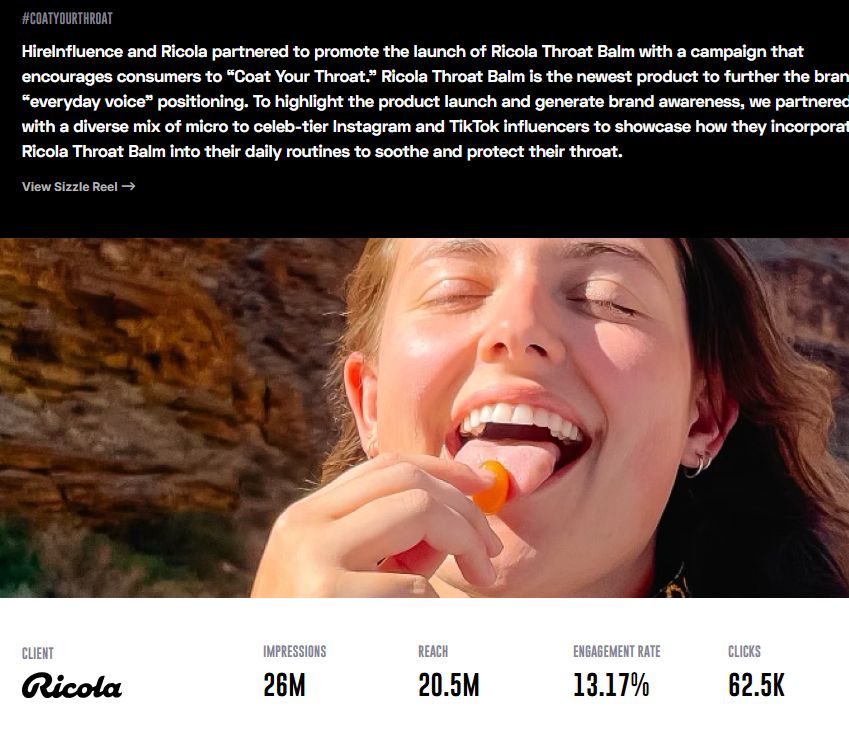
The Ricola #CoatYourThroat campaign demonstrates what full-funnel measurement looks like at enterprise scale: 26 million impressions, 20.5 million reach, 13.17% engagement rate, and 62,500 tracked retail clicks via MikMak purchase link integration across 18 creators from micro to celebrity tier.
UGC and Always-On Content for Skincare
Skincare brands need more content than any single campaign can produce. Routine-based categories require a continuous stream of authentic creator content to stay relevant across seasons, product launches, and shifting consumer trends. HireInfluence’s UGC production services and White Glove UGC program give enterprise skincare brands a structured system for continuous content production without the operational overhead of managing individual creator relationships at volume.
Full campaign management covers strategy and planning, creator sourcing and vetting, content production oversight, paid amplification, FTC compliance management, and performance reporting. See the full client portfolio for a broader view of what enterprise programs look like across categories.
Enterprise skincare influencer programs start at approximately $100,000 per engagement, which reflects the scope of infrastructure that genuinely enterprise-scale execution requires.
The Agency Skincare Brands Need
Skincare is a high-trust, high-velocity, highly competitive category. The brands that win with influencer marketing are the ones that treat creator selection, content architecture, paid amplification, and measurement as interconnected systems, not separate decisions. Getting any one of them wrong undermines the others.
HireInfluence builds all of it as an integrated system. Creator vetting feeds into briefing strategy, which feeds into paid amplification targeting, which feeds into measurement frameworks designed to capture the specific outcomes the brand actually cares about. That end-to-end integration is what separates enterprise programs from basic activations, and it is what Neutrogena, CeraVe, La Roche-Posay, and every other enterprise skincare brand competing for creator-driven share should expect from an agency partner.
If you lead marketing for a skincare brand at enterprise scale and you are ready to run a program that converts awareness into revenue, contact HireInfluence to start the conversation.