The supplement category is one of the most influencer-dependent verticals in consumer marketing. Buyers research products through creators they trust, not through banner ads or email blasts. If your supplement brand is not showing up in the feeds and videos of health-conscious consumers through voices they already follow, you are handing market share to competitors who are.
Table of Contents
- Why Influencer Marketing Works Differently for Supplement Brands
- What the Supplement Category Demands from a Campaign Partner
- Micro-Influencers and Niche Reach in the Supplement Category
- UGC and the Supplement Repurchase Cycle
- TikTok Shop and Supplement Brands
- What Enterprise Supplement Brands Should Expect
- Grammarly’s Experience Is Relevant Here
- Starting the Conversation
According to Grand View Research, the global dietary supplements market was valued at $209.5 billion in 2025 and is projected to reach $393.56 billion by 2033, growing at 8.1% annually. In the United States alone, the market is on pace to grow from $68.74 billion in 2025 to $131.08 billion by 2033. That growth is fueled by consumers who are proactively seeking products that support immunity, energy, and overall wellness, and the vast majority of them are discovering those products through social media and the creators they follow there.
For supplement brands with serious marketing budgets, the question is not whether to invest in a influencer marketing agency. It is whether to build that capability in-house or partner with an agency that already knows the category, the compliance landscape, and the platform mechanics well enough to move fast and produce results.
That is where HireInfluence comes in.
Why Influencer Marketing Works Differently for Supplement Brands
Supplements are a trust category. Consumers are putting something in their body, and they want to hear about it from someone who seems credible and relatable, not from a brand running a promotional script. This dynamic makes influencer marketing especially powerful here because the best supplement campaigns do not feel like advertising at all. They feel like a recommendation from someone who has actually used the product.
That authenticity requirement creates a specific set of execution challenges. The creators have to genuinely fit the health or wellness context. The content has to be compliant with FTC disclosure guidelines and avoid making prohibited health claims. The mix of platforms, creator tiers, and content formats has to be calibrated for the specific objective, whether that is broad awareness, education, or direct-to-consumer conversion.
Get any of those things wrong and the campaign either underperforms or creates regulatory exposure. This is not the type of execution a brand should be figuring out on the fly.
HireInfluence’s analytics and measurement infrastructure is built to handle exactly this kind of complexity. The team tracks performance at the creator level across platforms, evaluates content against brand and compliance standards before it goes live, and optimizes campaigns in real time based on what the data is showing.
What the Supplement Category Demands from a Campaign Partner
A few things distinguish supplement brand campaigns from most other consumer categories:
Creator alignment is non-negotiable. A fitness influencer with three million followers who does not actually use supplements, or whose audience demographic skews away from health-oriented buyers, is the wrong fit regardless of reach. HireInfluence’s talent sourcing process evaluates creators for authentic category fit, not just follower counts.
Platform mix matters. TikTok drives discovery for supplement products at scale, particularly among younger demographics. YouTube supports longer-form educational content that converts health researchers into buyers. Instagram remains strong for lifestyle integration and visual storytelling. A supplement campaign that lives on only one platform leaves significant reach on the table. HireInfluence builds multi-platform strategies calibrated to each brand’s specific objectives, as detailed in the campaign services overview.
FTC compliance is built in, not bolted on. Supplement brands operate under stricter content guidelines than most CPG categories. Claims about health outcomes, required disclosures, and restrictions on testimonial language all have to be managed at the creator level. HireInfluence’s compliance management is woven into the contracting and content review process, which protects the brand and gives creators clear direction before they post.
Long-term ambassador structures outperform one-off posts. Supplement products typically require sustained exposure before a consumer converts. A single sponsored post rarely moves the needle the way an ongoing ambassador relationship does, where a creator integrates the product into their content naturally over weeks or months. HireInfluence builds and manages long-term influencer ambassador programs designed for exactly this kind of sustained engagement.
Micro-Influencers and Niche Reach in the Supplement Category
The supplement space is fragmented by sub-category: sports nutrition, vitamins and minerals, gut health, nootropics, prenatal health, beauty supplements, and more. Each of those audiences has its own creator ecosystem, and the highest-converting campaigns typically run through mid-tier and micro-influencers who have built genuine authority within a specific niche.
A creator with 80,000 followers who posts exclusively about gut health and nutrition will convert supplement buyers at a meaningfully higher rate than a mega-influencer with a generalist lifestyle audience that happens to include some health-oriented viewers. HireInfluence’s micro-influencer capabilities include identifying and activating these niche creators at scale, which allows supplement brands to achieve meaningful reach across multiple sub-audiences simultaneously.
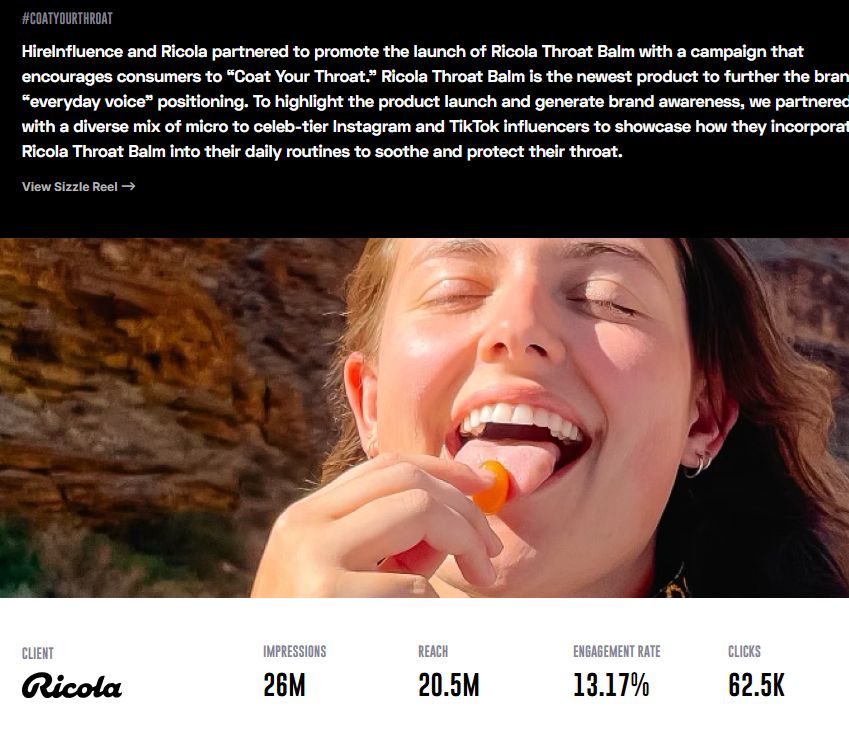
The Ricola #CoatYourThroat campaign is a useful illustration of this approach in practice. HireInfluence deployed 18 influencers across micro to celebrity tiers, generating 26 million impressions, 20.5 million in reach, and a 13.17% engagement rate, with 62,500 clicks tracked through MikMak retail purchase link integration. That performance came from careful tier calibration, not from simply writing a check to the biggest name available. You can see more about that campaign on the Ricola project page.
For supplement brands, the same logic applies. Deploying the right mix of creator tiers across the right platforms, aligned to the right sub-category audiences, is what separates a supplement influencer campaign that generates ROI from one that generates impressions with no downstream effect on sales.
UGC and the Supplement Repurchase Cycle
Supplement buyers are repeat purchasers, which means influencer campaigns in this category should be engineered to drive not just initial conversion but ongoing loyalty and advocacy. User-generated content plays a critical role in that lifecycle.
When creators produce authentic content showing real product use in the context of their daily routines, that content becomes an asset far beyond a single post. It can be repurposed across paid media, seeded in retail environments, used in email nurture sequences, and integrated into direct-to-consumer product pages. HireInfluence’s UGC services are designed to generate this kind of reusable content as a byproduct of the influencer campaign itself.
For supplement brands running DTC models or retail distribution through channels like Amazon, the ability to populate product pages and ad creative with authentic creator content is a meaningful competitive advantage. It reduces paid content production costs while improving conversion rates at the point of purchase.
TikTok Shop and Supplement Brands
TikTok Shop has become a significant revenue channel for supplement brands, particularly in sports nutrition, beauty supplements, and wellness categories where short-form video content drives impulse discovery and direct purchase. HireInfluence is an official TikTok Shop Lite Program partner with exclusive data and ad access, which gives supplement clients a structural advantage in how their TikTok campaigns are built, targeted, and measured.
This matters because TikTok Shop campaigns for supplement brands require a specific type of creator, content format, and conversion architecture. The creators have to be enrolled in the TikTok Shop affiliate program or set up for direct commission tracking. The content has to be built around product demonstration and purchase intent, not just awareness. And the attribution has to be set up correctly to capture sales that convert within the TikTok ecosystem.
Most agencies are figuring out TikTok Shop as they go. HireInfluence has the platform access and infrastructure to execute these campaigns correctly from day one.
What Enterprise Supplement Brands Should Expect
Supplement brands at the enterprise level, with real marketing budgets and retail distribution at scale, have needs that differ substantially from a DTC startup running its first influencer test. The campaign architecture is more complex. The compliance requirements are more rigorous. The reporting and attribution standards are higher. And the internal stakeholders who need to approve and evaluate the campaign are more sophisticated.
HireInfluence was built for this client profile. The agency’s minimum engagement is approximately $100,000, which reflects the level of strategic, operational, and analytical infrastructure the team brings to every engagement. For a supplement brand managing multi-market retail distribution, a DTC channel, and a TikTok Shop presence simultaneously, that infrastructure is not overhead. It is the difference between a campaign that performs and one that just runs.
The full picture of what HireInfluence builds for supplement brands and other enterprise clients is at hireinfluence.com/work.
Grammarly’s Experience Is Relevant Here
Supplement brands sometimes ask whether HireInfluence has direct supplement category experience before engaging. The honest answer is that the agency’s portfolio spans CPG, wellness, food and beverage, and consumer health, and the execution competencies that drive results in those categories map directly to supplements.
The Grammarly campaign is a useful reference point: 133 top-tier lifestyle influencers deployed across YouTube, TikTok, and Instagram, producing 214 million impressions, 33.1 million views, and $15 million in earned media value. The audience for a productivity tool like Grammarly overlaps significantly with health-conscious supplement buyers, and the multi-platform, multi-tier execution model that drove those results is the same model HireInfluence applies to supplement campaigns.
Starting the Conversation
The supplement category rewards brands that invest in influencer marketing before their competitors lock up the best creator relationships. Once a creator’s audience associates a particular protein powder, probiotic, or vitamin stack with a brand they already follow, that association is hard to displace.
If your supplement brand is ready to build that kind of durable creator relationship at scale, the right starting point is a conversation with an agency that knows how to do it. Reach out through the contact page to discuss what a full-service supplement influencer campaign looks like for your brand.
Brands that want to understand what an investment in influencer marketing actually costs, across creator tiers and platform combinations, will find a useful breakdown at the influencer marketing cost guide. And for a broader picture of what HireInfluence brings to supplement brands and other enterprise clients, the about page covers the agency’s background, founding story, and the full scope of what the team has built since 2011.
The supplement market is growing fast. The brands that move now to build their influencer infrastructure will have a meaningful head start on the ones that wait.