Wellness is no longer a niche category. According to McKinsey’s 2025 Future of Wellness research, the global consumer wellness market has reached $2 trillion, and Gen Z and millennials, while making up just 36% of the U.S. adult population, are driving more than 41% of annual wellness spend. Those consumers do not respond to traditional advertising the way previous generations did. They find brands through creators they follow, trust recommendations from influencers who share their values, and make purchase decisions based on authenticity signals that a television spot or banner ad simply cannot provide.
Table of Contents
- Why Wellness Is Different From Other Influencer Verticals
- The Creator Trust Problem in Wellness
- Multi-Platform Execution for Wellness Audiences
- Performance Infrastructure That Connects to Business Outcomes
- Paid Amplification and the Wellness Conversion Stack
- FTC Compliance at Volume
- What to Look For in a Wellness Influencer Agency
For wellness brands operating at enterprise scale, that shift creates a significant opportunity and a significant execution challenge. The opportunity is direct access to highly engaged, health-conscious audiences through creators who have already built the trust that brands spend years trying to earn. The challenge is running those programs with the rigor, compliance discipline, and performance infrastructure that a brand with real budget accountability actually requires.
That is the problem HireInfluence solves.
Why Wellness Is Different From Other Influencer Verticals
Wellness brand campaigns carry unique complexity that most agencies underestimate until they are already in the middle of a problem.
The trust stakes are higher. When a creator promotes a supplement, a fitness app, a mental health tool, or a personal care product, their audience is making decisions that affect their health. That means the creator selection process cannot be casual. Authenticity is not a nice-to-have in wellness, it is the entire value of the partnership. An audience can tell immediately when a creator does not actually use or believe in what they are promoting, and in wellness, that disconnect kills the campaign.
The compliance requirements are real. FTC disclosure obligations apply to every sponsored post, but wellness brands face additional scrutiny around health claims. A creator who overstates a product benefit or makes an unverified health claim puts the brand at legal and reputational risk. At scale, with dozens of creators posting across multiple platforms simultaneously, compliance management is an operational function, not something that can be handled with a quick briefing document.
The category breadth is wide. Wellness covers supplements, fitness, nutrition, personal care, sleep, mental health, weight management, and more. The creator landscape within each subcategory is distinct. The audience behaviors are different. The content formats that convert vary by platform and product type. An agency that has only run campaigns in one corner of wellness is not equipped to handle the full range of what an enterprise wellness brand actually needs.
HireInfluence has built its operations around all three of these realities. The agency manages creator sourcing and vetting, full-service campaign execution, FTC compliance management, paid media amplification, and proprietary performance analytics as part of every engagement.
The Creator Trust Problem in Wellness
McKinsey’s research highlights something worth sitting with: as the influencer economy grows, consumers are simultaneously becoming more skeptical of wellness endorsements and more reliant on trusted creators to navigate the space. They want social proof, but they can detect inauthenticity at a glance.
This creates a selection problem that many brands solve poorly. The instinct is to reach for the largest audience available, but in wellness, creator size is often inversely correlated with the trust signal that actually drives purchase behavior. A fitness creator with 2 million followers who posts a new supplement partnership every two weeks has diluted their credibility to the point where their audience tunes it out. A creator with 80,000 followers who has built a reputation around a specific wellness niche, who has consistently shared personal experience with the category, and who is selective about what they endorse carries far more conversion weight.
Getting this right requires expertise in creator evaluation that goes beyond follower counts and engagement rates. It requires understanding audience composition, historical partnership performance, content quality within the specific wellness subcategory, and the authenticity signal the creator has built over time.
HireInfluence’s creator sourcing and vetting process is built around exactly this kind of qualitative and quantitative evaluation. The agency identifies creators who can genuinely move the needle for a wellness brand, not just generate impressions.
Multi-Platform Execution for Wellness Audiences
Wellness audiences are not concentrated on a single platform. Supplement and nutrition content performs across Instagram, TikTok, and YouTube, with each platform serving a different stage of the consumer journey. TikTok drives discovery and impulse conversion for lower-consideration products. YouTube supports the longer-form educational content that higher-consideration wellness products often require. Instagram delivers visual brand building and community engagement that reinforces purchase decisions made elsewhere.
An enterprise wellness brand running a national campaign needs all three working in coordination, not as separate executions that happen to run at the same time. The creative strategy, messaging framework, and brand voice need to carry across platforms while the content format adapts to what each platform’s algorithm rewards.
HireInfluence manages multi-platform campaigns as an integrated operation. The agency handles everything from creator briefing and content approval through to scheduling, posting, and performance monitoring across TikTok, Instagram, YouTube, Facebook, and Pinterest. For wellness brands that need consistent messaging across a complex creator roster, that coordination function is not optional.
Performance Infrastructure That Connects to Business Outcomes
Wellness brands with serious budgets want to know what campaigns actually produce. Not reach and impressions, but downstream outcomes: website traffic, trial conversions, subscription sign-ups, and where applicable, tracked purchase behavior at retail.
This is where most agencies fall short. They report what the platforms give them, which is reach and engagement, and leave the attribution question unanswered. For a brand whose VP of Marketing is accountable to a CMO who is accountable to a CFO, that gap is untenable.
HireInfluence’s analytics team uses proprietary measurement tools built for campaign attribution. The Ricola #CoatYourThroat campaign demonstrates what this looks like in practice: 18 influencers deployed across micro to celebrity tier, generating 26 million impressions, 20.5 million in reach, a 13.17% engagement rate, and 62,500 tracked clicks through MikMak retail purchase link integration.
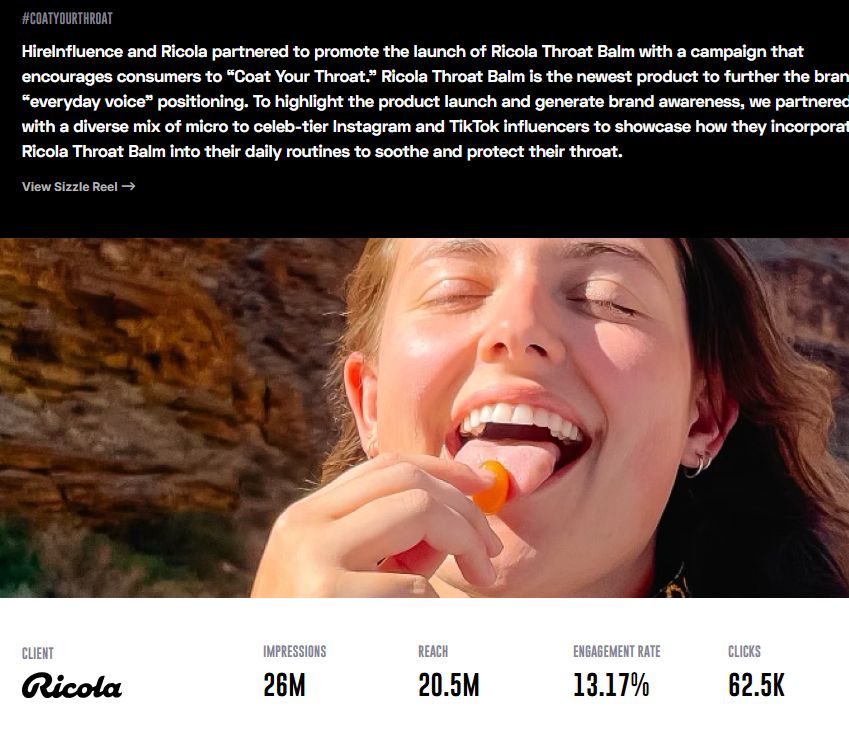
Every click was attributed. That is the standard HireInfluence applies to every engagement.
At a minimum engagement level of approximately $100,000, HireInfluence is structured for enterprise brands that need that level of accountability, not brands running experimental campaigns with no performance requirements.
Paid Amplification and the Wellness Conversion Stack
Organic creator content is the foundation of a wellness influencer program. Paid amplification is what scales it efficiently. For wellness brands, the combination of whitelisting and targeted paid distribution behind high-performing creator content is one of the most effective tools available.
Whitelisting allows the brand to run paid ads directly through a creator’s social account, preserving the authenticity signal of influencer content while giving the brand full targeting control. The content appears to come from the creator, not the brand, which maintains the trust dynamic that makes wellness influencer content effective in the first place.
HireInfluence manages influencer whitelisting and allowlisting as part of its full-service capability. For wellness brands that have identified creator content that converts and want to scale that content to new audiences, this is a significant performance multiplier.
FTC Compliance at Volume
Running 20 or 50 creators simultaneously across a wellness campaign without rigorous compliance management is a material risk. The FTC’s disclosure requirements are clear, but enforcement of those requirements in practice requires operational systems, not just good intentions.
Every post needs proper disclosure language. Every health claim in creator content needs to be reviewed against what the brand can actually support. Every contract needs to account for both the brand’s compliance requirements and the creator’s obligations. At volume, this is a full operational workflow.
HireInfluence manages FTC compliance as a core service, including 1099 and payment processing for influencers. For a wellness brand whose legal and marketing teams are already stretched, having a single agency partner handle compliance end to end removes a significant operational burden and a significant risk vector.
What to Look For in a Wellness Influencer Agency
A few questions worth asking before selecting a partner for an enterprise wellness campaign.
Do they understand the difference between wellness subcategories? A campaign for a supplement brand runs differently than one for a fitness app or a personal care line. The agency should demonstrate category knowledge, not generic influencer marketing knowledge.
Can they show performance attribution from past campaigns? Reach numbers are not enough. The agency should be able to point to tracked outcomes: clicks, conversions, or retail purchase data connected to specific creator activity.
Do they manage compliance in house? This is non-negotiable for wellness brands. FTC disclosure management, health claim review, and contract oversight should be internal capabilities, not something delegated to the brand or outsourced to a third party.
Are they equipped to run paid amplification natively? The best wellness campaigns integrate organic creator content with paid distribution from the start. If whitelisting and dark posting are treated as add-ons, the campaign loses coordination.
HireInfluence meets all four criteria. The agency has the category depth, performance infrastructure, compliance management, and paid amplification capability that wellness brands operating at enterprise scale actually need.