No U.S. city draws more visitors than Orlando. According to Visit Orlando’s official research data, the destination welcomed 75,333,800 visitors in 2024, comprising 68.84 million domestic and 6.49 million international travelers. Tourism generates nearly $92.5 billion in economic impact for Central Florida, supports 464,000 jobs, and contributes over 50% of all sales tax revenue in the region. The Orange County Convention Center set a new attendance record in 2024, hosting 172 events for a total of 1,744,329 attendees. For brands operating in this market, whether in theme parks, hospitality, food and beverage, entertainment, or conventions, that scale creates both a massive audience opportunity and a genuine marketing complexity. The influencer marketing services that perform here are not improvised. They are built.
Table of Contents
- What Makes Orlando a Distinct Influencer Marketing Market
- Theme Parks and Entertainment: The Content Opportunity
- Convention and B2B Influencer Marketing in Orlando
- Hospitality and Dining: Orlando’s Competitive Landscape
- TikTok and Orlando’s Visitor Content Economy
- UGC at Scale for Orlando Brands
- What to Look for in an Orlando Influencer Marketing Agency
What Makes Orlando a Distinct Influencer Marketing Market
Orlando is a city where the product is experience. Disney, Universal, and SeaWorld have built entire ecosystems around creating moments people want to document and share, and every visitor who walks through those gates arrives with a phone and a social feed. That organic content generation is real and valuable, but it is not a marketing strategy. The brands that win in this market do not leave creator programs to chance. They build deliberate campaigns that direct attention, shape narratives, and connect content to measurable outcomes.
The challenge is that Orlando’s audience is not static. Unlike cities where brands market primarily to a resident population, Orlando’s consumer base turns over constantly. A family visiting from Ohio this week will be replaced by a group from Brazil next week and convention attendees from across the country the week after. Influencer marketing in this context serves a pre-arrival function as much as an in-market one. The campaigns that drive the most value reach audiences while they are still planning, influencing hotel selection, dining decisions, and entertainment bookings before they book their flights.
That pre-arrival influence window is where national creator programs with genuine reach earn their keep. A creator with 400,000 followers documenting a Disney World trip reaches people who are dreaming about that trip, not just people who are already there. For Orlando brands across hospitality, theme parks, and entertainment, that reach is the primary value proposition of a well-run influencer program.
Theme Parks and Entertainment: The Content Opportunity
Walt Disney World, Universal Orlando Resort, and SeaWorld are among the most-photographed and most-shared destinations in the world. Content from these parks travels far beyond the people who produce it, and the brands that own the experiences have every incentive to shape how that content looks and what it communicates.
For entertainment and theme park brands, influencer marketing serves several distinct functions. Launch campaigns around new attractions use macro and mid-tier creators to build anticipation and drive intent among audiences who have not yet committed to a trip. Ongoing ambassador programs with creators who visit repeatedly build familiarity and trust over time. Seasonal and event-specific activations, tied to holiday programming, limited-time experiences, or major park milestones, use the urgency of a time-bound window to drive near-term booking decisions.
Each of these requires a different creator profile, a different brief, and a different measurement framework. Launch campaigns prioritize reach and awareness metrics. Ambassador programs prioritize engagement depth and audience loyalty. Event activations prioritize conversion signals: link clicks, booking inquiries, and ticket purchases.
HireInfluence’s campaign management infrastructure is built to handle this kind of segmented, multi-objective campaign architecture. The Grammarly program illustrates what coordinated multi-platform scale looks like: 133 creators across YouTube, TikTok, and Instagram, 214 million impressions, 33.1 million views, and $15 million in earned media value. For an Orlando entertainment brand running a major launch or seasonal activation, that kind of coordinated execution is the benchmark.
Convention and B2B Influencer Marketing in Orlando
The Orange County Convention Center is the second-largest convention facility in the United States, and its 2024 attendance record of more than 1.7 million event participants reflects how central the meetings and conventions industry has become to Orlando’s economy. For brands activating at major events here, whether in healthcare, technology, education, or any other sector that convenes in Orlando regularly, influencer marketing serves a specific and high-value function.
Pre-event creator content builds awareness and drives attendance among professionals still deciding whether to make the trip. On-site creator coverage extends the reach of whatever happens at the convention to audiences watching from home, generating earned media that outlasts the event itself. Post-event content captures the outcomes and announcements that give audiences reasons to engage after the fact.
HireInfluence has run campaigns for enterprise clients including Microsoft and Grammarly in categories with strong B2B and convention dimensions. The analytics infrastructure behind those programs, multi-platform performance tracking, creator-level data, and EMV measurement, translates directly to convention-focused campaigns where demonstrating ROI to internal stakeholders is as important as generating impressions.
Hospitality and Dining: Orlando’s Competitive Landscape
Orlando’s hospitality market is one of the most competitive in the country. Tens of thousands of hotel rooms, hundreds of restaurants, and a constant pipeline of new food and beverage concepts all compete for the attention of visitors who have more choices than they can process in a single trip. For hospitality and dining brands, influencer marketing is one of the most effective ways to cut through that noise.
The mechanism is familiar: a food creator with a highly engaged audience documenting a dining experience reaches people who trust their recommendations in a way that paid advertising rarely achieves. A travel influencer comparing hotel experiences on a Universal Orlando visit reaches families actively planning a similar trip. The content is native, credible, and reaches audiences at exactly the moment when brand consideration is highest.
What separates a program that produces these results from one that produces content without outcomes is the quality of creator selection and the specificity of the brief. An agency that selects creators based on audience alignment to the target customer, not just follower count or category, and builds briefs that give creators meaningful context without scripting away their authenticity, consistently outperforms one that treats creator selection as a volume exercise.
HireInfluence’s creator vetting and analytics capabilities are designed around this standard. For Orlando hospitality and dining brands, the goal is not just content. It is content that reaches the right audiences and moves them toward a reservation, a booking, or a visit.
TikTok and Orlando’s Visitor Content Economy
Orlando is one of the most TikTok-native travel markets in the country. Short-form video from theme parks, restaurants, and entertainment venues performs reliably well on the platform, and the discovery algorithm regularly surfaces Orlando content to audiences who have never engaged with it before. For brands in this market, TikTok is both the highest-reach awareness channel and the platform where organic and paid content intersect most productively.
HireInfluence is an official TikTok Shop Lite Program partner, with exclusive data and ad access that most agencies cannot access. For Orlando brands in food and beverage, retail, or any category with a direct commerce component, TikTok’s commerce infrastructure connects creator content to purchase decisions in ways that awareness-only campaigns do not.
The platform also supports a multi-format content strategy that suits Orlando’s diverse brand ecosystem well. TikTok drives discovery and reach. Instagram supports lifestyle positioning and destination aspiration. YouTube anchors deeper consideration content and evergreen search visibility. A well-coordinated program uses all three in proportion to the campaign objective, not just whichever platform is currently generating the most buzz.
UGC at Scale for Orlando Brands
Orlando generates an enormous volume of organic visitor content, and the brands being tagged in that content have an asset they often underutilize. A structured UGC program captures that organic enthusiasm, routes it through a quality and compliance review, and turns it into a library of authentic content the brand can deploy across paid and organic channels.
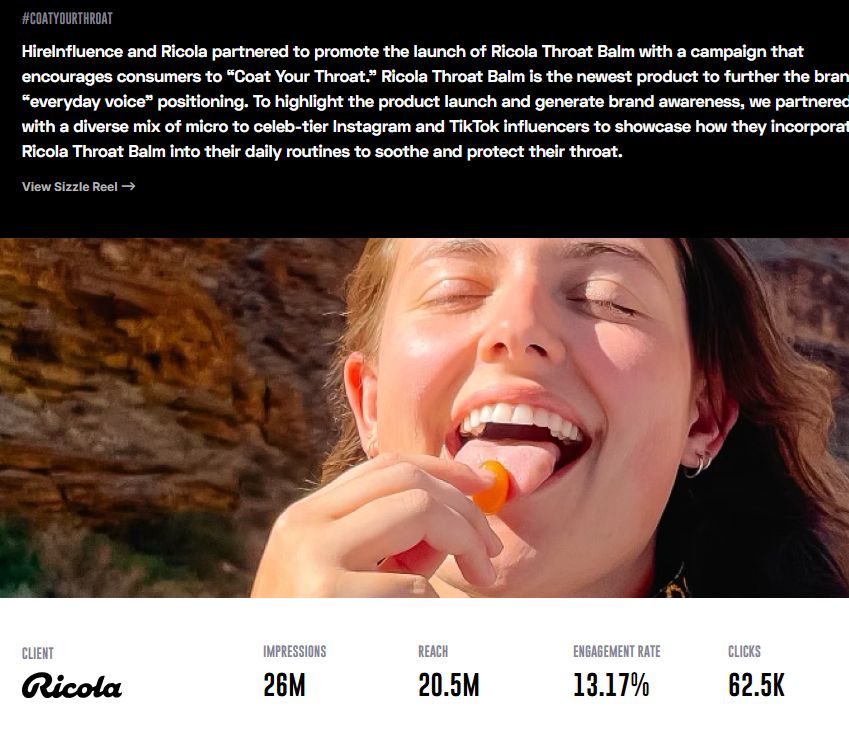
For theme park, hospitality, and entertainment brands operating at Orlando’s scale, this is not a small opportunity. The Ricola #CoatYourThroat campaign demonstrates the performance infrastructure HireInfluence brings to this kind of program: 18 creators spanning micro to celebrity tier, 26 million impressions, a 13.17% engagement rate, and 62,500 tracked clicks through MikMak retail link integration. Campaign details are on the Ricola project page.
HireInfluence’s UGC programs, including White Glove UGC for enterprise clients, are built to produce content pipelines that sustain ongoing campaigns rather than requiring brands to start from scratch with each new activation.
What to Look for in an Orlando Influencer Marketing Agency
Orlando brands evaluating agency partners should focus on a few specific questions. Does the agency have experience running campaigns tied to specific event windows or attraction launches, where timing matters as much as creative quality? Can they demonstrate multi-platform execution with the measurement infrastructure that connects content to bookings, ticket sales, or other conversion outcomes? Do they have the operational scale to run programs involving dozens of creators simultaneously without sacrificing brief quality or compliance oversight?
HireInfluence was founded in 2011 and has worked with enterprise clients including McDonald’s, Target, Southwest Airlines, and Microsoft. The minimum engagement is approximately $100,000, which reflects the operational depth that enterprise campaigns in complex, high-volume markets require.
For Orlando brands building or scaling an influencer program at the level this market demands, visit hireinfluence.com.