
Enterprise teams planning influencer marketing for food and beverage brands generally import a playbook built to create demand, and the category research says demand is not the variable in play. US retail food and beverage grew 2.2% in the first half of 2026, and growth is projected to settle into a 2-3% range in 2027. Volume growth was flat, as forecast. In Europe, sales through April grew 2.7% on 1.9% price and mix growth. Australia and New Zealand run above 5%, driven by inflation rather than appetite. The research names three forces shaping the shopper: pressured wallets, balanced living, and increasing algorithmic influence, and describes a market entering a sustained period of rationalization in which consumers are no longer simply trading down but becoming more intentional and efficient. Flat volume with positive dollar growth is a specific condition. It means nobody is eating more. It means the money moved.
Table of Contents
Why Flat Volume Changes What a Creator Program Can Do
The distinction between dollar growth and volume growth is the whole strategic content of this category right now, and marketing teams routinely read past it. Dollars rose. Units did not. That arithmetic has exactly one interpretation: the same quantity of food and drink left stores at a higher price and in a different mix. No brand in this condition is growing because more consumption is happening. Every brand that is growing is growing because it took a slot in a basket that another product used to occupy, or because it held a slot at a higher price than it used to command. Growth and demand are unrelated properties.
That reframes the creator program entirely, and it reframes it against the instinct most teams bring. A travel brand or an entertainment property runs creator work to make a person want something they were not previously planning. A food and beverage brand cannot do that, because the person is already going to the store, already buying from the category, and already has a slot allocated. The creator’s job is not to generate an appetite that did not exist. It is to be present, credibly, at the moment the shopper decides which specific item fills a slot they had already committed to filling. Demand creation is not available. Substitution is the only mechanism.
The rationalization finding makes this harder rather than easier, and it is where optimistic category planning tends to break. A shopper who is becoming more intentional and efficient is a shopper who has increased their resistance to exactly the kind of persuasion a creator program is built to deliver. They are optimizing pack size, weighing private label, and reducing waste. Those are deliberative behaviors, and a deliberative shopper is not moved by enthusiasm. They are moved by a reason, and the reason has to survive being thought about in an aisle, under time pressure, against a private-label alternative sitting directly beside it at a visibly lower price. That is a harder test than any brand campaign is usually built to pass. Creator content that reads as excitement will bounce off this shopper. Creator content that supplies a specific, checkable claim about what the product does or costs or replaces has something to work with.
The third named force, increasing algorithmic influence, is the one that makes creator work structurally necessary rather than merely useful. As discovery moves through recommendation surfaces and AI-assisted shopping, the brand’s own communication becomes a progressively smaller share of what a shopper encounters before deciding. What fills the gap is what other people have said. In a category where the purchase is habitual, low-consideration, and repeated weekly, the accumulated body of third-party speech about a product is not a campaign asset; it is the substrate the algorithmic surfaces are assembling from. A brand with nothing said about it is not merely unpersuasive. It is unretrievable.
The practical conclusion is unglamorous and it runs against how food and beverage creator budgets are usually deployed. Programs in this category are habitually built around launch moments, seasonal tentpoles, and campaign bursts, which is the architecture appropriate to demand creation. In a flat-volume market driven by mix, the useful architecture is continuous presence at low intensity, because the substitution decision is not made during a campaign window. It is made every week, by a shopper who is rationalizing, in a slot that gets refilled whether or not a brand happens to be in market that month. Always-on is not a fashionable preference here. It is what the purchase cycle actually looks like.
What Enterprise Brands Should Expect From a Food and Beverage Creator Partner
Program strategy and design. The agency has to build for the repeat purchase cycle rather than for a launch window, because in a flat-volume category the decision the program is trying to influence recurs weekly and does not wait for a campaign flight. That architecture belongs inside dedicated campaign services, where cadence can still be set against the purchase cycle rather than against a marketing calendar.
Creator sourcing and verification. The agency has to source creators whose audiences buy groceries in the brand’s actual footprint, since a national roster reaching a market where the product has no distribution generates demand that cannot be satisfied and measurement that cannot be read. Distribution-aware sourcing is a category-specific discipline that general influencer rosters do not apply.
Platform and commerce integration. The agency has to connect creator content to the retail environment where the substitution physically happens, because a food purchase overwhelmingly completes in a store or a grocery basket rather than on a brand site. Retail media adjacency and basket-level integration are the relevant paths, and they are structurally different from direct-to-consumer commerce.
Creative direction and content production. The agency has to direct creative toward a checkable reason rather than toward enthusiasm, since the rationalizing shopper the research describes is deliberating and deliberation defeats mood. The UGC overview covers how that supply gets built at the volume a weekly cycle requires.
Audience and segment-specific execution. The agency has to segment against the pressure the research identifies, because low- and middle-income shoppers pulling back on discretionary spend and premium shoppers holding are different problems requiring different arguments. A single message across that split will land as tone-deaf on one side and irrelevant on the other.
Cross-platform orchestration. The agency has to place content where food discovery actually happens rather than where the brand’s other marketing lives, since recipe, routine, and haul formats behave differently across surfaces. Reading across adjacent channels matters here, and the TikTok influencer marketing resource is useful on how one food-heavy surface operates.
Paid amplification. The agency has to amplify against distribution, because promoting a product into a market where a shopper cannot find it converts marketing budget into frustration. That geographic discipline runs through the specialties and services capability rather than being managed as a general reach buy.
Attribution and measurement. The agency has to measure against basket movement rather than against engagement, since the outcome that matters in a flat-volume category is whether a slot changed hands. That requires an analytics capability connected to retail data rather than to platform reporting, and most creator programs in this category have never been wired that way.
Program Delivery Across Food and Beverage Programs
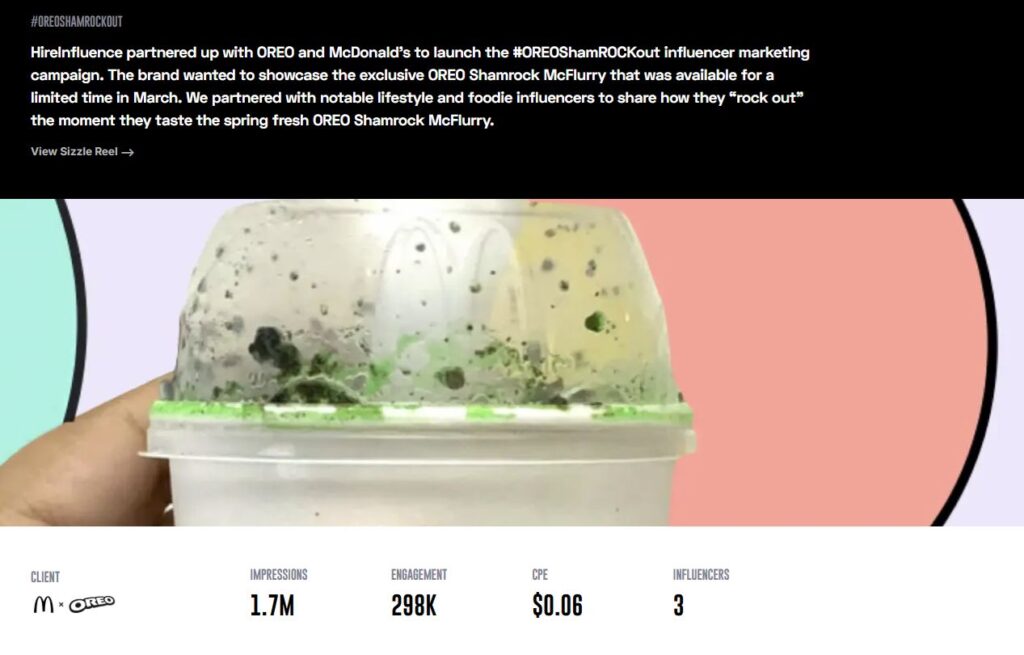
The Oreo and McDonald’s #OREOShamROCKout campaign is the reference case, having produced 1.7M impressions at a $0.06 cost per engagement, efficiency that comes from two food brands occupying an existing habit rather than trying to invent one. Southwest Airlines #SouthwestSaysAloha returned 56M impressions and 3M engagements.
The Grammarly creator program ran 133 creators to 214M impressions and 33.1M views. The MTV #MyMTVStyle activation delivered 16.1M impressions and 216,600 engagements at $0.01 CPV and a $1.50 CPM. The Ricola #CoatYourThroat program is the closest analogue to the category problem: 18 influencers from micro to celebrity tier, 26M impressions, 20.5M reach, a 13.17% engagement rate, and 62,500 MikMak retail clicks, which is the number that matters because it records a shopper moving toward a shelf rather than a viewer registering a message. The Ricola case study and the work portfolio document how that retail path was built.
How to Evaluate a Food and Beverage Creator Agency
First, ask how the program maps to the repeat purchase cycle. The agency should describe a cadence tied to how often the category is bought rather than to a campaign calendar, and a burst plan in a weekly category is a mismatch.
Second, ask how distribution constrains the roster. The agency should be able to explain which markets the creators reach and whether the product is on shelf there, because reach outside distribution is waste dressed as scale.
Third, ask what the creative reason is. The agency should be able to state the specific, checkable claim a rationalizing shopper is meant to act on, rather than describing a tone.
Fourth, ask how basket movement will be observed. The agency should propose a path to retail data rather than offering engagement as a proxy, and should be honest when that path does not exist.
Fifth, ask what continuous presence costs against a burst. The agency should price always-on honestly rather than presenting it as a cheaper tentpole; the cost of influencer marketing guide frames that comparison.
The HireInfluence Model for Food and Beverage Brands
HireInfluence has run enterprise influencer programs since 2011, with 25 or more people across 10 or more states and offices in Houston and The Woodlands, Austin, Los Angeles, and New York. Engagements begin at six figures, which reflects the verification and retail measurement infrastructure a substitution program requires rather than the volume of content shipped. The firm won Marketing Agency of the Year at the 2024 MUSE Creative Awards and Digital Marketing Agency of the Year at the 2026 U.S. Agency Awards, and has been a TikTok Shop Lite Program partner since July 2024, which matters in a category where discovery and purchase increasingly close on the same surface. Programs for Coca-Cola, McDonald’s, Oreo, Ricola, Grammarly, and Target have been built against habitual purchase rather than around launch moments. The contact page and the about section describe how engagements are structured.
Before founding the firm, Jason Pampell spent years managing content rights, licensing, and strategic media partnerships for Forbes and Billboard. A licensing desk learns to tell the difference between a property an audience loves and a property an audience will pay for at this price today, and the two conditions call for opposite work. Forbes and Billboard both had readers who would have said they valued the title and would not always buy the issue, and the desk’s discipline was knowing which of those two facts it was operating on. A flat-volume grocery aisle is the same distinction, made weekly, by someone with a budget.
The benchmark research makes the final case on its own terms. When dollars rise and volume does not, nobody is consuming more and every gain is a slot taken from someone else, which means the creator program is not building appetite and never was. When a shopper is deliberately rationalizing and the discovery surface is increasingly assembling what other people said, a food and beverage brand’s creator work is not a campaign that runs. It is the reason the brand is still in the basket when the slot gets refilled.