
Chicago is home to more Fortune 500 headquarters than almost any other US city, with a concentration of CPG, financial services, manufacturing, food and beverage, and industrial brands that anchor the Midwest economy. For those enterprise marketing teams, the question of what influencer marketing services should include has become significantly more urgent over the past eighteen months. According to the Interactive Advertising Bureau’s 2025 Creator Economy Ad Spend and Strategy Report, US creator ad spend is projected to reach $37 billion in 2025, up 26% year over year, growing about four times faster than the total media industry. Nearly half of the 450-plus advertising decision makers surveyed described creator content as a “must have,” and creator advertising now ranks as the third most important channel behind paid search and social media.
Table of Contents
The IAB data also reveals where the enterprise pressure sits: roughly one-third of advertisers cited finding the right creator as their biggest influencer marketing challenge, and brands are calling for clearer standards, better measurement, and tools to navigate an incredibly fragmented ecosystem. For Chicago-headquartered brands evaluating influencer marketing services, that fragmentation is the central operational problem. A retail brand headquartered in Chicago running a national creator program has to coordinate strategy, sourcing, creative, paid amplification, and attribution across a market that the IAB itself describes as lacking standardization. This guide breaks down what full-service delivery should include, how to evaluate services partners for Chicago-based enterprise programs, and what separates a services engagement built for this moment from one built for the experimental phase creator marketing has now left behind.
Why Chicago Enterprise Brands Face a Different Services Buying Decision
Chicago is not a creator capital the way Los Angeles or New York are. That matters less than it used to, because the creator economy has decentralized. Brands headquartered in Chicago now run national creator programs that draw from creator pools in every major US market, plus a significant local Chicago creator base that has grown alongside the city’s digital media and commerce sectors. What has not decentralized is the operational complexity of running those programs. The services partner coordinating a national program for a Chicago-based retail, CPG, or financial services brand has to navigate the same fragmentation the IAB identified, but from outside the coastal creator hubs where most agency capacity is concentrated.
That dynamic changes what “full-service” actually needs to mean. For Chicago brands, a services partner is valuable not because they sit in the city, but because they can execute at the scale and discipline that Chicago-headquartered enterprises require, anywhere the program needs to run. IAB’s finding that retail brands will spend $12.3 billion on creator advertising in 2025 (up 38% year over year and far ahead of every other vertical) puts the stakes in sharp relief for Chicago-based retail marketers. The services partner either has the infrastructure to deliver at that scale, or the program stalls at a fraction of its potential impact.
The IAB report also flagged that brands are rapidly reclassifying creator content alongside CTV and search, rather than treating it as an extension of social. That reclassification has operational consequences. Creator content is now being bought, amplified, measured, and optimized with the same rigor as other major media channels. For Chicago enterprise buyers accustomed to buying TV and search as managed services with full attribution, creator content without that infrastructure is no longer acceptable. A services partner has to deliver the same standard.
The Services Stack That Matches Enterprise Expectations
A credible full-service engagement for a Chicago-headquartered enterprise brand should cover eight operational capabilities, delivered by a coordinated program team rather than a single account manager coordinating across freelancers.
Strategy and objective definition. The engagement begins with business objectives, KPI frameworks, creator tier mix, platform selection, cadence, and measurement methodology. IAB’s data shows brand awareness remains the top creator marketing goal at 43%, followed closely by reaching new audiences at 41%, with online sales appearing as a top goal for 32% of advertisers. A strategy phase translates those objectives into specific program architecture. HireInfluence structures this through dedicated campaign services built for enterprise program delivery.
Creator sourcing across the tier spectrum. For Chicago brands running programs at national scale, sourcing has to cover the full creator tier range: nano, micro, mid, macro, and celebrity. The right mix depends on the specific campaign objective. A CPG brand driving trial on a new product often needs a broad nano and micro base to generate authentic consideration, paired with a smaller number of macro creators for reach. A retail brand running a seasonal campaign may skew toward mid and macro creators with direct commerce capability.
Vetting and brand safety review. The IAB data confirms that “finding the right creator” is the single biggest challenge for about a third of advertisers. Serious vetting includes fake follower detection, engagement authenticity review, past-content audits, political and category conflict screening, and audience demographic verification. For regulated categories including financial services, healthcare, and alcohol, vetting also has to include category-specific regulatory screening.
Creative direction and content production. Full-service delivery goes beyond brief delivery into active creative collaboration with creators, ensuring brand guidelines are honored while preserving the authentic voice that makes creator content effective. For enterprise brands repurposing creator content across paid and owned channels, the creative phase also has to plan for multi-format production and rights coverage.
Contracting and rights management. Enterprise legal review, usage rights structuring, exclusivity windows, approval workflows, and FTC-compliant disclosure language. Rights structure determines whether the content can be repurposed in paid social, retail media, CTV, and email later in the campaign lifecycle.
Paid media amplification. IAB’s data shows that creator content is now being bought and amplified with the same rigor as other paid media. A full-service partner runs paid amplification as a core service, not a separate vendor engagement. HireInfluence’s specialties service covers whitelisting, dark posting, paid media amplification, and multi-platform execution.
Attribution and measurement. The IAB report identifies advanced attribution, consistent reporting, creator discovery tools, and audience authentication as the top areas where brands are demanding improvement. A services partner that cannot deliver on attribution methodology cannot credibly serve an enterprise brand in 2026. HireInfluence’s analytics capability is built to close that measurement gap for enterprise programs.
Executive reporting. Reporting that translates creator activity into business outcomes for C-suite and cross-functional stakeholders. For Chicago-based enterprise marketers reporting to CFOs who are evaluating creator spend against paid search and CTV, reporting quality determines whether the program survives the next budget review.
What Enterprise-Scale Execution Actually Produces
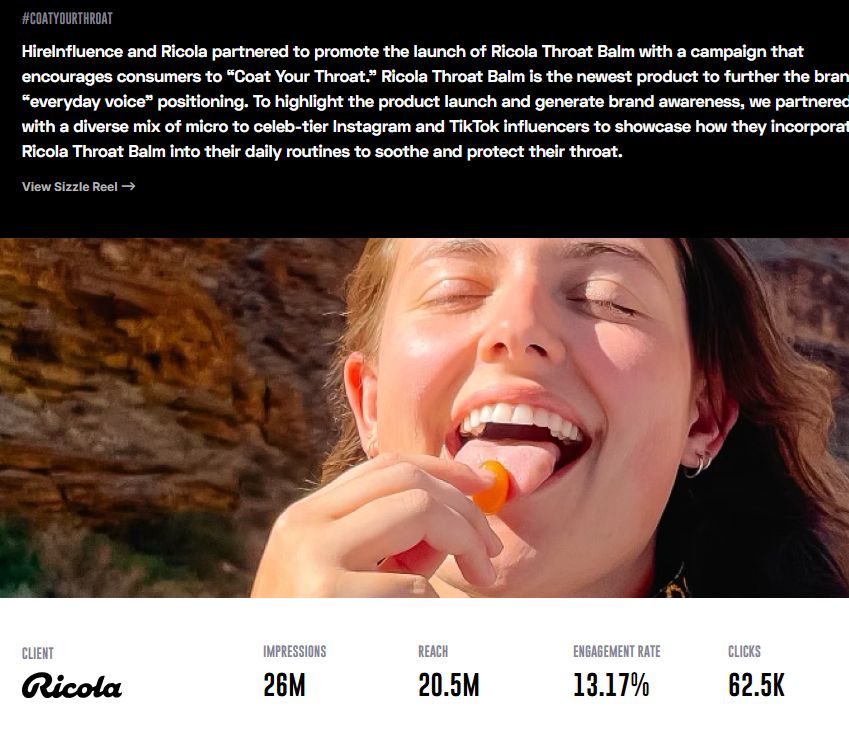
Chicago brands evaluating services partners should look at the specific campaigns that demonstrate what enterprise delivery looks like in practice. The Ricola #CoatYourThroat campaign is instructive for CPG marketers in particular. The program drove 26 million impressions, 20.5 million reach, a 13.17% engagement rate across 18 influencers spanning micro to celebrity tier, and 62,500 MikMak retail purchase clicks. For a Chicago-based CPG or food and beverage brand, that last number (retail purchase clicks tracked through commerce integration) is the kind of outcome that justifies continued investment. The Ricola case study documents the full campaign architecture.
The Grammarly program demonstrates scale. That engagement activated 133 creators across YouTube, TikTok, and Instagram, producing 214 million impressions, 33.1 million views, and $15 million in earned media value. For a technology or productivity brand based in Chicago running a national creator program, the Grammarly numbers set a benchmark for what full-service delivery can produce at scale.
The Oreo/McDonald’s #OREOShamROCKout campaign delivered 1.7 million impressions at a $0.06 CPE, which is the kind of efficiency that CFOs notice when comparing creator campaigns against other paid channels. The MTV #MyMTVStyle TikTok campaign generated 16.1 million impressions at $0.01 CPV and $1.50 CPM with 216,600 engagements. Those efficiency numbers are not accidents. They come from services engagements that coordinate creator selection, content strategy, and paid amplification with the same discipline applied to other media channels.
HireInfluence’s work portfolio is a useful reference point for Chicago brands trying to understand what enterprise-scale delivery produces across categories.
Evaluating a Services Partner From Chicago
The IAB data identifies the evaluation criteria that matter most. Five questions separate serious full-service partners from more limited offerings.
First, ask about attribution methodology in specific detail. UTMs, promo codes, pixel integration, conversion event tracking, retail commerce measurement. Generic answers about measurement capability are not answers.
Second, ask about the paid amplification capability. If creator content is being reclassified alongside CTV and search, the services partner has to run creator paid media as a core function, not an afterthought. The agency should describe specific platform amplification capabilities across Meta, TikTok, YouTube, and emerging platforms.
Third, ask about the creator network depth across tiers and categories. A partner running national programs for Chicago-based CPG, retail, financial services, and technology brands needs direct relationships across the full creator tier spectrum, not just a database subscription. IAB’s finding that one-third of advertisers cite creator discovery as their biggest challenge makes network depth a top evaluation criterion.
Fourth, ask about enterprise delivery capacity. Staffed program teams, dedicated account leadership, separate roles for strategy, sourcing, creative, paid media, and reporting. The services standard has moved beyond single-point coordination.
Fifth, ask for enterprise references in categories similar to the brand’s. Chicago-based CPG brands should talk to other CPG clients. Financial services brands should talk to financial services clients. Category-specific experience matters because regulatory and audience dynamics differ significantly across verticals.
The Services Partner Model for Chicago Enterprise Brands
HireInfluence serves Chicago-based enterprise brands as part of a national service delivery model. The agency operates from offices in Houston and The Woodlands, TX; Austin, TX; Los Angeles, CA; and New York, NY, and runs national creator programs for brands headquartered across major US markets including Chicago. That national footprint, combined with creator relationships built over more than a decade, positions the agency to deliver the kind of full-service engagement that Chicago enterprise programs require.
HireInfluence was founded in 2011 and is recognized as one of the first full-service influencer marketing agencies in the United States. Engagements typically start at approximately $100,000, reflecting the enterprise delivery standard. The client roster includes Microsoft, Southwest Airlines, Target, Coca-Cola, Walmart, Meta, McDonald’s, Oreo, Grammarly, Ricola, and MTV, a mix that spans the categories most concentrated in the Chicago economy. The agency has received recognition from the MUSE Creative Awards, Netty Awards, NYX Awards, Global Digital Excellence Awards, U.S. Agency Awards, and Vega Digital Awards across 2024 and 2026. The agency is also an exclusive TikTok Shop Lite Program partner since July 2024.
Jason Pampell, Founder and CEO, launched the company in 2011 and has led its growth into an award-winning partner for enterprise brands. His 30+ years of leadership experience in sales, marketing, and team building for Fortune 1000 organizations, combined with prior roles managing content rights and strategic media partnerships for Forbes and Billboard, shaped the full-service model the agency delivers today. The background on Jason’s approach informs how the agency structures enterprise engagements.
For Chicago-based enterprise brands ready to evaluate what a full-service engagement should look like, the HireInfluence team handles initial conversations directly. Brands benchmarking pricing should reference the cost of influencer marketing guide for context on enterprise-scale engagement costs. Those evaluating TikTok-heavy program structures should review the TikTok influencer marketing resource, and brands integrating creator content with broader UGC strategy should review the UGC overview for context on how those programs complement each other.
The IAB data is clear about where creator marketing sits in 2026: $37 billion in US ad spend, growing 4x faster than total media, classified alongside CTV and search rather than social, and demanding attribution and standardization that match those other mature channels. For Chicago enterprise brands, the services partner decision is whether to buy a program built for that standard, or continue working with vendors still operating under the experimental assumptions that defined creator marketing five years ago. The gap between those two options is where budget performance is going to separate in the next eighteen months.