
Dallas-Fort Worth is home to more Fortune 500 headquarters than every US metro except New York, Houston, and Chicago, with a concentration of enterprise marketing spend across retail, financial services, technology, airlines, telecommunications, healthcare, and consumer goods. For those enterprise marketing teams, the services buying decision around influencer marketing has shifted significantly. It is no longer a question of whether creator programs belong in the media mix. It is a question of which services partner can deliver the operational discipline that a national, enterprise-grade creator program now requires.
Table of Contents
- Why Dallas Enterprise Brands Face an Enterprise Services Decision
- The Full-Service Stack That Matches Dallas Enterprise Expectations
- What Enterprise Service Delivery Produces at Scale
- How Dallas Enterprise Brands Should Evaluate a Services Partner
- The Services Partner Model HireInfluence Delivers for Dallas Brands
The market data confirms why that services question has become the central concern. According to Fortune Business Insights, the global influencer marketing platform market was valued at $23.59 billion in 2025 and is projected to grow from $27.54 billion in 2026 to $89.90 billion by 2034, exhibiting a 15.90% compound annual growth rate. North America dominated the market with a 37.20% share in 2025, and the enterprise segment dominated the market with a 47.07% share in 2026. Fortune Business Insights attributes enterprise dominance to large brands increasingly adopting integrated influencer marketing solutions that consolidate analytics, content workflows, and campaign automation, enabling greater marketing agility and compliance across global marketplaces. That consolidation is the exact buying pattern Dallas-based enterprise marketers are now navigating.
This guide breaks down what full-service influencer marketing services should include for Dallas-based enterprise brands, what separates credible delivery partners from surface-level offerings, and how to evaluate the services engagement that will actually produce measurable outcomes at the scale Dallas enterprise programs require.
Why Dallas Enterprise Brands Face an Enterprise Services Decision
Fortune Business Insights’ data on the 47.07% enterprise market share reflects a specific operational reality: large brands are increasingly choosing to run creator programs through consolidated service partners rather than cobbling together freelance sourcing, platform licenses, content contractors, and paid media vendors. The reasons are operational and financial. Enterprise programs at national scale generate too many coordination points for a distributed vendor model to handle efficiently. Margin leaks at every handoff. Measurement gaps compound across vendors. Compliance exposure grows when contracting and content approval are managed by different parties. For Dallas-based retail, financial services, airlines, and telecommunications brands running creator programs at the scale their marketing budgets now support, consolidation under a single full-service partner has become the default enterprise model.
The growth trajectory Fortune Business Insights documents makes the stakes clear. A global influencer marketing platform market growing from $23.59 billion in 2025 to a projected $89.90 billion by 2034, with North America holding more than a third of that market, means enterprise buyers are investing at scale on the assumption that creator content will continue to outperform traditional paid media. Dallas enterprise marketers are making those bets alongside their peers in New York, LA, and Chicago. The services engagement has to match the scale of the commitment.
The Full-Service Stack That Matches Dallas Enterprise Expectations
A credible full-service engagement for a Dallas-based enterprise brand covers eight operational capabilities, delivered by a coordinated program team rather than a single point of coordination managing distributed vendors.
Program strategy and measurement design. Business objectives, KPI definition, creator tier and platform mix, campaign cadence, and attribution methodology defined up front. Fortune Business Insights identifies integrated analytics and campaign automation as a primary driver of enterprise platform adoption. The strategy phase has to design the measurement architecture that will run through the program. HireInfluence delivers this through dedicated campaign services built for enterprise program delivery.
Creator sourcing and tier-matched selection. Full-service sourcing covers the tier spectrum from nano to celebrity. For Dallas enterprise brands running national programs, the right mix depends on the specific campaign objective. A retail brand driving conversion during a promotional window may prioritize mid and macro creators. A financial services brand building consideration over a longer window may draw heavily from micro creators to reinforce authenticity. A telecommunications brand launching a new product may run a broad multi-tier program with integrated paid amplification.
Audience authenticity and brand safety vetting. Fake follower detection, engagement quality analysis, past-content screening, and category conflict review. For Dallas-based financial services and healthcare brands, vetting has to include category-specific compliance screening alongside standard brand safety review. A services partner without regulated-category experience will not build that vetting into the sourcing phase automatically.
Creative direction and content production. Full-service creative collaboration with creators, preserving authentic voice while ensuring brand guidelines are honored. For enterprise brands planning cross-channel repurposing, creative planning has to account for multi-format content production from the start.
Contracting and rights management. Enterprise-standard legal review, usage rights structuring across organic, paid, retail media, email, and CTV distribution, exclusivity windows, approval workflows, and FTC-compliant disclosure language. Rights structure at the contract phase determines whether content can be repurposed across channels or becomes legally unusable after the initial creator post.
Paid media amplification. Creator content as a paid media channel, not an organic-only engagement. Fortune Business Insights notes that enterprises are adopting integrated solutions that consolidate analytics, content workflows, and campaign automation. Paid amplification is one of the capabilities that consolidation is designed to solve. HireInfluence’s specialties capability covers whitelisting, dark posting, cross-platform paid amplification, and multi-platform execution across Meta, TikTok, YouTube, and emerging platforms.
Attribution and measurement. UTM infrastructure, promo code systems, pixel tracking, conversion event integration, and in some cases retail commerce measurement. HireInfluence’s analytics capability is designed to give enterprise clients the attribution data that Dallas finance and operations stakeholders require.
Executive reporting. Deliverables that translate creator activity into the business metrics Dallas enterprise leadership uses to evaluate other media investments. Cost-per-acquisition, revenue attribution, or measurable lift data have to be present in reporting. Impression and engagement metrics alone no longer clear the bar for enterprise program continuation.
What Enterprise Service Delivery Produces at Scale
Dallas brands evaluating services partners should look at campaigns that demonstrate what enterprise-scale delivery actually produces.
The Ricola #CoatYourThroat program drove 26 million impressions, 20.5 million reach, a 13.17% engagement rate across 18 influencers spanning micro to celebrity tier, and 62,500 MikMak retail purchase clicks. For Dallas-based retail, CPG, and food and beverage brands, the retail commerce attribution is the exact capability that Fortune Business Insights identifies as a primary driver of enterprise platform adoption. The Ricola case study documents the full campaign architecture.
The Grammarly program activated 133 creators across YouTube, TikTok, and Instagram, producing 214 million impressions, 33.1 million views, and $15 million in earned media value. For Dallas-based technology and enterprise software brands, the Grammarly numbers set a benchmark for what full-service delivery can produce at scale. Running 133 creators as a coordinated program, rather than 133 separate creator engagements, is the operational difference between a full-service stack and a distributed vendor model.
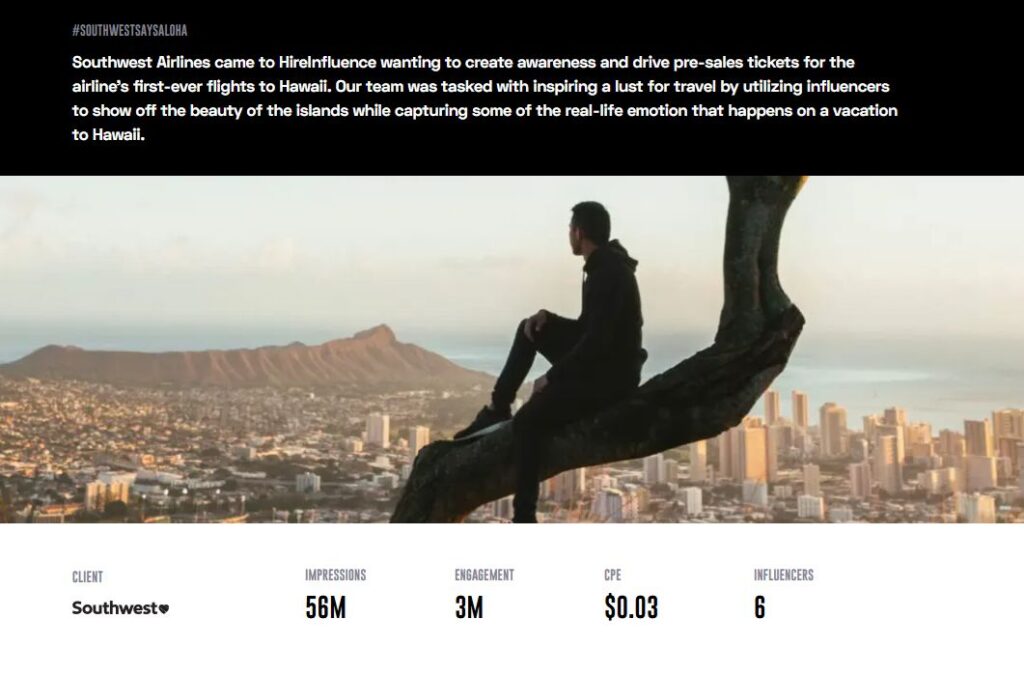
The Southwest Airlines #SouthwestSaysAloha campaign delivered 56 million impressions and 3 million engagements. For Dallas-based airline, travel, and hospitality brands, those numbers represent what national creator programs can produce when strategy, creative, and amplification are coordinated under a single services engagement. The MTV #MyMTVStyle TikTok campaign generated 16.1 million impressions at $0.01 CPV and $1.50 CPM, with 216,600 engagements, producing the kind of efficiency that enterprise finance teams use to benchmark creator spend against other paid media channels.
The Oreo/McDonald’s #OREOShamROCKout campaign delivered 1.7 million impressions at $0.06 CPE. The imPress Nails campaign at New York Fashion Week demonstrated a different dimension of enterprise delivery, with luxury-aligned creator selection and direct-to-website CTAs structured to convert moment-specific attention into purchase activity. The full HireInfluence work portfolio covers additional case examples across categories most relevant to Dallas enterprise buyers.
How Dallas Enterprise Brands Should Evaluate a Services Partner
Five questions separate credible full-service partners from surface-level offerings for Dallas enterprise buyers.
First, ask about the integrated services architecture. Fortune Business Insights identifies consolidation as the primary enterprise buying pattern. The partner should describe how strategy, sourcing, creative, contracting, paid media, and reporting function as a coordinated system, not as sequential handoffs.
Second, ask about attribution methodology in specific detail. UTMs, promo codes, pixel integration, conversion event tracking, retail commerce measurement. The services partner has to demonstrate measurement capability at the level that Dallas-based CFOs and CMOs require for continued program investment.
Third, ask about the paid amplification capability. Creator content that produces impressions organically but cannot scale through paid media is not enterprise-ready. The services partner has to run creator content as a paid media channel with the same discipline applied to other paid investments.
Fourth, ask about enterprise delivery capacity. Staffed program teams, dedicated account leadership, and separate roles for each service capability. Single-point coordination across freelancers and contractors does not meet the enterprise services standard.
Fifth, ask about category experience. Dallas enterprise brands in regulated categories (financial services, healthcare, pharmaceuticals, insurance) need partners with specific experience running creator programs under those compliance requirements. Partners without regulated-category experience will not build compliance into the program architecture from the start.
The Services Partner Model HireInfluence Delivers for Dallas Brands
HireInfluence serves Dallas-based enterprise brands through a national service delivery model anchored by offices in Houston and The Woodlands, TX; Austin, TX; Los Angeles, CA; and New York, NY. The Austin office specifically provides Texas-local delivery capability for Dallas brands that value a Texas-based services relationship alongside the national creator network depth the agency brings to enterprise engagements.
HireInfluence was founded in 2011 and is recognized as one of the first full-service influencer marketing agencies in the United States. Engagements typically start at approximately $100,000, aligning with the enterprise delivery standard. The client roster includes Microsoft, Southwest Airlines, Target, Coca-Cola, Walmart, Meta, McDonald’s, Oreo, Grammarly, Ricola, and MTV, a mix that spans categories heavily represented in the Dallas-Fort Worth enterprise economy. Award recognition across 2024 and 2026 includes the MUSE Creative Awards, Netty Awards, NYX Awards, Global Digital Excellence Awards, U.S. Agency Awards, and Vega Digital Awards. The agency is also an exclusive TikTok Shop Lite Program partner since July 2024, providing direct access to TikTok’s social commerce infrastructure for programs that require conversion-measurable delivery.
Jason Pampell, Founder and CEO, launched HireInfluence in 2011 after managing content rights and strategic media partnerships for Forbes and Billboard. His 30+ years of leadership experience in sales, marketing, and team building for Fortune 1000 organizations shaped the full-service model the agency delivers today. The background on the agency’s approach informs how the services model is structured for enterprise engagements.
For Dallas-based enterprise brands ready to evaluate what a full-service engagement should include, the HireInfluence team handles initial conversations directly. Brands benchmarking pricing should reference the cost of influencer marketing guide for context on enterprise-scale engagement costs. Those evaluating TikTok-focused program structures should review the TikTok influencer marketing resource, and brands integrating creator content with broader UGC strategy should review the UGC overview for context on how those capabilities work together within an enterprise engagement.
Fortune Business Insights’ projection that the influencer marketing platform market will grow from $23.59 billion in 2025 to $89.90 billion by 2034 is a clear signal of where enterprise investment is heading. Dallas enterprise brands are making those commitments alongside their peers in every other major US market, and the services partner decision is where the return on that investment will be determined. A program built on integrated services delivery will produce the measurable outcomes enterprise marketing now requires. A program assembled from distributed vendors will not. That gap is where Dallas enterprise marketing teams have to make the call that their creator budgets depend on.