
Houston is home to more Fortune 500 headquarters than almost any US city other than New York, with 24 Fortune 500 companies anchored in the metro area spanning energy, healthcare, technology, aerospace, and industrial sectors. For the marketing teams inside those enterprises, the evolution of influencer marketing from experimental channel to core growth function has reshaped what they expect from creator services. The 2026 data confirms the maturity shift. According to SharkPlatform’s Influencer Marketing Statistics 2026 report, the global influencer marketing industry reached $32.55 billion in 2025, with the broader influencer marketing platform market valued at $25.44 billion in 2024 and projected to reach $97.55 billion by 2030 at a 23.3% compound annual growth rate. Sprout Social data cited in the same report shows 86% of US marketers expected to partner with influencers in 2025, with 59% planning to partner with more influencers than the prior year.
Table of Contents
- Why Houston Enterprise Buyers Should Care About Services Quality
- The Services Stack a Houston Enterprise Brand Should Expect
- Houston-Specific Considerations for Enterprise Creator Programs
- Campaign Execution Examples That Set the Bar
- How to Evaluate a Services Partner From Houston
- The Services Model HireInfluence Delivers for Houston Brands
Those numbers matter for Houston enterprise buyers because they establish the scale at which creator programs now operate. A services engagement for a Houston-based energy, healthcare, or aerospace brand running a national creator program has to deliver enterprise-grade program infrastructure, not a handful of one-off influencer buys. This guide breaks down what influencer marketing services in Houston should include for enterprise brands, how to evaluate services partners at the scale Houston enterprises require, and what separates credible full-service delivery from surface-level offerings.
Why Houston Enterprise Buyers Should Care About Services Quality
Houston’s enterprise base is different from most other major US markets. Where LA and New York enterprise marketing is concentrated in media, entertainment, consumer goods, and financial services, Houston’s concentration tilts heavily toward energy, healthcare, industrial technology, and aerospace. Those sectors share a specific set of characteristics that shape what creator services need to deliver: heavy regulatory oversight, complex compliance requirements, long purchase cycles, technical audiences, and C-suite stakeholders who evaluate marketing spend against traditional ROI benchmarks rather than social media engagement metrics.
The SharkPlatform data identifies the broader market conditions that make services quality the deciding factor. The report highlights that adoption is still accelerating, with the platform and software layer growing rapidly as brands demand better influencer discovery, campaign management, and analytics. Sprout Social’s 2025 figures show 86% of US marketers partnering with influencers and 59% expanding partnerships year over year. But the SharkPlatform report also flags the fragmentation that every enterprise marketer navigating the channel has encountered. Creator content requires coordinated strategy, sourcing, vetting, contracting, amplification, and attribution. Running that coordination across multiple vendors produces margin leakage, execution gaps, and measurement inconsistencies that Houston enterprise finance teams will not tolerate at the scale creator budgets now operate.
The case for consolidating services under a single delivery partner is stronger for Houston-based enterprise brands than almost anywhere else. A brand running a program at national scale, with regulated-category compliance requirements, and with C-suite accountability for ROI, cannot operate a creator program as a collection of disconnected tactical buys. It needs a service stack designed for enterprise program delivery.
The Services Stack a Houston Enterprise Brand Should Expect
A credible full-service engagement covers eight operational capabilities. Each has to function in coordination with the others for the program to deliver on enterprise expectations.
Strategy and program architecture. The engagement begins with business objectives, KPI definition, creator tier and platform strategy, campaign cadence, and measurement methodology. For regulated categories heavily represented in Houston (healthcare, energy, financial services), strategy also has to account for category-specific compliance requirements from the first phase. HireInfluence structures strategy as the opening phase of every full-service campaign engagement.
Creator sourcing and tier selection. Enterprise programs draw from the full creator tier spectrum. The SharkPlatform data documents the broader shift toward nano and micro creators for authenticity, paired with strategic use of larger creators for reach. The right mix depends on campaign objective. For Houston enterprise brands, sourcing also has to include regulatory and category conflict screening from the initial discovery phase, not after creators are selected.
Audience authenticity and brand safety vetting. Fake follower detection, engagement authenticity analysis, past-content audits, political and category conflict screening. For Houston-based healthcare brands, vetting has to include compliance-specific screening against medical claim restrictions, prescription drug advertising rules, and content history that could create regulatory exposure.
Creative direction and content production oversight. Full-service partners collaborate with creators on content direction while preserving the authenticity that makes creator content effective. For enterprise brands repurposing content across multiple channels, creative planning also has to account for multi-format production and cross-channel adaptation from the start.
Contracting and rights management. Enterprise-standard legal review, usage rights structuring, exclusivity windows, approval workflows, and FTC-compliant disclosure language. Rights structure is especially consequential for enterprise programs that plan to run creator content in paid social, retail media, email, and CTV. HireInfluence handles this layer across enterprise engagements as part of the integrated service model.
Paid media amplification. Creator content as a paid media channel, not an organic-only engagement. The specialties and services capability at HireInfluence covers whitelisting, dark posting, cross-platform paid amplification, and multi-platform execution across TikTok, Instagram, YouTube, and emerging platforms.
Attribution and measurement infrastructure. UTM frameworks, promo code systems, pixel integration, conversion event tracking, and in some cases retail commerce integration. The analytics service at HireInfluence is structured to give enterprise clients the attribution detail that Houston-based finance and operations stakeholders require to approve continued creator investment.
Executive reporting. Deliverables that translate creator activity into the business metrics Houston enterprise leadership uses to evaluate other major media investments. Impression, engagement, and EMV reports alone are not sufficient. Enterprise reporting has to show cost-per-acquisition, revenue attribution, or measurable lift.
Houston-Specific Considerations for Enterprise Creator Programs
The concentration of regulated-category enterprises in Houston changes what the services partner has to deliver. A Houston-based healthcare brand running a creator program has compliance requirements that a standard consumer goods program does not. Medical claim restrictions, prescription advertising rules, and FDA regulatory oversight all apply to creator content the same way they apply to any other advertising channel. The services partner has to build compliance review into every phase of the program, from initial creative brief through final content approval.
The same logic applies to Houston-based energy companies running programs focused on sustainability, technology innovation, or consumer-facing initiatives. Creator content in those categories attracts more scrutiny than consumer goods content. The services partner has to vet creators for past content that could create brand conflict, manage messaging to stay within defensible claims, and structure rights agreements that allow the brand to pull content quickly if regulatory conditions change.
For Houston-based industrial and aerospace brands, the creator program often has to balance consumer-facing content (for recruitment, brand perception, and employer positioning) with B2B content (for technical audiences and decision-maker influence). Those two use cases require different creator pools, different platform mixes, and different content approaches. A services partner with experience across both B2B and B2C creator marketing can run them as integrated programs. Partners with only one side of that experience cannot.
Campaign Execution Examples That Set the Bar
Houston enterprise brands evaluating services partners should look at campaigns that demonstrate what enterprise-scale delivery produces across complex programs.
The Ricola #CoatYourThroat program drove 26 million impressions, 20.5 million reach, a 13.17% engagement rate across 18 influencers spanning micro to celebrity tier, and 62,500 MikMak retail purchase clicks. The retail attribution piece is what matters for Houston enterprise marketers evaluating programs that need to connect creator content to commerce outcomes. The Ricola case study shows the full campaign architecture.
The Grammarly engagement activated 133 creators across YouTube, TikTok, and Instagram, producing 214 million impressions, 33.1 million views, and $15 million in earned media value. A 133-creator program at that scale cannot be run without the complete service stack operating in coordination. It is the kind of engagement that Houston-based technology and enterprise SaaS marketers should benchmark when evaluating services capacity.
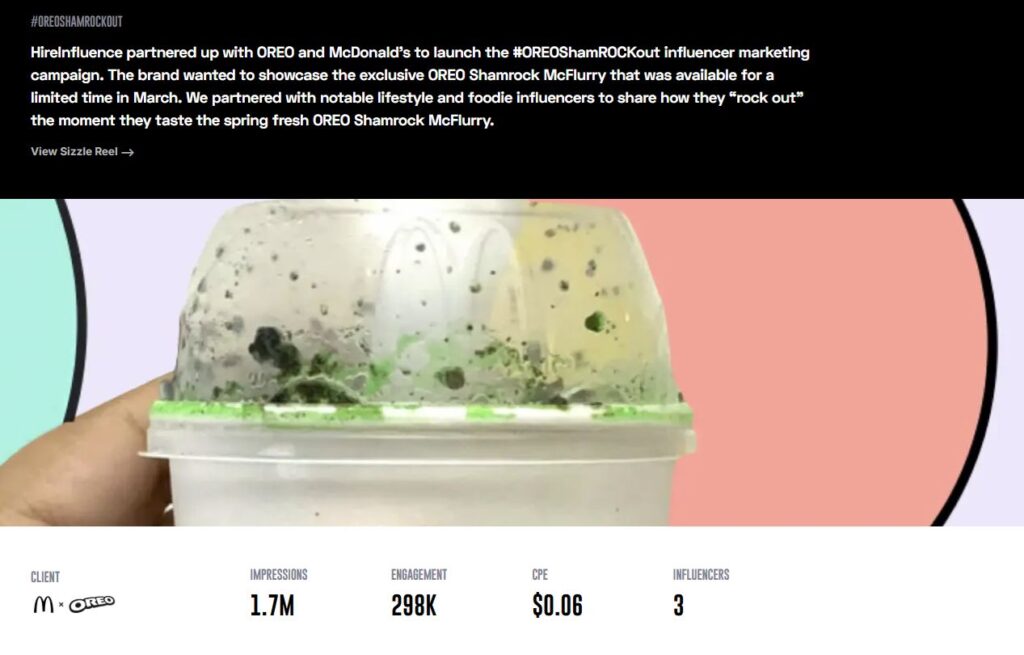
The Oreo/McDonald’s #OREOShamROCKout campaign delivered 1.7 million impressions at $0.06 CPE. The MTV #MyMTVStyle TikTok campaign generated 16.1 million impressions at $0.01 CPV and $1.50 CPM with 216,600 engagements. Those efficiency numbers are what enterprise finance teams compare against other media channels. They are also the kind of numbers that only come from services engagements disciplined enough to optimize across creative, targeting, and amplification in real time.
The Southwest Airlines #SouthwestSaysAloha campaign drove 56 million impressions and 3 million engagements. For Houston-based travel, hospitality, and consumer brands, the Southwest numbers demonstrate what national-scale creator programs can produce when the services partner has enterprise-grade infrastructure. The full HireInfluence work portfolio covers additional case examples across the categories most relevant to Houston enterprise buyers.
How to Evaluate a Services Partner From Houston
Five questions separate serious full-service partners from surface-level offerings for Houston enterprise buyers.
First, ask about category experience in regulated industries. Healthcare, energy, financial services, and pharmaceuticals all have compliance requirements that significantly shape creator program execution. A partner that has not run programs in regulated categories will not know how to structure compliance review into the program architecture.
Second, ask about attribution methodology in specific detail. UTMs, promo codes, pixel tracking, conversion event integration, retail measurement. The SharkPlatform data confirms attribution is the area where enterprise buyers are demanding the most improvement.
Third, ask about the paid amplification capability. Creator content that performs in organic-only contexts but cannot scale through paid media is not enterprise-ready. The services partner has to run creator content as a paid media channel across Meta, TikTok, YouTube, and emerging platforms.
Fourth, ask about enterprise delivery capacity. Staffed program teams, dedicated account leadership, and separate roles for strategy, sourcing, creative, contracts, paid media, and reporting. The services standard has moved past single-point coordination.
Fifth, ask about reporting format. The deliverables should translate creator activity into business outcomes for C-suite and cross-functional stakeholders. Impression and engagement metrics alone are not sufficient for Houston enterprise finance teams evaluating creator spend against other major media channels.
The Services Model HireInfluence Delivers for Houston Brands
HireInfluence was founded in Houston in 2011 and maintains its original office in Houston and The Woodlands alongside additional offices in Austin, TX; Los Angeles, CA; and New York, NY. The agency’s Houston roots are not incidental. Running a full-service influencer marketing agency from Houston has shaped the service model to fit enterprise buyer expectations from the beginning, with particular depth in the categories most concentrated in the Houston economy.
The agency’s client roster spans Microsoft, Southwest Airlines, Target, Coca-Cola, Walmart, Meta, McDonald’s, Oreo, Grammarly, Ricola, and MTV. Engagements typically start at approximately $100,000, aligning with the enterprise delivery standard. Award recognition includes the MUSE Creative Awards, Netty Awards, NYX Awards, Global Digital Excellence Awards, U.S. Agency Awards, and Vega Digital Awards across 2024 and 2026. The agency is also an exclusive TikTok Shop Lite Program partner since July 2024, providing direct access to TikTok’s social commerce infrastructure for programs that require conversion-measurable delivery.
Jason Pampell, Founder and CEO, launched HireInfluence in 2011 after managing content rights and strategic media partnerships for Forbes and Billboard. His 30+ years of leadership experience in sales, marketing, and team building for Fortune 1000 organizations shaped the full-service model the agency delivers today. The background and company history informs how the agency structures enterprise engagements for brands headquartered in Houston and across the US.
For Houston-based enterprise brands evaluating what a full-service engagement should include, the HireInfluence team handles initial conversations directly. Brands benchmarking pricing should reference the cost of influencer marketing guide for context on enterprise-scale engagement costs. Those evaluating TikTok-focused program structures should review the TikTok influencer marketing resource, and brands integrating creator content with broader UGC strategy should review the UGC overview for context on how those capabilities complement each other within an enterprise engagement.
The data makes the trajectory clear. Creator marketing is now a $32 billion industry with the platform and services infrastructure growing at more than 23% annually through 2030. Houston enterprise brands have budgets, stakeholder expectations, and compliance requirements that demand enterprise-grade services delivery. The services partner either matches that standard, or the program produces content without producing the measurable outcomes that enterprise marketing is now required to deliver.