
Los Angeles has become the most concentrated creator market in the United States. More professional creators live in LA than any other city, more entertainment brands headquarter here, and more creator-adjacent infrastructure (talent agencies, production studios, post houses, creator incubators) operates here than anywhere outside a handful of global media capitals. For enterprise brands evaluating influencer marketing services in Los Angeles, that density changes what the buying decision actually is. It is not a question of whether creators are available. It is a question of which service partner can navigate a market saturated with options while running a program disciplined enough to produce measurable outcomes.
Table of Contents
The data on that shift is stark. According to CreatorIQ’s 2026 State of Creator Marketing Report, which surveyed 1,723 marketers, agencies, and creators, average reported annual influencer marketing budgets have grown 171% year over year, with 71% of organizations reporting budget increases. Enterprises now invest an average of $5.6 million to $8.1 million annually in creators, and industry leaders average $7.8 million in spend. Nearly two-thirds of those increasing spend pulled the budget directly from paid media funds. That budget reallocation is happening fastest in markets with deep creator supply and high competition for attention, which describes Los Angeles exactly.
This guide breaks down what enterprise influencer marketing services in Los Angeles should include, how to evaluate delivery partners in a saturated market, and what separates a services engagement that delivers ROI from one that produces content without commercial outcomes.
Why Los Angeles Creates Both the Opportunity and the Complication
The LA creator market has a paradox baked into it. The same density that makes the city an ideal place to run influencer programs also makes it the hardest market in which to run them well. There are more creators to choose from. There are also more agencies, more brokers, more managers, more production companies, and more middle layers between a brand and the creator who will actually make the content. Navigating that ecosystem is a service capability in itself, and it separates full-service partners from surface-level offerings.
CreatorIQ’s findings underscore why the service component matters more than ever. The report frames the current moment as the “Era of Efficacy,” where investment decisions are guided by proven impact and scalable ROI rather than experimentation. Brands are no longer willing to spend seven or eight figures annually on programs that produce engagement numbers without commercial attribution. Los Angeles, because it absorbs a disproportionate share of enterprise creator budget, is the market where that ROI pressure shows up first and hardest.
Full-service influencer marketing services in Los Angeles are designed to operate inside that reality. The service stack is built to deliver measurable outcomes across multiple creator tiers, multiple platforms, and multiple campaign windows without the inefficiencies that piecemeal engagements generate. A brand running a $5 million to $8 million annual creator program cannot afford to burn margin on coordination gaps between separate strategy, sourcing, content, paid media, and reporting vendors. That is the structural case for consolidating services under a single delivery partner with deep LA presence.
The Services Stack Enterprise Brands Should Expect
At the enterprise scale CreatorIQ documented, a credible services engagement in Los Angeles needs to cover nine operational capabilities in coordinated sequence.
Program strategy and measurement design. The engagement should start with defined business objectives, KPI frameworks, attribution methodology, and the creator tier and platform mix required to hit the targets. In LA, strategy also has to account for the entertainment and media calendar: awards season, festival launches, platform product announcements, and the windows where creator content competes for the highest possible attention. HireInfluence structures this as the first phase of every engagement through its end-to-end campaign services.
Creator sourcing and tier-matched selection. LA supply is deep across every tier from nano to celebrity. A full-service partner matches the right tier mix to the campaign objective. For a brand building long-term cultural relevance, that often means a mix of nano/micro creators for authenticity plus one or two mid or macro creators for reach. For a launch campaign with a finite window, the mix skews toward creators with larger audiences and faster content turnaround. The LA market’s depth means almost any creator profile is available locally, but the right fit still has to be found through disciplined vetting.
Audience authenticity and brand safety vetting. Fake follower analysis, engagement authenticity review, past-content audits, and category conflict screening. Enterprise brands in categories like financial services, alcohol, and healthcare also need regulatory compliance vetting that goes beyond standard brand safety.
Creative direction and production oversight. In Los Angeles, full-service delivery often includes on-set presence for higher-production content shoots. The LA market has more creator-friendly production infrastructure than any other US city, which means programs can include higher-production content at reasonable marginal cost if the service partner has the local relationships to coordinate it.
Contracting and rights management. Usage rights, exclusivity windows, approval workflows, and FTC-compliant disclosure language. For enterprise programs repurposing creator content across paid media, retail media, and CTV, the rights structure has to be negotiated correctly at the contract stage or the content is legally unusable downstream.
Paid media amplification. CreatorIQ’s data confirms that nearly two-thirds of new creator budget is pulled from traditional paid media, which means brands expect creator content to perform in paid placements. A full-service partner runs paid amplification as part of the integrated program, not as a separate vendor engagement. HireInfluence delivers this through its specialties and services capability, which includes whitelisting, dark posting, and cross-platform paid media management.
Attribution infrastructure. UTM frameworks, promo code systems, pixel tracking, and conversion event integration with brand analytics platforms. HireInfluence’s analytics service is structured to give enterprise clients the attribution data that CreatorIQ identifies as the key requirement for the efficacy era.
Ongoing optimization. Always-on programs require in-flight optimization: reallocating budget across creators and platforms based on performance, adjusting creative direction mid-campaign, and identifying emerging creators who should be added to the program.
Executive reporting. Deliverables that translate creator activity into the business metrics that enterprise leadership cares about. This is where many agencies fail. They report on impressions, engagements, and EMV without translating those into the cost-per-acquisition, revenue attribution, or lift metrics that justify continued investment.
LA Campaign Execution: How It Looks in Practice
Enterprise engagements in Los Angeles require a track record of campaigns that demonstrate what full-service delivery actually produces. The Grammarly program is a useful benchmark. That engagement activated 133 creators across YouTube, TikTok, and Instagram, producing 214 million impressions, 33.1 million views, and $15 million in earned media value. A program of that scale cannot be run as a collection of independent creator buys. It requires the full service stack operating in coordination: strategy, sourcing, contracting, content direction, paid amplification, and reporting all functioning as a single system. HireInfluence’s work portfolio documents how the agency scales across campaign complexity levels.
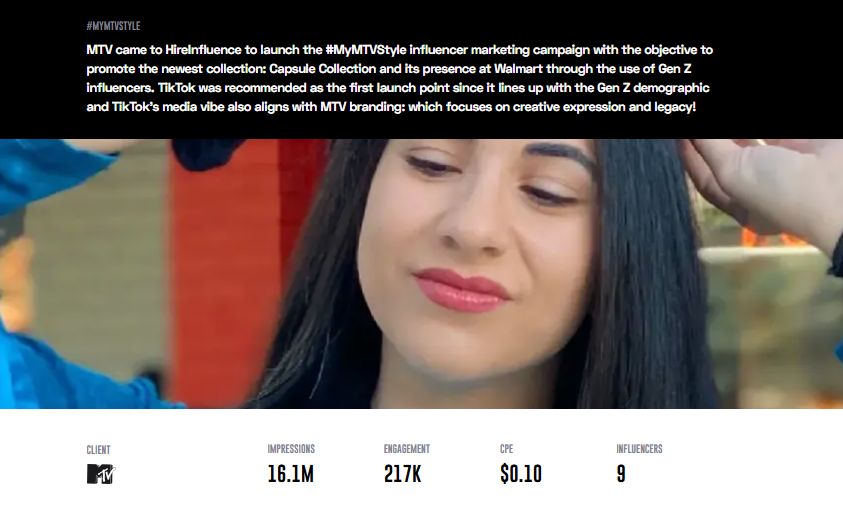
The MTV #MyMTVStyle TikTok campaign illustrates a different dimension of LA-relevant execution. The program generated 16.1 million impressions at $0.01 CPV and $1.50 CPM, with 216,600 engagements. For entertainment brands based in Los Angeles, those efficiency numbers are the benchmark for what TikTok creator campaigns should produce. They are also the kind of metrics that only come from a services engagement disciplined enough to optimize creative, audience targeting, and paid amplification in coordination.
The Ricola #CoatYourThroat campaign demonstrates how full-service delivery integrates retail measurement into the program architecture. The campaign drove 26 million impressions, 20.5 million reach, a 13.17% engagement rate across 18 influencers from micro to celebrity tier, and 62,500 MikMak retail purchase clicks. The specifics matter: 18 creators spanning five tier levels, one coordinated campaign concept, and retail purchase tracking embedded in the attribution stack. The Ricola case study shows what enterprise-scale service delivery produces when attribution is built in from the start.
How Enterprise Brands Should Evaluate LA Services Partners
For marketing teams in the evaluation phase, the LA market’s saturation makes credential and track-record screening more important than it is elsewhere. Five questions separate full-service partners from more limited offerings.
First, ask for specific campaign outcomes with attribution detail, not just impression totals. A serious partner can point to programs where creator activity produced measurable business results and explain the attribution methodology used.
Second, ask about the LA creator network the partner draws from. Does the agency have direct relationships with creators in the tiers and categories the brand needs, or does the sourcing rely entirely on database queries? In a market this deep, direct relationships often determine whether a brand can secure the right creators at the right windows.
Third, ask about the integrated paid media capability. CreatorIQ’s finding that two-thirds of new creator spend is pulled from paid budgets means the partner needs to run creator content as a paid media channel, not just an organic one. A partner that treats paid amplification as an add-on rather than a core service is not built for the efficacy era.
Fourth, ask for attribution methodology specifics. UTMs, promo codes, pixel tracking, conversion event integration, retail measurement partners. Vague answers about “full-funnel measurement” are not answers.
Fifth, ask about enterprise delivery capacity. Programs at the $5 million to $8 million annual scale that CreatorIQ identifies as the enterprise average require staffed program teams, not a single account lead coordinating with freelancers. The partner should describe dedicated roles covering strategy, sourcing, creative, contracts, paid media, and reporting.
The Agency Foundation for LA Enterprise Programs
HireInfluence maintains a Los Angeles office as part of a national footprint that also includes Houston and The Woodlands, TX; Austin, TX; and New York, NY. The agency was founded in 2011 and is recognized as one of the first full-service influencer marketing agencies in the United States. That history matters in the LA market because creator relationships compound over time, and agencies that have been active in LA for more than a decade have depth that newer entrants cannot replicate. Engagements typically start at approximately $100,000, which aligns with the enterprise delivery standard for the kinds of programs CreatorIQ’s research describes.
The agency’s 2024 and 2026 award portfolio includes recognition from the MUSE Creative Awards, Netty Awards, NYX Awards, Global Digital Excellence Awards, U.S. Agency Awards, and Vega Digital Awards. That award profile reflects the kind of creative strategy and execution capability that matters in the LA market, where content quality is benchmarked against the city’s professional production standards. The agency is also an exclusive TikTok Shop Lite Program partner since July 2024, which gives enterprise clients direct access to TikTok’s social commerce infrastructure for programs built around measurable conversion.
Jason Pampell, Founder and CEO, launched HireInfluence in 2011 and has led its growth into an award-winning partner for enterprise brands. His 30+ years of leadership experience in sales, marketing, and team building for Fortune 1000 organizations, combined with prior roles managing content rights and strategic media partnerships for Forbes and Billboard, informs the service model at the foundational level. The agency’s client roster includes Microsoft, Southwest Airlines, Target, Coca-Cola, Walmart, Meta, McDonald’s, Oreo, Grammarly, Ricola, and MTV. Those are the kinds of enterprise engagements that require the full service stack, operating with the discipline that the CreatorIQ data says the current market demands.
For enterprise brands ready to evaluate what an LA-anchored services engagement could look like, the HireInfluence team handles initial conversations through the main site. Brands looking to benchmark pricing should review the cost of influencer marketing guide for context on what enterprise-scale engagements actually cost, and those evaluating TikTok-heavy program structures should reference the TikTok influencer marketing breakdown for platform-specific service considerations. For brands interested in how UGC fits into full-service creator programs, the guide on user-generated content covers how UGC integrates with influencer strategy at the enterprise level.
Influencer marketing services in Los Angeles have reached the point where the choice of partner materially determines whether a $5 million to $8 million annual creator program produces ROI. CreatorIQ’s data makes the stakes clear: budgets have surged 171%, the market is now in the efficacy era, and the brands winning are the ones running programs disciplined enough to prove commercial impact. In the most creator-saturated market in the country, that discipline is not something to assemble from multiple vendors. It is something to buy as a service stack, from a partner with the infrastructure to deliver at the scale Los Angeles enterprise marketing demands.