
Most influencer marketing programs that underperform share a common root cause: strategy came after creator selection, not before it. The brand identified creators they liked, built a brief around those creators, and then asked what outcomes the campaign would produce. That sequence produces impressive follower counts and unimpressive business results.
Table of Contents
Enterprise brands with serious marketing budgets and real performance expectations cannot afford that approach. An influencer marketing strategy that drives measurable outcomes starts with business objectives, works backward to the campaign structure, and only then identifies the creator mix and content framework required to hit those goals.
Why Strategy Comes First
According to impact.com’s Influencer Marketing Trends 2026 report, the brands pulling ahead are treating influencer spend with the same discipline and tiered strategy they bring to their paid media mix. That means defining success metrics before any creator is briefed, building attribution infrastructure before the campaign launches, and treating creator content as a performance asset from day one rather than an organic awareness play that gets attribution retrofit later.
The gap between brands doing this well and brands still running influencer programs as glorified celebrity endorsements is widening. In 2026, 74% of brands are moving budget into creator programs, but the performance dispersion is significant. Brands with clear strategic frameworks are generating customer acquisition cost data and conversion tracking. Brands without them are generating impressions.
The Elements of a Sound Influencer Marketing Strategy
A fully structured influencer marketing strategy for an enterprise brand covers several distinct layers that need to be designed in sequence.
Objective definition comes first. Brand awareness, purchase consideration, direct conversion, and UGC production for owned channels are all legitimate campaign objectives, but they require different creator tiers, content formats, and measurement frameworks. A campaign designed for awareness should not be evaluated on conversion metrics. A direct response program should not be built around celebrity creators whose audiences do not overlap with the buyer profile.
Audience mapping follows. The target consumer profile should drive creator selection, not the other way around. Understanding where the target audience spends time across TikTok, Instagram, and YouTube, what content formats they engage with, and which creator voices they trust in the relevant category determines the creator mix before a single creator is contacted.
Creator tier strategy comes next. Enterprise programs typically perform best with a mix of creator tiers rather than a single-tier approach. Macro creators provide broad reach and brand legitimacy. Micro and mid-tier creators deliver higher engagement rates and stronger audience trust signals in specific categories. Nano creators provide hyperlocal and niche community access that larger creators cannot replicate. The right mix depends on the campaign objective and the category.
Content strategy and creative direction must preserve creator authenticity while ensuring brand alignment. The best influencer marketing briefs provide creative guardrails, not scripts. Creators who sound like they are reading brand copy do not generate the trust transfer that makes influencer marketing effective. HireInfluence’s content briefing and review process, managed through its full-service campaign operations, balances brand compliance with creative latitude across every creator on a program, regardless of roster size.
Attribution and measurement architecture needs to be in place before content goes live. Unique UTM parameters per creator, branded promo codes, pixel-based conversion tracking, retail purchase link integration, and earned media value tracking all need to be designed upfront. Retrofitting attribution to a campaign that is already running produces incomplete data and makes optimization impossible.
Common Strategic Mistakes at Enterprise Scale
Several patterns show up repeatedly in enterprise influencer programs that underperform.
Choosing creators based on follower count rather than audience alignment is the most common. A macro creator with 5 million followers whose audience is 60% outside the brand’s target geography and demographic is less valuable than a micro creator with 150,000 deeply engaged followers who match the buyer profile precisely.
Treating paid amplification as an optional add-on rather than a core program component is another. Influencer whitelisting and paid distribution behind high-performing organic content is where a significant portion of influencer marketing ROI is generated. Brands that skip this layer leave measurable return on the table.
Failing to negotiate usage rights upfront is a third. Brands that want to amplify content through paid channels after it goes live often discover they do not have the rights to do so, or that renegotiation with the creator adds significant cost and delay. HireInfluence structures commercial usage rights as standard contract terms on every engagement.
How HireInfluence Builds Strategy-First Programs
HireInfluence begins every engagement with a strategy session that establishes campaign objectives, target audience profiles, platform priorities, creator tier mix, content format guidance, paid amplification structure, and measurement framework before a single creator is identified. The creator sourcing process flows from that strategic foundation rather than preceding it.
For the Grammarly campaign, HireInfluence’s strategy placed 133 top-tier lifestyle creators across YouTube, Instagram, and TikTok in a program that generated 214 million impressions, 33.1 million views, and $15 million in earned media value. That scale of outcome required strategic coordination across creator tiers, content formats, and platforms, with paid amplification layered on top of the strongest organic performers.
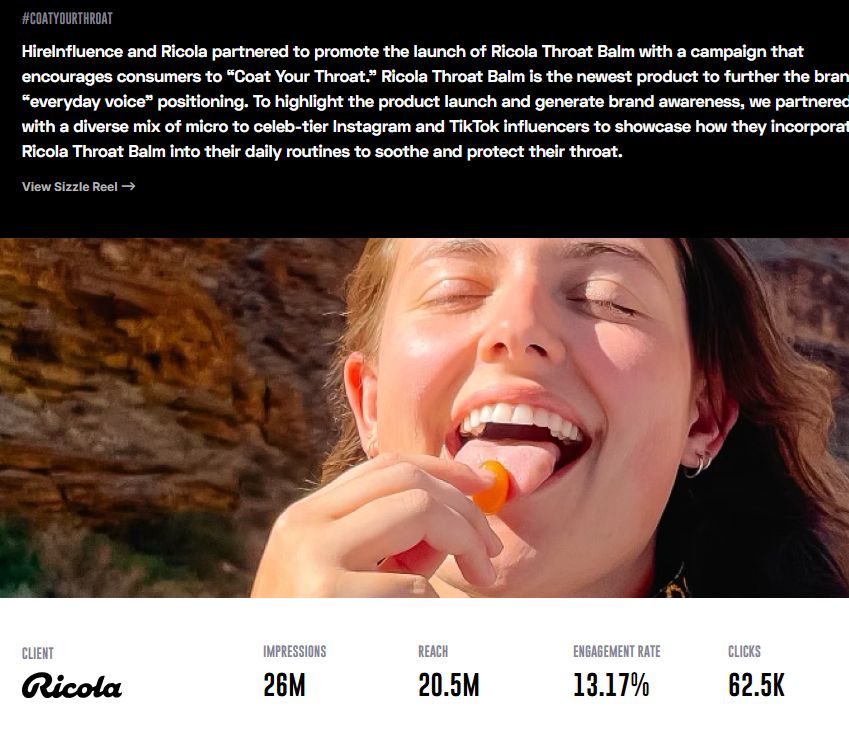
For the Ricola #CoatYourThroat campaign, strategic alignment between the campaign objective (driving retail purchase consideration) and the measurement infrastructure (MikMak retail purchase link tracking) meant the program could report 62,500 tracked retail purchase clicks alongside 26 million impressions and a 13.17% engagement rate. The business metric was built into the strategy from the start, not added after the fact.
The Role of Analytics in Strategic Iteration
A well-designed influencer marketing strategy does not end when the campaign launches. The analytics infrastructure that tracks campaign performance should feed back into creator selection, content direction, and paid amplification decisions in real time. Creators whose content performs above benchmark should have their reach extended through paid channels. Content formats that are not generating engagement should be adjusted before the campaign window closes.
HireInfluence’s proprietary analytics platform tracks earned media value, sentiment, and conversion data in ways designed to support in-flight optimization rather than just post-campaign reporting. For enterprise brands whose marketing programs span multiple campaigns per year, that iterative learning is what compounds strategy quality over time.
Evaluating Strategy Capability in an Agency
For VP-level marketing leaders evaluating influencer agency partners, the test of strategic capability is whether the agency leads with objectives or with a creator roster. Agencies that open with talent relationships and negotiate backward to campaign goals are built around supply. Agencies that start with the brand’s business objectives and build toward creator selection are built around outcomes.
HireInfluence’s minimum engagement starts at approximately $100,000. Named clients include Microsoft, Target, Grammarly, McDonald’s, Oreo, and Southwest Airlines. For enterprise brands ready to build or rebuild their influencer marketing program on a strategic foundation, the conversation starts with your business objectives. Review the work at hireinfluence.com/work/ and connect with the team at hireinfluence.com/contact/.