Most brands that run influencer campaigns are leaving the most valuable part of the strategy unused. The organic post goes live, performs reasonably well with the creator’s existing audience, and then fades. The creator-produced content that could have become the brand’s highest-performing paid social creative never gets activated. The rights to amplify it were never negotiated. The paid team was not involved in the brief. By the time anyone asks about running the content as an ad, the moment has passed.
Table of Contents
An influencer paid media agency is built to prevent exactly that failure. Paid amplification is not an afterthought or an optional upgrade in this model. It is a structural component of the campaign from the first brief, with usage rights negotiated upfront, creative formats optimized for both organic and paid contexts, and performance data from organic posts informing the paid amplification strategy in real time.
The Economics of Paid Amplification
The business case for paid amplification of creator content is well established. Influencer whitelisting, where brand-licensed creator content runs as a paid ad through the creator’s own account rather than the brand’s handle, outperforms standard brand social ads by 20% to 50% on engagement metrics. Creator-generated content running through paid channels consistently produces lower cost-per-click and higher conversion rates than equivalent brand-produced creative.
According to the IAB’s analysis of the US creator economy, as reported by Digiday, paid amplification of creator content is projected to reach $13.2 billion in 2026, a 48% increase from the prior year. That growth reflects what enterprise brands are discovering through performance data: creator content is their best paid media asset, and the programs that integrate both organic and paid from the start outperform those that treat them as separate budget lines.
The underlying dynamic is trust transfer. When creator content runs as a paid ad through the creator’s account, audiences see a familiar voice rather than a brand message. The authenticity signal that makes influencer content effective organically holds in a paid context, which is why performance metrics improve rather than degrade when the same content moves from organic to paid distribution.
Why Usage Rights Cannot Be an Afterthought
The most common operational failure in influencer paid media programs is rights negotiation that happens too late. A creator posts content. It performs well. The brand wants to amplify it as a paid ad. The creator’s original contract covers organic use only. Now the brand has to reopen negotiation at a moment when the creator knows the content has value, often resulting in higher fees, delays of days or weeks, and in some cases, the creator declining entirely.
HireInfluence structures commercial usage rights as standard contract terms on every engagement. Before a single creator is briefed, the contract covers organic rights, paid amplification permissions, duration of use, and exclusivity terms where applicable. When content performs and the brand wants to amplify it, the rights are already in place. The paid campaign can launch within hours of making the decision rather than weeks after a negotiation.
This is not a minor operational detail. For campaigns with narrow promotional windows, product launches, seasonal activations, or LTO windows in QSR and retail, missing the organic-to-paid handoff by even a week can eliminate most of the amplification’s value. HireInfluence’s talent contracting workflow eliminates that risk.
What Paid Amplification Actually Requires
Running creator content as paid advertising requires specific technical infrastructure that most influencer agencies lack and most media agencies lack on the influencer side.
Influencer whitelisting and allowlisting requires managing creator account permissions, setting up ad accounts correctly across Meta, TikTok, and other platforms, and structuring campaigns so paid posts run compliantly through the creator’s handle without violating platform terms. TikTok’s Spark Ads have their own permission workflow. Instagram’s whitelisting process differs from Facebook’s. Each platform requires platform-specific setup and management.
Dark posting extends paid capabilities further, enabling brands to run creator content as targeted paid ads that never appear on the creator’s organic profile. This is particularly valuable for geo-targeted campaigns, A/B creative testing, or retargeting programs where the brand wants precise audience control without the content appearing publicly.
Analytics and attribution must connect paid amplification spend to downstream business outcomes, not just impressions. For enterprise brands, the question is not whether the paid posts ran. It is whether they drove traffic, conversions, or in retail contexts, purchase events. HireInfluence’s proprietary reporting infrastructure closes that loop.
The HireInfluence Paid Amplification Model
HireInfluence manages paid amplification as a native component of every campaign through its full-service campaign operations, coordinated through the same team that manages creator sourcing, content direction, and FTC compliance. There is no vendor handoff between the influencer program and the media buying function. The data flows between both layers continuously, which means the paid amplification strategy evolves based on which organic content is performing rather than being locked in before organic results are known.
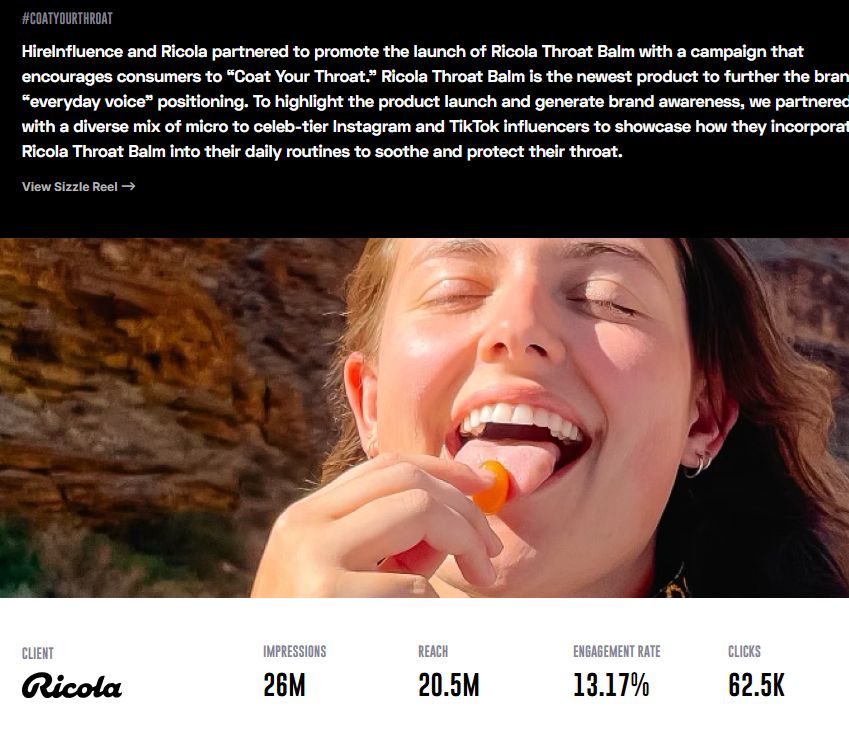
For the Ricola #CoatYourThroat campaign, HireInfluence managed 18 creators across micro to celebrity tier, generating 26 million impressions and a 13.17% engagement rate, with 62,500 tracked retail purchase clicks through MikMak integration. The retail attribution layer was built into the campaign structure from the start, not added after the fact, because the entire program was designed around connecting creator content to measurable purchase behavior.
The Grammarly campaign, with 133 top-tier lifestyle influencers across TikTok, Instagram, and YouTube, generated 214 million impressions, 33.1 million views, and $15 million in earned media value. At that creator volume and across three platforms simultaneously, coordinating organic content timelines with paid amplification scheduling requires the kind of operational infrastructure that only an integrated agency can provide.
Platform-Specific Paid Execution
Paid amplification works differently across platforms, and the strategy needs to reflect those differences rather than apply a uniform approach.
On TikTok, Spark Ads allow brands to boost creator content through the creator’s account while preserving the native look and feel of the organic post. As an official TikTok Shop Lite Program partner, HireInfluence has exclusive data and ad access on TikTok that standard agencies cannot access, including early features, advanced analytics, and commerce integration capabilities. For brands running influencer content alongside TikTok Shop, that partnership is a meaningful operational advantage.
On Instagram, whitelisted creator posts appear as paid ads in users’ feeds and Stories from the creator’s handle rather than the brand’s. Dark posts give brands the option to run paid creative that never appears on the creator’s public profile, which is useful for testing multiple creative variants or for geo-targeted campaigns where audience segmentation matters.
On YouTube, pre-roll and mid-roll placement of creator-sourced video content extends reach to audiences beyond the creator’s existing subscriber base, with performance data feeding back into content direction for future creator activations.
Evaluating an Influencer Paid Media Agency
For enterprise brands evaluating agency partners on paid amplification capability, the key questions are operational. Are usage rights built into creator contracts by default, or negotiated ad hoc after content goes live? Does the agency manage whitelisting and dark posting internally, or does it outsource media buying to a third party? Does it have platform-specific expertise on TikTok, Instagram, and YouTube, or does it apply a generic paid social approach across channels?
HireInfluence’s minimum engagement starts at approximately $100,000. Named clients include Microsoft, Target, Grammarly, McDonald’s, Oreo, and Southwest Airlines. To review campaign documentation and start a conversation about building an integrated influencer paid media program, visit hireinfluence.com/contact/.