
Influencer program management is the operational discipline that separates enterprise brands running creator programs effectively from those running them expensively. When a brand treats influencer marketing as a series of individual activations rather than a managed program, the results are predictable: inconsistent execution, compliance gaps, missed amplification windows, and reporting that cannot survive a CFO review. When it is managed as a program — with defined infrastructure, repeatable workflows, and performance accountability built in from the start — the outcomes are fundamentally different.
Table of Contents
The performance pressure behind this shift is documented in impact.com’s Influencer Marketing Trends 2026 report. During Cyber Week 2025, creator-driven revenue surged 51% year-over-year while commission costs stayed flat, and influencers’ share of total transactions rose from 5% to 9% in a single year. The channel is now producing results at a scale that demands the same operational rigor as paid search or programmatic media. For enterprise brands, that means treating influencer program management as a core marketing function, not an add-on managed through whoever has bandwidth.
What Influencer Program Management Actually Involves
At the enterprise level, influencer program management covers every stage of the creator campaign lifecycle, from initial strategy through post-campaign reporting and into ongoing program optimization. The operational requirements are more complex than most marketing leadership teams fully appreciate before they begin running programs at scale.
Creator discovery and validation is where most programs that fail begin to fail. Finding creators whose audiences are genuinely aligned with the brand’s target consumer — not just topically adjacent, but demographically matched with authentic engagement and a content history that is brand-safe — requires a vetting process that goes well beyond what database searches provide. At scale, this process has to be systematic and documented, because every creator selection carries brand risk.
Contract management covers talent negotiation, rate setting, exclusivity terms, FTC disclosure requirements, content approval workflows, and commercial usage rights for paid amplification. For a program running 30 or 50 creators simultaneously, contract management is a significant operational function. Missing a usage rights negotiation at this stage is one of the most common and costly errors in enterprise influencer programs, because the discovery happens after the best content has already performed organically and cannot be legally amplified without renegotiation.
Content oversight includes brief development, creator review, FTC compliance verification, and approval workflows before any content goes live. For regulated industries — consumer health, financial services, food and beverage — this layer is not optional and cannot be managed through a briefing call alone. It requires a systematic review process with documented sign-off at each stage.
Performance measurement connects the program to the business outcomes that justify continued investment. Impressions and engagement are starting metrics. Enterprise programs need earned media value, sentiment tracking, conversion attribution tied to retail purchase data or CRM records, and reporting structured to hold up at the executive level.
The Challenge of Managing Programs Internally
The impact.com report notes that only 20% of brands currently track customer acquisition cost from their influencer programs, and just 18% measure average order value. These measurement gaps are not primarily a data problem. They are an operational problem. Brands running influencer programs with internal teams that have never been staffed or structured for this function are generating activity without the infrastructure to connect that activity to outcomes.
The same research found that 74% of brands are moving budget into creator programs in 2026, but that most are not yet running those programs with the performance accountability those budgets require. The organizations that are pulling ahead are building what the report calls creator infrastructure — systematic processes for sourcing, briefing, tracking, and optimizing creator programs across channels and creator tiers — rather than continuing to execute activations as one-off events.
Building that infrastructure in-house is expensive, time-consuming, and requires specialized talent that is difficult to hire and retain. The alternative is an agency partner that has already built it.
HireInfluence’s Program Management Infrastructure
HireInfluence was founded in 2011 as the first full-service influencer marketing agency. The agency’s operational infrastructure reflects 15 years of building, refining, and scaling the systems that enterprise influencer program management requires.
The program management workflow covers every stage. Strategy and ideation define campaign objectives, audience mapping, platform allocation, creator tier mix, and measurement framework before creator outreach begins. Talent sourcing and vetting uses manual validation processes that evaluate audience authenticity, engagement quality, content history, and brand safety signals — not just follower counts. Contract negotiation covers commercial usage rights as a standard term, so high-performing content is available for paid amplification without renegotiation.
Content briefing and review maintains brand compliance while preserving the creator voice that makes content perform. FTC compliance is managed in-house for every creator posting simultaneously, with disclosure verification built into the workflow rather than delegated to individual creators. Influencer payment and 1099 processing is handled by the agency, removing that administrative burden from the brand’s finance and legal teams.
The campaign services infrastructure includes paid amplification through whitelisting and dark posting, TikTok Spark Ads through the agency’s exclusive TikTok Shop Lite Program partnership secured in July 2024, and cross-platform performance tracking consolidated through a proprietary analytics platform that reports on earned media value, sentiment, and conversion attribution in formats designed for executive review.
What Well-Managed Programs Produce
The difference between managed and unmanaged influencer programs shows up in the results. The Grammarly program is the right reference point for enterprise scale. Managing 133 creators across YouTube, TikTok, and Instagram simultaneously — with brief coordination, content review, FTC compliance verification, scheduling, and real-time performance monitoring across all three platforms — is an operational undertaking that requires the systems HireInfluence has spent years building. The outcome: 214 million impressions, 33.1 million views, and $15 million in earned media value.
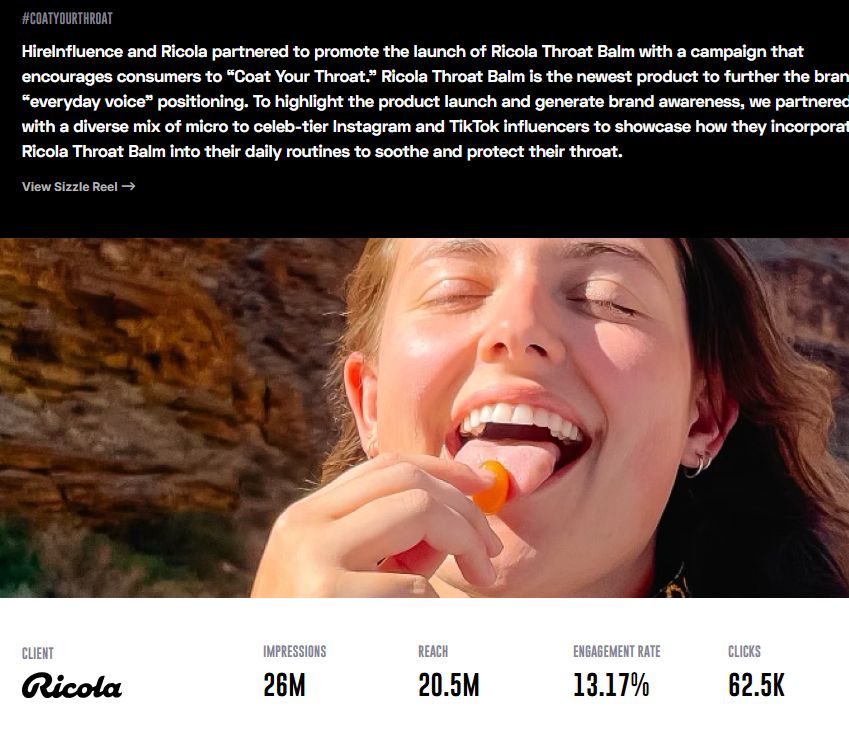
The Ricola #CoatYourThroat campaign demonstrates what managed attribution looks like. The program ran 18 influencers with MikMak retail purchase link integration, tracking 62,500 purchase clicks from creator content directly to retail point-of-sale. That connection — between a creator posting about a consumer health product and a documented retail transaction — is only possible when the program management infrastructure is in place before the campaign launches.
The Southwest Airlines #SouthwestSaysAloha campaign generated 56 million impressions and 3 million engagements. The MTV #MyMTVStyle TikTok campaign delivered 16.1 million impressions at $0.01 cost per view. These are outcomes from programs built and managed with the operational discipline enterprise brands require, not results achieved by booking a roster of creators and hoping for the best.
What to Look for in an Influencer Program Management Partner
Enterprise brands evaluating program management partners should ask questions that expose operational capabilities rather than surface-level credentials.
How does the agency handle compliance at volume? For a program with 40 creators posting within a single week, compliance review cannot be manual and individual. It has to be systematic. Ask for a specific description of the compliance workflow, including how disclosure language is verified before content goes live and what the documented process is for a creator who misses required disclosures.
What does the measurement architecture include? The output of a managed influencer program should be reporting that a CMO can present to a CEO. That means earned media value, conversion attribution, and performance benchmarks against program objectives — not a summary of impressions and a spreadsheet of engagement rates.
How are usage rights managed? Commercial usage rights should be a standard contract term, not a separate negotiation that happens after content has already been produced. An agency that cannot explain its standard contract terms on usage rights is not built for enterprise program management.
HireInfluence’s minimum program engagement is approximately $100,000, which reflects the operational depth each engagement requires. For enterprise brands ready to run influencer programs with the same accountability standards applied to other performance channels, the conversation starts at hireinfluence.com/contact/. Review the agency’s confirmed campaign results at hireinfluence.com/work/ and learn more about the full-service approach at hireinfluence.com/about/.
The brands that are moving budget into creator programs in 2026 are not all getting the same return. The ones generating results at enterprise scale are the ones with creator-driven content and TikTok-native execution managed through the right program infrastructure. That infrastructure is what HireInfluence provides.