
The distinction between running influencer marketing and managing it is the difference between activity and outcomes. Brands that run influencer campaigns book creators, publish content, and count engagement. Brands that manage them build programs with defined strategy, validated talent, compliance workflows, paid amplification, and attribution-connected reporting — and generate results that hold up in an executive review.
Table of Contents
Managed influencer marketing services describe the full-service model where an agency owns every stage of the influencer program lifecycle on behalf of the brand. The brand sets objectives and approves outcomes. The agency handles everything in between — from strategy and creator vetting through content review, compliance, paid amplification, and performance reporting. This model is distinct from self-service platforms where brands manage programs themselves, and from hybrid arrangements where agencies provide partial support while the brand coordinates execution internally.
According to Moburst’s State of Influencer Marketing 2026, the global influencer marketing industry has exceeded $32 billion and is projected to surpass $40 billion by year end, with full-service campaign management cited as one of the primary criteria enterprise brands use when evaluating agency partners. At that investment level, the operational requirements of running programs in-house have become a genuine bottleneck for marketing teams that are already stretched. Managed services exist to solve that problem — and to solve it completely, not partially.
What Full-Service Managed Influencer Marketing Covers
The scope of managed influencer marketing services is broader than most brands expect before they work with an agency that actually delivers the full model. It starts before a single creator is contacted and does not end when content goes live.
Strategy and planning comes first. A managed service program does not start with a creator roster. It starts with a strategy session that defines campaign objectives, target audience profiles, platform allocation, creator tier mix, content format guidance, paid amplification structure, and measurement framework. This sequence is not procedural — it is the reason managed programs outperform ad hoc activations. Every downstream decision is calibrated to specific objectives rather than generic best practices.
Creator sourcing and vetting follows. Finding creators whose audiences genuinely align with a brand’s target consumer requires analysis that goes beyond database searches. It means evaluating audience authenticity to identify fake followers and bot engagement, assessing content history for brand safety signals, verifying category alignment, and confirming that the creator’s track record reflects the quality of work the brand needs. At enterprise scale, with creator rosters spanning micro through macro tiers simultaneously, this vetting function requires systematic infrastructure, not manual review.
Contract management covers rate negotiation, exclusivity terms, FTC disclosure requirements, content approval timelines, and — critically — commercial usage rights. Rights negotiated at contracting, before content is created, allow the brand to amplify high-performing organic content through paid channels without renegotiation delays and added cost. Brands that skip this step at contracting consistently discover it at the worst possible moment: when the best content in the campaign cannot legally be amplified.
Content oversight includes brief development, creator direction, review workflows, and FTC compliance verification before content goes live. In regulated categories — consumer health, financial services, food and beverage — this layer is not optional and cannot be managed through a briefing call alone. It requires a systematic review process with documented sign-off at each stage of production.
Performance measurement closes the loop. Managed influencer marketing programs report on earned media value, sentiment tracking, and conversion attribution in formats that hold up in a quarterly marketing review. Impressions and engagement are supporting data, not the primary deliverable.
Why In-House Management Falls Short at Enterprise Scale
Enterprise marketing teams evaluating whether to manage influencer programs internally or through a managed services partner consistently underestimate the operational load until they are inside a program. Creator discovery, vetting, and outreach across a roster of 30 to 50 creators involves weeks of research before a single contract is signed. Contract negotiation with individual creators requires legal bandwidth most marketing teams do not have. Content review at volume — with creators posting across multiple platforms simultaneously — requires a monitoring and approval infrastructure that does not exist in most internal marketing operations.
The compliance exposure from poorly managed programs is the most consequential risk. A single undisclosed sponsored post from a creator during a high-visibility campaign creates FTC liability and brand reputation risk at precisely the moment the brand has invested to build visibility. Managing disclosure compliance systematically across a large creator roster is an operational discipline, not a checklist. It requires process, documentation, and accountability mechanisms that most in-house teams have not built.
The strategic cost is harder to quantify but equally real. In-house teams managing program operations spend the time they should spend on strategy on logistics instead. The campaign performs to its execution constraints rather than to its strategic potential.
HireInfluence’s Managed Influencer Marketing Model
HireInfluence has operated as a full-service influencer marketing agency since 2011. Every engagement is managed end to end — the brand brings objectives and approval authority, and the agency owns execution from strategy through reporting.
The campaign services infrastructure covers the complete lifecycle: strategy and ideation, creator sourcing and validation through a manual vetting process that extends beyond platform databases, contract negotiation with commercial usage rights built in as standard, content briefing and review, FTC compliance management, influencer payment and 1099 processing, paid amplification through whitelisting and dark posting, and cross-platform performance tracking through a proprietary analytics platform.
Creator sourcing spans nano through celebrity tier, with tier mix calibrated to specific campaign objectives rather than applied as a default structure. The agency’s TikTok Shop Lite Program partnership, exclusive since July 2024, provides direct platform data and premium ad access for campaigns with social commerce components — a structural advantage that standard agencies cannot replicate.
What Managed Programs Produce
The difference between managed and unmanaged programs shows up in results. The Grammarly program required managing 133 creators across YouTube, TikTok, and Instagram simultaneously — brief coordination, content review, FTC compliance across all three platforms, scheduling optimization, and real-time performance tracking. The outcome: 214 million impressions, 33.1 million views, and $15 million in earned media value. That program could not have been executed without the full managed services infrastructure.
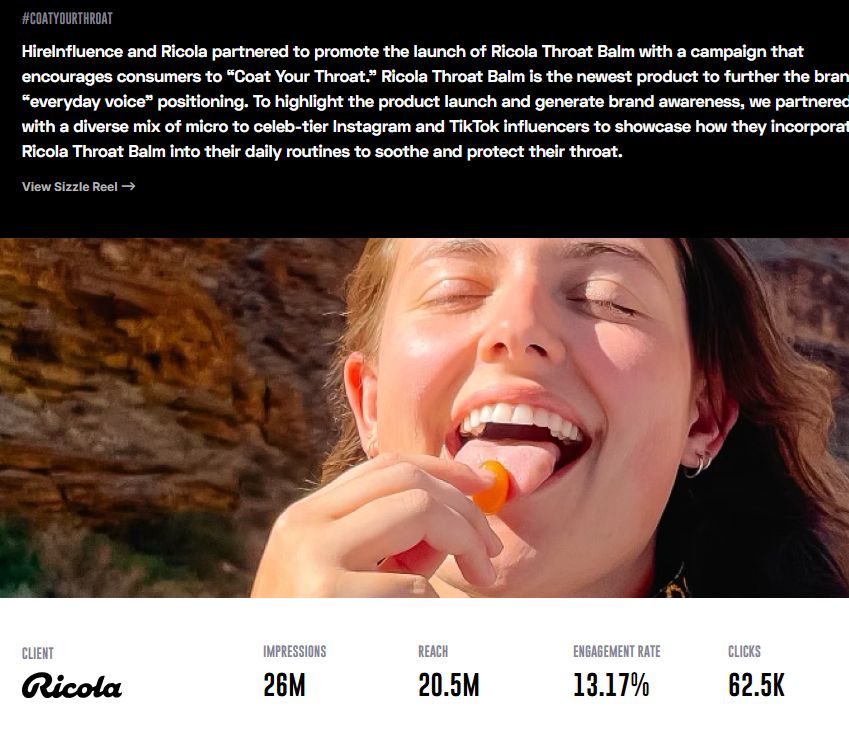
The Ricola #CoatYourThroat campaign demonstrates what managed attribution looks like. The program ran 18 influencers with MikMak retail purchase link integration, tracking 62,500 purchase clicks from creator content directly to retail point-of-sale. Attribution at that precision is only possible when the measurement infrastructure is built into the program architecture before launch, not assembled after results come in.
The Southwest Airlines #SouthwestSaysAloha campaign generated 56 million impressions and 3 million engagements. The MTV #MyMTVStyle TikTok campaign delivered 16.1 million impressions at $0.01 cost per view. These are outcomes from programs built and managed with the operational discipline managed services require.
Selecting the Right Managed Influencer Marketing Partner
Enterprise brands evaluating managed influencer marketing services should ask questions that expose operational depth rather than surface credentials. What is the compliance workflow for a program running 40 creators simultaneously? How are commercial usage rights structured in standard creator contracts? What does the attribution reporting include, and how does it connect to existing business measurement systems?
HireInfluence’s minimum engagement is approximately $100,000, which reflects the full operational scope of what managed services at enterprise scale actually requires. For brands ready to run creator content programs with genuine performance accountability, the conversation starts at hireinfluence.com/contact/. Review confirmed campaign results at hireinfluence.com/work/ and learn about the agency’s history at hireinfluence.com/about/.
The brands extracting the highest return from TikTok-integrated and multi-platform influencer programs in 2026 are not the ones with the largest budgets. They are the ones running those budgets through a managed services partner with the infrastructure to convert investment into measurable outcomes.