
Micro-influencer marketing is not a budget workaround for brands that can’t afford celebrities. For enterprise brands with serious marketing goals, working with creators in the 10,000 to 100,000 follower range is often the highest-performing tier in the entire program. The data backs this up, and the brands that have built micro-influencer strategies into their core channel mix are seeing it in their results.
Table of Contents
According to Later’s 2025 Influencer Marketing Report, which analyzed over 2,500 campaigns across eight industries, 73% of brands now prefer micro and mid-tier creators specifically because they deliver stronger engagement-to-cost ratios. Micro and nano creators achieve engagement rates between 6.15% and 6.76%, compared to 1% to 2% for macro-tier accounts. That gap is not marginal. It represents a fundamentally different relationship between creator and audience.
The challenge for enterprise brands is not whether micro-influencers work. It is whether they have an agency that can run micro-influencer programs at the scale and sophistication their campaigns require.
Why Micro-Influencer Engagement Is Higher
The engagement rate difference between micro and macro creators comes down to one thing: how closely an influencer’s audience actually pays attention to their content. A creator with 25,000 followers in a specific niche — outdoor fitness, plant-based cooking, sustainable fashion, personal finance for young professionals — has typically built that audience through consistent, specific content that attracted people with a genuine shared interest. When that creator recommends something, the recommendation lands with real weight.
A creator with 5 million followers may have reached that scale by being broadly entertaining rather than deeply credible in any specific category. The follower count is real. The attentiveness of that audience to any particular product recommendation is not.
For enterprise brands, this matters especially in categories where the purchase decision requires some level of trust or expertise: CPG products, health and wellness, consumer technology, apparel, home goods, and almost anything sold through a considered decision rather than a pure impulse. The micro-influencer’s audience is a concentrated pool of the exact people who care about what the influencer cares about. That’s where brand messages actually land.
Scale Is Where Most Brands Get Stuck
The strategic logic for micro-influencers is easy to accept. The execution is where most enterprise brands run into problems.
Running a single macro-influencer partnership is operationally straightforward. One creator, one contract, one set of deliverables. Running a micro-influencer program at meaningful scale means managing dozens or hundreds of creator relationships simultaneously — sourcing and vetting creators, negotiating contracts, briefing content, reviewing posts, tracking performance, managing payments, and maintaining FTC compliance across every single activation.
Brands that try to manage this in-house, or with agencies that are not set up for high-volume creator operations, consistently underestimate the complexity. The first few campaigns run fine. As volume grows, gaps in process create gaps in performance. A creator posts without the required disclosure. A tracking link is set up wrong. Content goes live with a claim that shouldn’t have made it past review. At scale, these are not edge cases. They are operational realities.
The agencies that run effective enterprise micro-influencer programs have built the infrastructure to manage this complexity: creator sourcing and vetting workflows that can scale, contract and payment systems built for high creator volume, brief and content review processes that maintain consistency, and analytics setups that aggregate performance data across many creators into a coherent view of what the campaign is actually doing.
HireInfluence’s full-service campaign infrastructure is built to manage exactly this. The campaign capabilities at HireInfluence cover the entire program from creator sourcing through performance measurement, with the compliance oversight and analytics capabilities that enterprise brands require.
What Good Micro-Influencer Vetting Actually Looks Like
At the micro tier, creator quality varies enormously. Follower count tells you almost nothing on its own. Two creators with 40,000 followers can have wildly different audience quality, engagement authenticity, and content credibility. The vetting process that separates good micro-influencer programs from mediocre ones goes well beyond the surface metrics.
Audience authenticity is the first filter. Fake followers and purchased engagement are widespread at every creator tier, but they are particularly common at the micro level because the detection is harder and the cost of buying followers is lower. An agency running micro-influencer programs at scale needs the tools and processes to evaluate whether a creator’s engagement is real, not just whether the numbers look acceptable on first glance.
Audience composition is the second filter. The right follower count in the wrong demographic is worthless. A creator whose 50,000 followers are predominantly 18-to-24-year-olds in markets where your product doesn’t ship, or whose audience doesn’t match your buyer profile, will not move your business metrics regardless of their engagement rate.
Content quality and brand safety are the third filter. Micro-influencers are often less professionally managed than their macro counterparts. Their content history is longer and less curated. An agency vetting at scale needs to assess not just recent posts but the full content record, looking for anything that creates brand association risk.
HireInfluence’s talent sourcing and placement capabilities apply this vetting standard across every creator tier, including the micro level. See the specialties that support HireInfluence’s creator programs.
The Ricola Campaign as a Model
The Ricola #CoatYourThroat campaign, executed by HireInfluence, is a strong example of what a well-structured multi-tier creator program looks like in practice. The campaign used 18 influencers spanning micro to celebrity tier, generating 26 million impressions, 20.5 million in reach, and a 13.17% engagement rate — with 62,500 tracked clicks and MikMak retail purchase link integration to connect campaign activity directly to purchase behavior.
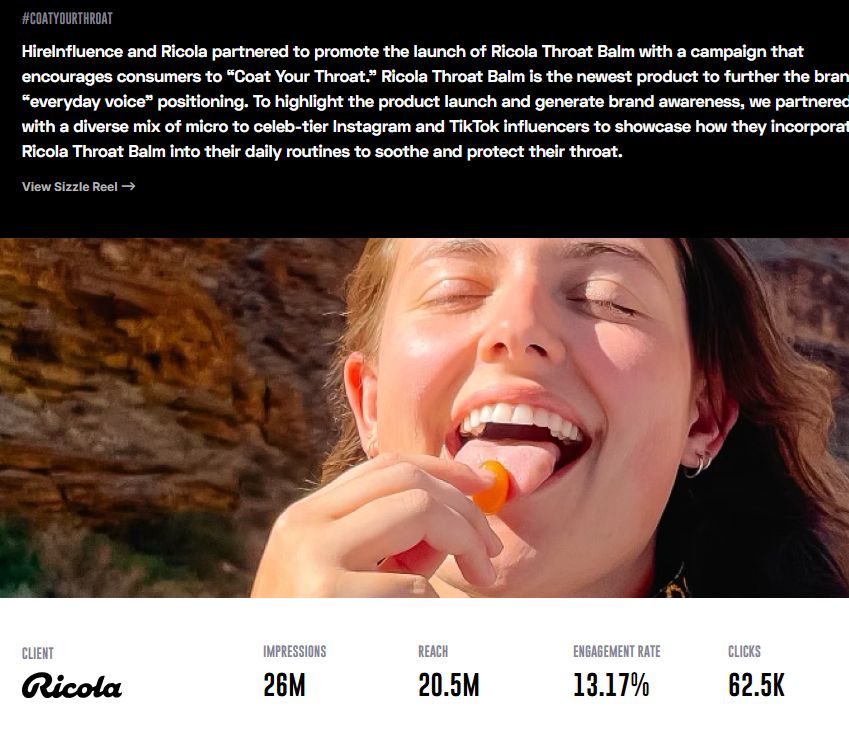
That engagement rate, 13.17% across the full campaign, reflects the contribution of micro-tier creators in the mix. Celebrity-only campaigns don’t produce numbers like that. The combination of broader reach from higher-tier talent and concentrated engagement from micro creators is a structure that HireInfluence builds into multi-tier programs intentionally.
See the Ricola campaign details for more on how this program was structured and delivered.
Micro-Influencers Across Platforms
Micro-influencer strategy is not the same on every platform, and enterprise brands need an agency that understands the platform-specific dynamics rather than applying a single playbook everywhere.
On Instagram, micro-influencers in specific lifestyle, beauty, food, and wellness niches consistently outperform macro creators on engagement. Reels-format content from micro creators gets algorithmic distribution that can meaningfully extend reach beyond the creator’s existing follower base, which changes the math on micro-influencer value.
On TikTok, the platform’s algorithm makes creator follower count less predictive of performance than on any other platform. A micro-creator with 30,000 followers and a strong content concept can reach millions if the algorithm picks it up. That dynamic makes TikTok one of the best platforms for micro-influencer investment because you’re effectively buying strong creative with distribution potential, not just access to a fixed audience.
On YouTube, micro-influencers in specific interest categories — personal finance, home improvement, fitness, gaming, cooking — have built audiences with a level of attentiveness and trust that is difficult to replicate at larger scale. Long-form content from a credible micro-creator in the right category can drive search traffic, product consideration, and direct conversions long after the initial post.
HireInfluence executes across all of these platforms, which means the agency can build a micro-influencer strategy that deploys the right creator types in the right formats on the right channels, rather than defaulting to a single platform because that’s where the agency’s expertise happens to be concentrated. See the full range of HireInfluence’s campaign work.
What to Ask a Micro-Influencer Agency Before You Engage
Before committing to an agency for enterprise micro-influencer work, there are a few specific questions worth asking directly.
How do you vet creator authenticity at scale? If the answer is a general reference to “our tools,” ask which tools and what the process looks like. Vague answers here signal that the vetting is less rigorous than it should be.
How do you manage FTC compliance across high-volume creator programs? Each creator activation is a separate compliance point. An agency running 50 or 100 creators on a single campaign needs a defined process for ensuring every post includes proper disclosure, not a policy that creators are expected to follow on their own.
How do you aggregate performance data across many creators into campaign-level reporting? Individual creator metrics are not the same as campaign performance. Ask how the agency consolidates data and what the reporting looks like. HireInfluence’s analytics team builds performance measurement into every program from the start. See how analytics work at HireInfluence.
Why HireInfluence for Micro-Influencer Programs
HireInfluence has been managing multi-tier influencer programs for enterprise brands since 2011. The agency’s infrastructure — creator sourcing and vetting, contract and payment services, FTC compliance management, paid media amplification, and proprietary analytics — is built for the operational complexity of running programs at scale, including at the micro tier.
For senior marketing leaders at Fortune 500 and large enterprise brands, the right micro-influencer agency is not the one with the most impressive pitch deck. It’s the one with the infrastructure to execute at volume without losing control of quality, compliance, or performance data.
HireInfluence’s minimum engagement is approximately $100,000. That reflects the actual investment required to run a micro-influencer program with the operational rigor and measurement capability that enterprise brands need.
To start a conversation about what a micro-influencer program looks like for your brand, contact HireInfluence here. For an overview of full-service campaign management, visit the campaigns page.