Nano influencers, defined as creators with between 1,000 and 10,000 followers, are the most misunderstood tier in influencer marketing. The common assumption is that small followings mean small impact. The data says otherwise. Nano influencers consistently produce the highest engagement rates of any tier, generate content that audiences treat as personal recommendations rather than advertising, and deliver conversion efficiency that larger tiers cannot match.
Table of Contents
According to Social Cat’s Influencer Marketing Report, nano influencers achieve the highest average engagement rate at 2.71%, compared to 1.81% for micro-influencers and significantly lower rates for macro and mega creators. On TikTok specifically, nano-influencer engagement reaches 10.3%. And gifted collaborations with nano-influencers produce 2.76% engagement, outperforming both paid partnerships and collaborations with larger tiers. These are not marginal differences. They reflect the fundamental dynamic that makes nano-influencer marketing work: audiences follow nano creators because they trust them as people, not because they are famous.
What Makes Nano Influencers Different
The trust dynamic at the nano level is qualitatively different from other tiers. A nano creator with 3,000 followers in a specific niche, whether that is sustainable cooking, home renovation in a specific city, or skincare for a particular skin type, has built an audience that knows them. Their followers have watched enough content to feel a genuine relationship. When that creator mentions a product, it lands differently than a sponsored post from a creator with 500,000 followers who produces three paid placements a week.
This is why nano influencers consistently outperform larger tiers on conversion metrics. Their audiences act on recommendations because the recommendation feels like advice from someone they know. For brands where purchase decisions depend on trust, such as CPG, food, wellness, baby and parenting, home goods, and health-adjacent categories, nano-influencer programs are often the highest-ROI option in the creator mix.
There is a practical tradeoff. Managing 50 or 100 nano creators requires significantly more operational infrastructure than managing five macro influencers. Briefing, contracting, content review, compliance, usage rights, and performance tracking all have to work at a volume that most brand teams cannot handle internally. This is where an experienced nano influencer marketing agency becomes essential.
What Enterprise-Scale Nano Programs Require
Enterprise brands do not run nano-influencer programs by working with one creator at a time. The value of nano-tier is in scale: aggregating the authentic, high-engagement content and combined reach of dozens or hundreds of creators across relevant audience segments. Getting that right requires a full operational infrastructure.
HireInfluence runs this infrastructure for enterprise brands. Their full-service campaign management covers talent identification and vetting across nano and all other tiers, creative briefing that preserves authentic voice at scale, FTC compliance management for every placement, paid media amplification to extend the reach of the best-performing nano content, and proprietary analytics that track performance across creators and aggregate it into campaign-level reporting.
Niche alignment is one of the most important and most underutilized factors in nano-influencer selection. Research consistently shows that campaigns matching an influencer’s niche precisely to the product category deliver 13.59% higher engagement and 81.39% more views than campaigns without niche alignment. At the nano tier, getting this right matters even more because the creator’s entire audience credibility is built on their specific content lane. An agency that selects nano creators purely by follower count or engagement rate, without evaluating niche fit, will consistently underperform one that makes alignment the primary selection criterion.
How Nano Fits Into a Broader Tier Strategy
Nano influencers work best as part of a coordinated multi-tier program, not as a standalone strategy. The tier structure should follow campaign objectives. Nano creators drive trust, consideration, and conversion within niche audiences. Micro creators extend reach while maintaining strong engagement. Mid-tier and macro creators provide scale and social proof. Celebrity tier generates launch moments and earned media.
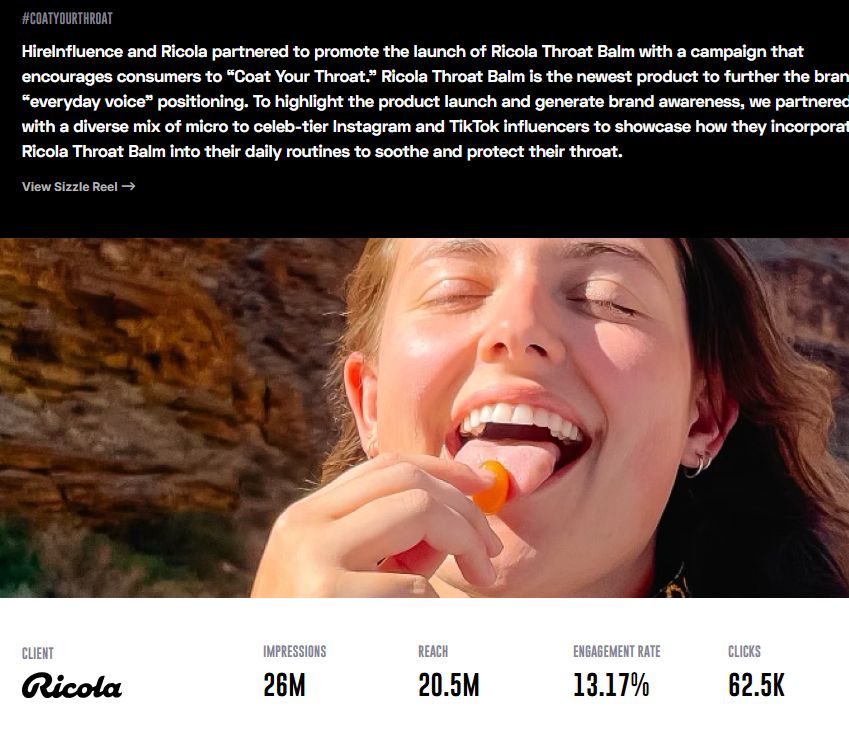
HireInfluence builds these multi-tier programs with campaign objectives as the starting point, not creator availability. The Ricola #CoatYourThroat campaign, documented on the Ricola project page, deployed 18 influencers across tiers and generated 26 million impressions, 20.5 million reach, a 13.17% engagement rate, and 62,500 tracked retail clicks. That engagement rate, which is exceptional at campaign scale, reflects the contribution of smaller-tier creators whose authentic content drove the consideration and conversion layer while broader-tier creators generated awareness.
UGC as a Nano Program Output
One of the most valuable and least discussed outputs of a well-run nano influencer program is the UGC library it creates. Authentic creator content from nano influencers, produced in real-life settings with genuine product use, performs exceptionally well when licensed and amplified through paid social channels. It also outperforms studio-produced brand creative on click-through and conversion metrics consistently.
Understanding what UGC is and how it functions in a broader campaign architecture is foundational for brands considering nano programs. HireInfluence’s White Glove UGC Services manage the full cycle from briefing through licensing and paid placement, giving brands a sustainable content pipeline from their nano creator partnerships.
Platform Considerations for Nano
TikTok is the highest-performing platform for nano creators based on engagement data. The algorithm rewards content quality over follower count, which means a nano creator with 2,000 followers can achieve the same or greater organic reach on a strong piece of content as a mid-tier creator with 200,000. For brands with TikTok Shop integration, HireInfluence’s status as an official TikTok Shop Lite Program partner provides access to data and ad infrastructure that amplifies the performance of nano-tier content beyond organic reach. More on how TikTok influencer marketing works in practice is available on the HireInfluence blog.
Instagram remains the most widely used platform for nano creator programs. Story content, Reels, and feed posts all perform well at the nano tier because the intimate audience relationship translates to higher swipe-through rates and genuine comment engagement rather than passive likes.
What Enterprise Brands Should Expect From a Nano Influencer Marketing Agency
The criteria that matter most when evaluating a nano influencer marketing agency are operational depth, niche alignment capability, and measurement infrastructure.
Operational depth means the agency can manage the volume and complexity of a large nano creator program without creating bottlenecks in briefing, compliance, or content review. Niche alignment capability means they select creators based on category fit and audience composition, not just metrics. Measurement infrastructure means they aggregate performance across dozens of creators and connect campaign activity to business outcomes.
HireInfluence delivers this for enterprise brands at the scale and budget level where these programs make the biggest difference. Minimum engagement is approximately $100,000. To discuss what a nano influencer program would look like for your brand, contact HireInfluence.