
Consumer packaged goods marketing teams have been running creator content through social media for more than a decade, but the discipline has shifted significantly over the past two years. NetSuite’s 13 Key CPG Industry Trends in 2026 report documents a set of structural changes that directly reshape what a social media influencer agency has to deliver for CPG enterprise brands. According to NetSuite, influencer marketing has become one of the most popular channels for CPG brands, with partnerships deployed across Instagram, TikTok, and YouTube as primary platforms. At the same time, 79% of global consumers say they are trading down when shopping, according to McKinsey data that NetSuite cited, 81% of consumers ignore irrelevant marketing messages, and 96% say personalized messages from brands make them likely to purchase, per Attentive’s 2025 Consumer Trends Report that NetSuite incorporated. The DTC market is projected to hit $319.6 billion in 2026, with major CPG companies including Unilever and Procter & Gamble acquiring DTC businesses to protect market position.
Table of Contents
- Why NetSuite’s CPG Trend Data Reshapes the Social Media Influencer Agency Decision
- What Enterprise CPG Brands Should Expect From a Social Media Influencer Agency
- What Enterprise CPG Social Media Influencer Delivery Produces
- How Enterprise CPG Brands Should Evaluate a Social Media Influencer Agency
- The Social Media Influencer Agency Model for CPG Brands
For CPG marketing teams evaluating a social media influencer agency, those NetSuite findings establish a specific capability profile. Social media influencer marketing for CPG brands cannot rely on broad-reach follower-count campaigns. The trading-down consumer behavior means campaigns have to connect to value messaging, the 81% irrelevant-message-ignoring data means content targeting has to be audience-specific, the 96% personalization conversion signal means creator content has to feel native to specific consumer contexts, and the DTC market expansion means the agency has to coordinate social media influencer activity with direct-to-consumer infrastructure alongside traditional retail channels. This guide breaks down what enterprise CPG brands should expect from a social media influencer agency in 2026, how NetSuite’s trend data reshapes the capability requirements, and what separates a partner built for the current CPG operating environment from a generalist offering.
Why NetSuite’s CPG Trend Data Reshapes the Social Media Influencer Agency Decision
NetSuite’s documentation of the CPG shift toward personalization, value, and DTC expansion changes what social media influencer marketing has to deliver operationally. When 81% of consumers ignore irrelevant marketing messages, mass-reach creator campaigns targeting broad demographics produce diminishing returns compared to creator programs calibrated to specific consumer segments with specific needs. The agency has to source creators whose audiences match the narrow segments the CPG brand is trying to reach, direct content to speak to those specific consumer contexts, and measure program performance at the segment level rather than aggregate impressions. Generic creator content deployed broadly falls into the 81% ignored category that NetSuite’s data identifies.
For CPG brands specifically, NetSuite’s finding on trading-down behavior compounds the requirements. Consumers under economic pressure are making more deliberate purchase decisions, which means creator content that builds trust and authentic product association drives better outcomes than content that simply generates awareness. The creator’s existing credibility with their audience transfers to the brand when the partnership feels authentic. That transfer does not happen when the content feels like a sponsored post deployed without regard for how the creator normally communicates with their audience. A social media influencer agency that respects creator voice and produces content that fits the creator’s existing content patterns delivers the trust-building outcomes CPG brands in the trading-down environment need.
NetSuite’s documentation of DTC expansion and major CPG acquisition activity is equally consequential for how social media influencer programs have to operate. When Unilever and Procter & Gamble are acquiring DTC businesses, they are acquiring the commerce infrastructure that connects social media activity directly to purchase. A social media influencer agency supporting CPG enterprise brands now has to coordinate creator programs with both traditional retail channels (grocery, mass, drug, club) and DTC channels (brand-owned e-commerce, subscription services, digital-first product lines). The agency that can operate across both channel types with unified measurement and attribution has the capability profile the current CPG environment demands.
The 96% personalization-to-conversion signal NetSuite highlighted reinforces what creator marketing has to look like in practice. Creator content that feels personalized to the creator’s specific audience context (community conversations, specific use cases, authentic product integration, creator-native formats) performs against that 96% data point. Content that follows generic brand campaign templates does not. The social media influencer agency’s creative direction capability is what determines whether CPG creator content lands in the personalized category or the ignored category.
What Enterprise CPG Brands Should Expect From a Social Media Influencer Agency
A credible social media influencer agency for CPG brands operates across eight coordinated service functions calibrated specifically to CPG category dynamics and the NetSuite trend profile.
CPG social media influencer strategy and commerce measurement design. The engagement begins with business objectives tied to CPG-specific outcomes (shelf velocity, retail partner visibility, DTC conversion, trial generation, community building) and a measurement framework that connects creator activity to those outcomes. HireInfluence structures CPG social media influencer strategy through dedicated campaign services built for enterprise CPG engagements.
Creator sourcing calibrated to CPG category dynamics and segment precision. NetSuite’s data on consumer message filtering makes segment precision central. The agency has to source from creators with proven capability in food, beverage, beauty, personal care, and household goods categories, with audience demographics that match the specific segments the CPG brand is targeting rather than broad demographic buckets.
Creative direction supporting personalized, authentic content. NetSuite’s 96% personalization data reinforces what creator content has to accomplish. The agency’s creative direction preserves authentic creator voice, supports segment-specific communication, and integrates CPG product into content contexts that feel native to the creator’s existing audience relationship rather than imposed on it.
Contracting and rights management calibrated to CPG multi-channel distribution. Rights structure has to cover retail partner distribution (in-store screens, retailer digital channels, retail media networks), DTC channel distribution (brand-owned e-commerce, subscription service marketing), and standard social plus paid channel usage. Multi-channel rights negotiated at the contract phase enable creator content to flow across the full CPG distribution footprint.
Long-term creator partnership management. CPG programs benefit disproportionately from sustained creator relationships because repeat authentic product integration builds the trust transfer that short campaigns cannot. Ambassador programs, multi-year partnerships, and always-on content programs require operational infrastructure calibrated to sustained relationship management.
Paid media amplification with retail and DTC integration. Creator content performs best when organic distribution is paired with paid amplification on platforms with commerce infrastructure. HireInfluence delivers this through its specialties and services capability, including whitelisting, dark posting, cross-platform paid amplification, and retail media coordination for CPG programs that need to connect to both retail and DTC commerce environments.
Commerce-connected attribution infrastructure. UTM frameworks, promo code systems, pixel tracking, conversion event integration, retail commerce measurement (MikMak, retail partner tracking), platform commerce integration (TikTok Shop, Instagram Shopping), and DTC attribution infrastructure. HireInfluence’s analytics capability is designed to give enterprise CPG clients the attribution depth that connects social media influencer activity to measurable retail and DTC outcomes.
Category and community expertise. Food, beverage, beauty, personal care, and household goods all have distinct consumer dynamics, regulatory considerations, and community norms. The agency should demonstrate direct experience in the specific CPG categories where the brand competes rather than generic creator program capability.
What Enterprise CPG Social Media Influencer Delivery Produces
CPG brands evaluating a social media influencer agency should look at programs that demonstrate what enterprise-scale CPG social media influencer marketing produces.
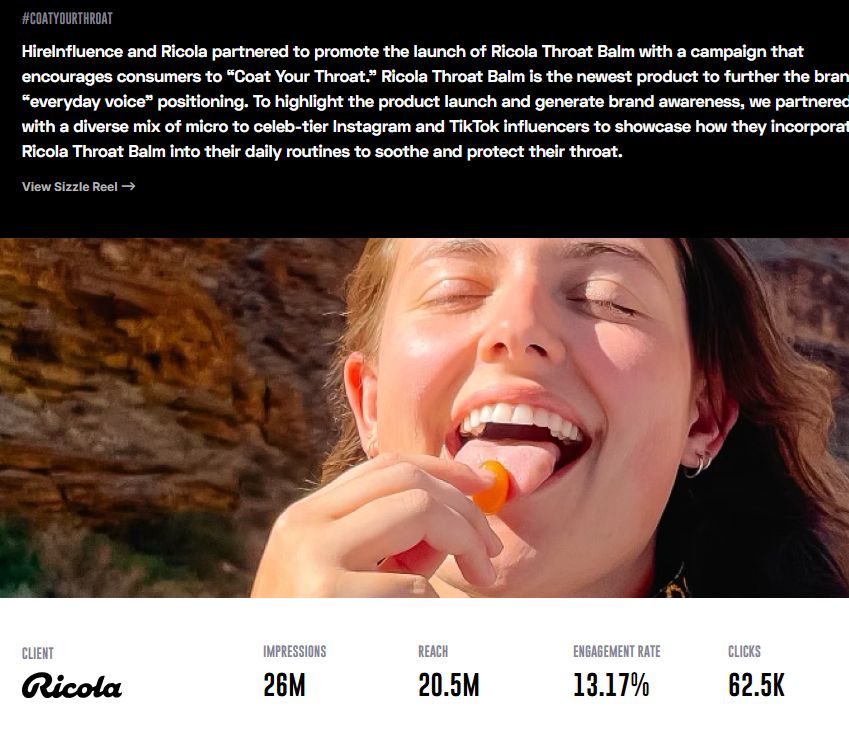
The Ricola #CoatYourThroat program is the reference benchmark for CPG social media influencer marketing. The campaign drove 26 million impressions, 20.5 million reach, a 13.17% engagement rate across 18 creators spanning micro to celebrity tier, and 62,500 MikMak retail purchase clicks. The MikMak integration is the specific capability that NetSuite’s CPG trend framework points to: creator content connected directly to measurable retail purchase activity, with the commerce attribution infrastructure required for enterprise finance validation. The Ricola case study documents how creator tier selection, content strategy, and retail attribution came together.
The Oreo/McDonald’s #OREOShamROCKout campaign delivered 1.7 million impressions at $0.06 CPE. That efficiency metric is what CPG enterprise finance teams use to compare social media influencer spend against other paid media investments, and it sets a baseline for what CPG creator programs should produce when creator selection, creative strategy, and paid amplification are coordinated as a single system.
The broader HireInfluence engagement with CPG-adjacent brands including Coca-Cola, Walmart (for CPG product activations), Target (for CPG product activations), and Oreo demonstrates the CPG category depth enterprise social media influencer programs require. HireInfluence’s food and beverage capability documents category-specific examples worth referencing for CPG brand buyers. The work portfolio includes additional CPG case examples.
How Enterprise CPG Brands Should Evaluate a Social Media Influencer Agency
Five evaluation questions separate credible CPG social media influencer partners from generalist agency offerings.
First, ask about segment precision in creator sourcing. NetSuite’s 81% irrelevant-message-ignoring data makes this central. The agency should describe how creator sourcing matches specific audience segments rather than broad demographics, with examples of CPG segment-specific creator programs.
Second, ask about commerce attribution methodology across both retail and DTC channels. MikMak integration, retail partner tracking, TikTok Shop infrastructure, Instagram Shopping integration, retail media network connectivity, and DTC attribution infrastructure. A CPG social media influencer program that cannot connect to commerce outcomes across both channel types is not serving the current enterprise CPG environment.
Third, ask about long-term creator partnership infrastructure. The trust transfer CPG programs need builds through sustained relationships. The agency should describe how ambassador programs, long-term partnerships, and always-on content programs are structured with examples of multi-year CPG creator engagements.
Fourth, ask about CPG category experience specifically. Food, beverage, beauty, personal care, and household goods each require distinct category expertise. The agency should demonstrate direct experience in the CPG category where the brand competes, with outcome data calibrated to CPG business objectives.
Fifth, ask about retail calendar alignment. CPG campaigns are built around seasonal moments, product launches, and promotional windows tied to retail partner plans. An agency without retail calendar coordination cannot deliver against CPG-specific timing requirements.
The Social Media Influencer Agency Model for CPG Brands
HireInfluence runs enterprise social media influencer programs for CPG-adjacent brands across the category. The agency was founded in 2011 and maintains offices in Houston and The Woodlands, TX; Austin, TX; Los Angeles, CA; and New York, NY. That national footprint, combined with CPG category depth built across more than a decade, positions the agency to deliver social media influencer programs calibrated specifically to CPG business requirements and the trend profile NetSuite documented.
Engagements typically start at approximately $100,000, aligned with the enterprise delivery standard. Confirmed clients include Microsoft, Southwest Airlines, Target, Coca-Cola, Walmart, Meta, McDonald’s, Oreo, Grammarly, Ricola, and MTV, multiple of which are direct CPG engagements or CPG-adjacent programs. Award recognition across 2024 and 2026 includes the MUSE Creative Awards, Netty Awards, NYX Awards, Global Digital Excellence Awards, U.S. Agency Awards, and Vega Digital Awards. The agency is also an exclusive TikTok Shop Lite Program partner since July 2024, providing direct access to TikTok’s commerce infrastructure for CPG social media influencer programs that need to connect to measurable commerce outcomes.
Jason Pampell, Founder and CEO, launched HireInfluence in 2011 after managing content rights and strategic media partnerships for Forbes and Billboard. His 30+ years of leadership experience in sales, marketing, and team building for Fortune 1000 organizations informs how the agency structures CPG social media influencer engagements. His approach to building the company shaped how enterprise programs get delivered for CPG clients today.
For enterprise CPG brands ready to evaluate what a social media influencer engagement calibrated to the current CPG environment should include, the HireInfluence team handles initial conversations directly. Brands benchmarking pricing should reference the cost of influencer marketing guide for context on enterprise engagement costs. Those evaluating TikTok-focused strategies should review the TikTok influencer marketing resource.
NetSuite’s CPG trend data makes the operating environment clear. Consumer message filtering, trading-down behavior, DTC expansion, and personalization-to-conversion dynamics all point toward segment-precise, authentically-voiced, commerce-connected creator programs. The social media influencer agency decision for CPG enterprise brands is the decision about which partner has built the capability profile the trend data describes. The brands winning in the current CPG environment are working with partners calibrated to the current consumer and channel dynamics, not those still operating on broad-reach creator marketing models from an earlier moment in the discipline.