Travel marketing teams evaluating a social media influencer agency in 2026 are operating against a demand environment that has shifted from post-pandemic recovery momentum to a more measured pace. Deloitte’s 2026 Travel Industry Outlook, based on synthesized findings from three primary 2025 research efforts including the 2025 Deloitte Summer Travel Survey, 2025 Deloitte Holiday Travel Survey, and 2025 Deloitte Corporate Travel Study, documents the reality travel brands now face. Over the 2025 to 2026 holiday season, more than half of Americans planned to travel (the highest share since the onset of the COVID-19 pandemic), but many have shifted toward a conservative approach with cuts to trip frequency, trip length, distance traveled, accommodation class, and in-destination activities. Financial pessimism, reaching into higher income levels compared to recent years, is the primary cause of this frugal trip planning. Even households making at least $100,000 annually reported the biggest drop in planned trips across income groups and expressed a strong inclination for shorter trips throughout the holiday travel season. Additional government regulations including a new US$250 visa integrity fee and narrowed requirements for waivers of in-person visa interviews are affecting inbound international tourism, though international visits are forecast to resume growth in 2026 (+3.7%) driven by U.S.-hosted events including the FIFA World Cup and America 250 celebrations.
Table of Contents
- Why Deloitte’s 2026 Travel Data Reshapes the Social Media Influencer Agency Decision
- What Travel Brands Should Expect From a Social Media Influencer Agency
- Travel Social Media Influencer Program Delivery
- How Travel Brands Should Evaluate a Social Media Influencer Agency
- The Social Media Influencer Agency Model for Travel Brands
For travel marketing teams, Deloitte’s findings establish a specific reality a social media influencer agency has to address. Consumer financial caution is driving more selective travel purchase decisions, which means creator content now has to work harder to convert travelers who are evaluating value more carefully and choosing trips more deliberately. The shift in intent behavior (shorter trips, more conservative accommodation choices, fewer in-destination activities) means creator programs have to connect to specific conversion points along the travel booking funnel rather than generating broad aspiration-only content. At the same time, the 2026 event-driven international inbound opportunity (World Cup, America 250) creates a specific window for travel brands to capture international visitor attention through creator programs that reach visitors in their origin markets. This guide breaks down what enterprise travel brands should expect from a social media influencer agency in 2026 using the “social media influencer agency” framing that differentiates from full-service travel marketing, how Deloitte’s 2026 travel industry data reshapes the capability requirements, and what separates a partner built for current travel dynamics from a generalist agency offering.
Why Deloitte’s 2026 Travel Data Reshapes the Social Media Influencer Agency Decision
Deloitte’s documentation of consumer financial caution reaching higher income levels changes what travel social media influencer marketing has to deliver. When even $100K+ households are cutting trip frequency and considering shorter itineraries, creator content targeting travel audiences has to work harder at the conversion stage rather than producing aspiration content that does not connect to specific booking decisions. The agency has to structure creator programs that move audiences from awareness through consideration to booking, with attribution infrastructure that tracks creator activity’s contribution to actual bookings rather than impression or engagement metrics alone.
For travel brands specifically, the shift in intent behavior (shorter trips, more conservative accommodation choices, fewer in-destination activities) reinforces what the agency’s capability profile has to include. Creator content has to support travelers evaluating specific trip variables (destination selection, accommodation tier, activity choices, trip length) with authentic information that helps decision-making rather than inspirational content that does not address the specific considerations current travelers are weighing. Creator programs for hotel brands now have to support value positioning and specific property differentiation, creator programs for destination marketing organizations have to support destination-specific trip planning, and creator programs for travel platforms have to support specific booking outcomes.
Deloitte’s finding on the 2026 event-driven international inbound opportunity is particularly consequential. The FIFA World Cup and America 250 celebrations represent specific windows where travel brands can capture international visitor attention. Creator programs that reach international audiences in their origin markets, operate in appropriate local languages and cultural contexts, and align with specific visitor planning behaviors around these events produce outcomes tied to identifiable visitor flows. An agency without international creator infrastructure or multi-market coordination capability misses the specific opportunity the 2026 calendar creates.
The regulatory changes Deloitte documented (visa integrity fee, narrowed interview waiver requirements, proposed social media history requirements) reshape how international audiences think about U.S. travel. Creator content addressing U.S. destinations has to address the practical considerations international audiences face, which requires creator partners with direct credibility addressing those considerations for specific source market audiences.
Travel creator content performs strongly because travel audiences actively seek visual and authentic information as part of the trip planning process. The agency’s ability to source creators with proven travel category audiences, produce platform-native content that works through the booking funnel, and measure outcomes against actual bookings rather than awareness proxies is what determines whether travel creator programs serve the demand environment Deloitte documented.
What Travel Brands Should Expect From a Social Media Influencer Agency
A credible social media influencer agency for travel brands operates across eight coordinated service functions calibrated to travel category dynamics.
Travel social media influencer strategy and booking attribution measurement. The engagement begins with business objectives tied to travel outcomes (bookings, room nights, flight segments, destination consideration, travel platform revenue) and a measurement framework that connects creator activity to those outcomes. HireInfluence structures travel social media influencer strategy through dedicated campaign services built for enterprise travel engagements.
Creator sourcing with travel category depth. Travel creators come in multiple distinct sub-categories: luxury travel, budget travel, family travel, solo travel, adventure travel, cultural travel, business travel, and destination-specific specialists. The agency should describe specific travel creator sourcing calibrated to the audience segment the travel brand is targeting, not generic travel creator database access.
Platform-native creative direction calibrated to travel planning behavior. Travel audiences use different platforms at different stages of the planning funnel. Pinterest and Instagram for aspiration and discovery, YouTube for detailed property research and destination guides, TikTok for spontaneous travel decisions and quick reference, Reddit and forum-adjacent content for detailed planning research. The agency’s creative direction has to match content to planning funnel stage with platform-native formats.
Contracting and rights management calibrated to travel distribution needs. Rights structure has to cover social organic and paid, travel booking platform integration, destination marketing channels, retail partner channels where relevant (airline partner marketing, hotel booking platform co-marketing), and international rights where cross-market distribution applies.
Long-term creator partnership management. Travel programs benefit from sustained creator relationships because travel audiences follow creators for recommendations over extended planning cycles. Ambassador programs, property-dedicated creators, destination-dedicated creators, and multi-year partnerships build the audience trust that drives actual bookings.
Paid media amplification with travel commerce integration. Creator content performs best when organic distribution pairs with paid amplification including integration with travel booking platforms, search-specific amplification, and platform commerce infrastructure. HireInfluence delivers paid amplification through its specialties and services capability.
Booking attribution infrastructure. UTM frameworks, promo code systems, travel booking platform tracking, property-specific attribution, flight segment tracking, destination visit measurement, and conversion attribution across the travel booking funnel. HireInfluence’s analytics capability is designed to deliver travel-specific attribution depth.
International market coordination capability. The 2026 event-driven inbound opportunity requires agencies capable of coordinating creator programs across international source markets with appropriate local creator sourcing, language and cultural adaptation, and multi-market measurement.
Travel Social Media Influencer Program Delivery
Travel brands evaluating a social media influencer agency should look at programs that demonstrate enterprise-scale travel creator marketing delivery.
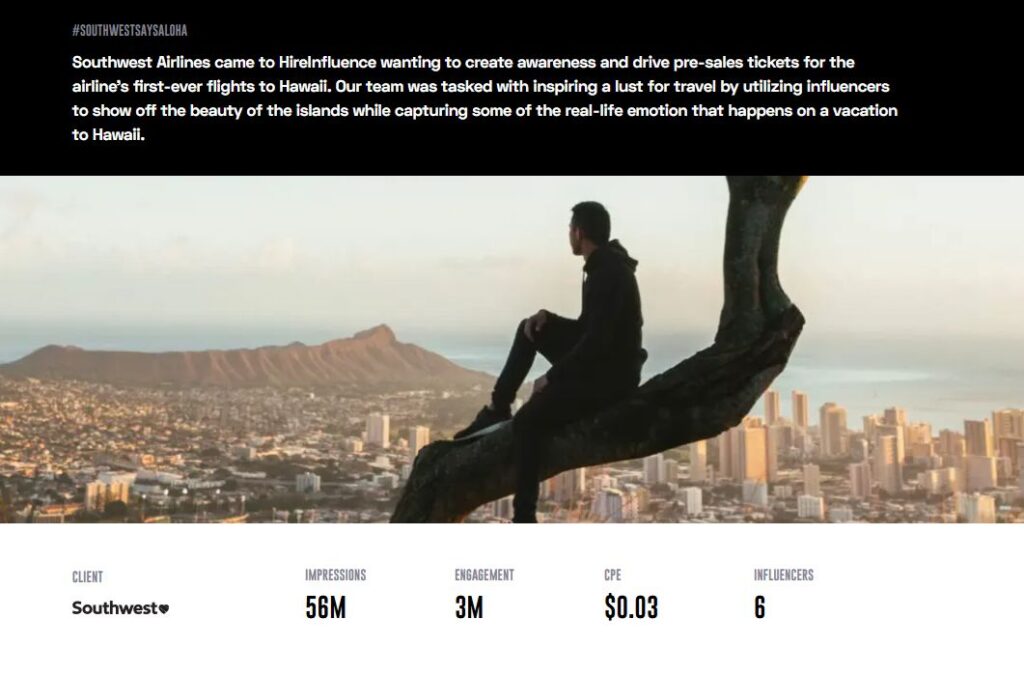
The Southwest Airlines #SouthwestSaysAloha campaign is the direct travel-category reference. The campaign supported the launch of Southwest’s new Hawaiian routes by hand-selecting and activating mainland and Hawaii-based influencers paired together to drive consumer awareness and booking consideration. The program targeted influencers across Family, Lifestyle, Food & Dining, Surfing, and Adventure categories to match Southwest’s key market targets, and organized account takeovers where Hawaii-based influencers temporarily took over the Instagram Stories of mainland influencers. The campaign delivered 56 million impressions and 3 million engagements while producing high-quality influencer-captured UGC positioned so audiences felt they were getting Hawaii-local “inside secrets.” That kind of travel category execution establishes what creator programs produce when calibrated specifically to travel audience dynamics.
The Ricola #CoatYourThroat program demonstrates how creator programs integrate with commerce attribution, which applies directly to travel brands running creator programs with merchandise commerce, retail partner integration, or ancillary product marketing. The campaign drove 26 million impressions, 20.5 million reach, a 13.17% engagement rate across 18 creators spanning micro to celebrity tier, and 62,500 MikMak retail purchase clicks. The Ricola case study documents the full program architecture.
The Grammarly engagement demonstrates multi-platform scale that translates directly to travel brands running cross-platform campaigns around destination launches or seasonal travel windows. The program activated 133 creators across YouTube, TikTok, and Instagram, producing 214 million impressions, 33.1 million views, and $15 million in earned media value. Running a program at that scale across three video-native platforms simultaneously requires the operational infrastructure travel marketing programs now demand. The work portfolio documents how the agency scales across program complexity.
How Travel Brands Should Evaluate a Social Media Influencer Agency
Five evaluation questions separate credible travel-category partners from generalist agency offerings.
First, ask about travel category expertise and sub-category depth. Luxury, budget, family, solo, adventure, cultural, business travel, and destination-specific specialists each represent distinct creator ecosystems and audience dynamics. The agency should describe specific travel sub-category experience with examples of programs calibrated to distinct audience segments.
Second, ask about booking attribution methodology specifically. Deloitte’s data on consumer financial caution makes this consequential. The agency should describe how creator activity connects to actual bookings (UTM structures, promo codes, travel platform integration, property-specific attribution) with specific examples of travel programs that demonstrated booking impact.
Third, ask about platform allocation calibrated to travel planning funnel stages. Pinterest, Instagram, YouTube, TikTok, and Reddit-adjacent content each serve different travel planning functions. The agency should describe how platform allocation gets calibrated to funnel stage with specific examples of multi-platform travel program execution.
Fourth, ask about international market coordination capability. The 2026 event-driven inbound opportunity makes this differentiating. The agency should describe international creator sourcing infrastructure, multi-market language and cultural adaptation, and coordination infrastructure for programs spanning multiple origin markets.
Fifth, ask about long-term creator partnership infrastructure for travel. Travel audiences follow creators for recommendations over extended planning cycles. The agency should describe ambassador programs, property-dedicated creator partnerships, and multi-year arrangements with specific examples of sustained travel brand creator engagements.
The Social Media Influencer Agency Model for Travel Brands
HireInfluence runs enterprise social media influencer programs for travel and travel-adjacent brands. The agency was founded in 2011 and maintains offices in Houston and The Woodlands, TX; Austin, TX; Los Angeles, CA; and New York, NY. That national footprint, combined with travel category depth built across more than a decade with brands including Southwest Airlines, positions the agency to deliver creator programs calibrated to travel marketing requirements and the industry profile Deloitte documented. The about section documents how the company operates.
Engagements typically start at approximately $100,000, aligned with the enterprise delivery standard. Confirmed clients include Microsoft, Southwest Airlines, Target, Coca-Cola, Walmart, Meta, McDonald’s, Oreo, Grammarly, Ricola, and MTV, with Southwest Airlines representing direct travel category experience. Award recognition across 2024 and 2026 includes the MUSE Creative Awards, Netty Awards, NYX Awards, Global Digital Excellence Awards, U.S. Agency Awards, and Vega Digital Awards. The agency is also an exclusive TikTok Shop Lite Program partner since July 2024.
Jason Pampell, Founder and CEO, launched HireInfluence in 2011. Prior to founding the company, he managed content rights and strategic media partnerships for Forbes and Billboard. His 30+ years of leadership experience in sales, marketing, and team building for Fortune 1000 organizations shaped how the agency structures enterprise travel creator engagements today.
For travel brands ready to evaluate what a social media influencer engagement calibrated to current travel market dynamics should include, the HireInfluence team handles initial conversations directly through the contact page. Brands benchmarking pricing should reference the cost of influencer marketing guide for context on enterprise engagement costs. Those evaluating TikTok-focused strategies should review the TikTok influencer marketing resource. Travel brands integrating creator content with broader UGC strategy should review the UGC overview.
Deloitte’s 2026 travel industry data makes the operating environment direct. Consumer financial caution is driving more selective travel purchase decisions, trip variables are being evaluated more deliberately, and the 2026 event-driven international inbound opportunity creates specific windows for travel brands to capture international audience attention. The social media influencer agency decision for travel enterprise brands is the decision about which partner has built the capability profile the demand environment now requires. The travel brands winning in the current market are working with partners calibrated to booking-conversion-focused creator programs, multi-platform funnel-aware content strategy, and international market coordination capability, not those still operating on aspiration-only creator marketing models from a different moment in the category.