
Chicago anchors one of the densest concentrations of Fortune 500 headquarters in the United States, with enterprise marketing budgets concentrated across retail, CPG, financial services, food and beverage, industrial technology, airlines, and healthcare. For those enterprise marketing teams, the question of which social media influencer agency to engage has become significantly more consequential as the broader trust environment has shifted under the discipline. The 2026 Edelman Trust Barometer, based on 30-minute online interviews conducted between October 25 and November 16, 2025 across nearly 34,000 respondents in 28 countries, documents a structural change in how trust now flows in society and in consumer relationships with brands. Edelman’s central finding: trust has contracted into what the research calls an “insular trust mindset,” with 70% of people globally hesitant or unwilling to trust those who differ from them in values, beliefs, or background. Trust is retreating from institutions, from celebrity, and from broadcast channels, and flowing inward toward community, shared values, and people who feel familiar.
Table of Contents
- Why the Edelman Trust Data Reshapes the Chicago Social Media Influencer Agency Decision
- What Chicago Fortune 500 Brands Should Expect From a Social Media Influencer Agency
- What Enterprise Social Media Influencer Delivery Produces
- How Chicago Enterprise Brands Should Evaluate a Social Media Influencer Agency
- The National Social Media Influencer Agency Model Serving Chicago
For Chicago Fortune 500 brands, Edelman’s findings establish a specific capability profile a social media influencer agency has to deliver. The research also surfaces a path through the insularity. Among respondents who trust an influencer or creator, 62% say they would trust or consider trusting a company they currently distrust if that influencer vouched for it. For financial influencers specifically, the figure is 57%. Creators function as trust brokers inside closed community circles, translating brand credibility to audiences that have already decided who they trust. A social media influencer agency has to be capable of identifying those trusted nodes, structuring creator partnerships that respect the community dynamics, and measuring impact in ways that capture trust transfer rather than raw reach. This guide breaks down what Chicago Fortune 500 brands should expect from a social media influencer agency in 2026, how Edelman’s trust research reshapes the capability requirements, and what separates a partner built for the trust-broker environment from one still operating on broadcast-era assumptions.
Why the Edelman Trust Data Reshapes the Chicago Social Media Influencer Agency Decision
Edelman’s finding that 70% of people globally are hesitant or unwilling to trust those who differ from them changes the structural logic of social media influencer marketing. Broadcast strategies that assumed reach would translate to influence no longer function the way they did five years ago. Audiences are more skeptical, more insular, and more reliant on voices that feel proximate to their own communities. For Chicago Fortune 500 brands with national or global reach, the implication is direct. The brand is an institution in the Edelman framework, and institutions are under trust pressure. The creator sitting inside a specific community circle has trust access the brand does not. The social media influencer agency’s job is to identify those creators, structure partnerships that enable authentic trust transfer, and measure program performance in terms that actually reflect the trust dynamics Edelman documented.
The specific 62% figure Edelman reported (influencer-trusting audiences who would trust or consider trusting a company vouched for by that influencer) is one of the most consequential data points in recent influencer marketing research. It quantifies trust transfer in a way that directly connects creator partnerships to measurable brand-level trust outcomes. For Chicago financial services brands, the 57% equivalent for financial influencers is particularly relevant because it documents trust transfer potential in a category where consumer trust is historically difficult to build. The social media influencer agency has to be capable of operationalizing that trust transfer through creator selection, relationship structure, and content approach that preserve the authentic trust the creator has already built with their audience.
Edelman’s framing of the broader shift (from an attention economy to what the research calls an “attachment economy”) captures what this means operationally. In the attention economy, influence followed scale: bigger follower count meant more influence. In the attachment economy Edelman describes, influence follows proximity: the creator with 12,000 followers who shares the audience’s values drives more trust transfer than the creator with 2 million followers who feels like an institution themselves. For Chicago enterprise brands, that shift means the agency has to source creators based on audience attachment signals, not just follower count metrics, and structure programs that compound authentic community relationships over time.
The implications for content strategy are equally consequential. Edelman’s research surfaces that broadcast messaging is losing its grip, while earned credibility within specific communities is gaining commercial weight. A social media influencer program at Chicago enterprise scale now has to produce creator content that functions as community-native communication rather than amplified brand messaging. The creator’s voice, the specific audience context, the cultural moments that matter to that community, and the authentic trust signals the audience uses to evaluate credibility all have to be preserved in program design. An agency applying generalized creator content strategies across communities cannot deliver the trust-broker capability the Edelman data shows is now the relevant outcome.
What Chicago Fortune 500 Brands Should Expect From a Social Media Influencer Agency
A credible enterprise-grade social media influencer agency operates across eight coordinated service functions calibrated to the trust-broker environment Edelman documented.
Trust-broker strategy and measurement design. The engagement starts with business objectives that include trust transfer outcomes, not just reach and engagement metrics. KPI frameworks incorporate community-level trust measurement, brand perception shifts among creator audiences, and the specific trust transfer dynamic Edelman documented. HireInfluence structures social media influencer strategy through dedicated campaign services calibrated to enterprise trust outcomes.
Creator sourcing calibrated to community trust signals. Edelman’s data on audience attachment versus raw reach means sourcing has to focus on creators whose audiences display high trust attachment signals, not simply follower count thresholds. A credible agency runs tier-matched sourcing with community attachment analysis, audience authenticity validation, and long-term partnership potential scoring built into creator discovery.
Creative direction supporting authentic community-native voice. Edelman’s research shows that community-native communication drives trust transfer more effectively than amplified brand messaging. The agency’s creative direction has to preserve authentic creator voice, respect community-specific cultural context, and translate brand positioning into the creator’s natural communication style rather than imposing scripted brand content.
Contracting and rights management. Enterprise legal review standards, usage rights structuring, exclusivity windows, approval workflows, and FTC compliance. Rights negotiated at the contract phase have to preserve the creator’s ability to maintain authentic community relationships while enabling brand-appropriate content distribution.
Long-term creator partnership infrastructure. Trust transfer compounds through sustained creator relationships, not one-off campaigns. Edelman’s attachment economy framing makes ambassador programs, multi-year partnerships, and always-on content programs more valuable than project-by-project campaigns. The agency should describe specific infrastructure for managing creator relationships across extended time.
Paid media amplification with community-respectful targeting. Paid amplification of creator content has to reach the creator’s existing community primarily, not force the content into adjacent audiences that may not share the trust relationship. HireInfluence delivers this through its specialties and services capability, including whitelisting, dark posting, and community-calibrated amplification across Meta, TikTok, YouTube, and emerging platforms.
Trust-oriented attribution and measurement. UTM frameworks, promo code systems, pixel tracking, conversion event integration, and measurement that tracks trust transfer through brand lift studies, purchase intent shifts, and long-term brand perception changes alongside immediate engagement metrics. HireInfluence’s analytics capability is designed to provide enterprise clients with the attribution depth required for trust-oriented outcome measurement.
Category and community-specific expertise. Chicago Fortune 500 brands operate across categories with distinct community dynamics. Financial services communities, CPG consumer communities, retail communities, airline and travel communities, and healthcare communities each have specific trust signals and communication norms. The agency should demonstrate specific community expertise rather than applying generic creator program structures.
What Enterprise Social Media Influencer Delivery Produces
Chicago Fortune 500 brands evaluating a social media influencer agency should look at programs that demonstrate what enterprise-scale delivery produces.
The Grammarly engagement is a strong benchmark for Chicago-based technology, SaaS, and productivity brands. The program activated 133 creators across YouTube, TikTok, and Instagram, producing 214 million impressions, 33.1 million views, and $15 million in earned media value. Running 133 creators across three platforms simultaneously requires the operational infrastructure that enterprise trust-broker programs now need. The work portfolio documents how the agency scales across influencer program complexity.
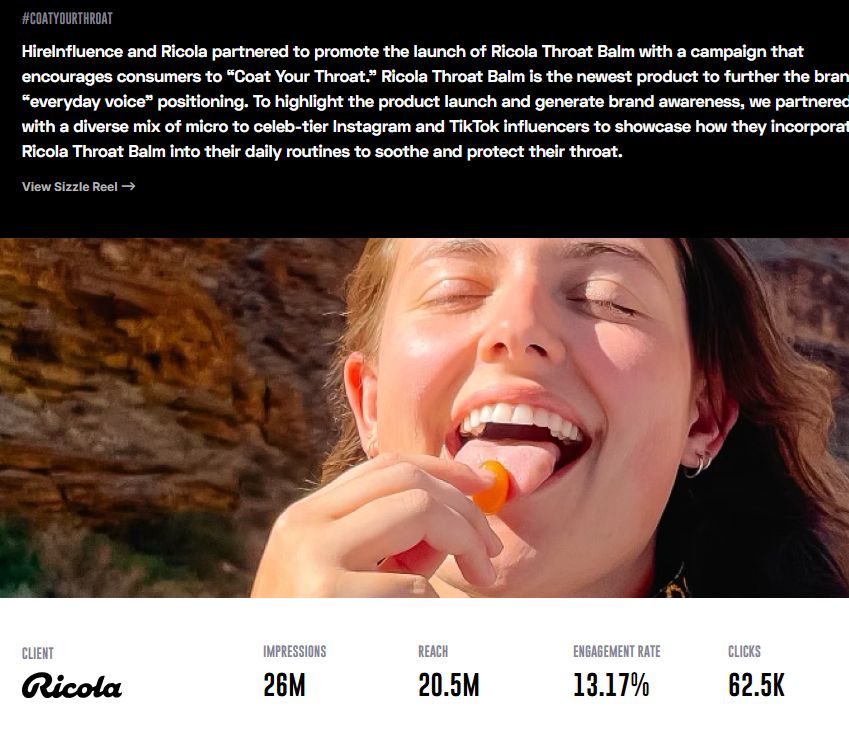
The Ricola #CoatYourThroat program illustrates how creator trust transfer connects to commerce outcomes. The campaign drove 26 million impressions, 20.5 million reach, a 13.17% engagement rate across 18 creators spanning micro to celebrity tier, and 62,500 MikMak retail purchase clicks. The engagement rate specifically (13.17%, significantly above typical influencer program benchmarks) reflects the kind of trust transfer Edelman’s research identifies as the outcome that matters. The Ricola case study documents how creator tier selection, community calibration, and commerce attribution came together.
The Oreo/McDonald’s #OREOShamROCKout campaign delivered 1.7 million impressions at $0.06 CPE. The MTV #MyMTVStyle TikTok campaign generated 16.1 million impressions at $0.01 CPV and $1.50 CPM with 216,600 engagements. The Southwest Airlines #SouthwestSaysAloha campaign drove 56 million impressions and 3 million engagements. For Chicago-based brands in QSR, entertainment, airline, and consumer categories, those efficiency and scale numbers are what enterprise finance teams use to benchmark social media influencer spend against other paid channels.
How Chicago Enterprise Brands Should Evaluate a Social Media Influencer Agency
Five evaluation questions separate credible trust-broker partners from broadcast-era offerings for Chicago Fortune 500 social media influencer buyers.
First, ask about trust transfer measurement methodology. Edelman’s 62% data point makes this central. The partner should describe how the agency measures trust transfer from creator to brand, what specific brand lift methodologies are used, and how trust outcomes get reported alongside standard engagement metrics.
Second, ask about community attachment analysis for creator sourcing. The partner should describe how creator sourcing evaluates audience attachment signals beyond follower count, what specific community trust signals the agency uses, and how those signals inform tier-matched creator selection.
Third, ask about category-specific community expertise. Chicago Fortune 500 brands operate in distinct categories with distinct community dynamics. Financial services, CPG, retail, airlines, and healthcare communities each have specific communication norms. The agency should demonstrate category-specific community expertise, not generic creator program capability.
Fourth, ask about long-term creator partnership infrastructure. Edelman’s attachment economy framing makes sustained relationships more valuable than one-off campaigns. The agency should describe specific infrastructure for ambassador programs, long-term partnerships, and always-on content programs with examples of multi-year creator engagements.
Fifth, ask about creative direction that preserves authentic community voice. The partner should describe how creative direction translates brand positioning into creator-native communication, with specific examples of campaigns where creator authenticity was preserved rather than overridden.
The National Social Media Influencer Agency Model Serving Chicago
HireInfluence serves Chicago-based Fortune 500 brands through a national social media influencer service delivery model. The agency operates from offices in Houston and The Woodlands, TX; Austin, TX; Los Angeles, CA; and New York, NY, and runs national social media influencer programs for brands headquartered across major US markets including Chicago. That national footprint, combined with creator relationships built across more than a decade, positions the agency to deliver the kind of trust-broker engagement Chicago enterprise social media influencer programs require.
HireInfluence was founded in 2011 and is recognized as one of the first full-service social media influencer agencies in the United States. Engagements typically start at approximately $100,000, reflecting the enterprise delivery standard. The client roster includes Microsoft, Southwest Airlines, Target, Coca-Cola, Walmart, Meta, McDonald’s, Oreo, Grammarly, Ricola, and MTV, clients whose categories align closely with the Chicago enterprise economy. Award recognition across 2024 and 2026 includes the MUSE Creative Awards, Netty Awards, NYX Awards, Global Digital Excellence Awards, U.S. Agency Awards, and Vega Digital Awards. The agency is also an exclusive TikTok Shop Lite Program partner since July 2024, which matters for Chicago retail and CPG brands whose creator programs need to integrate with commerce infrastructure.
Jason Pampell, Founder and CEO, launched HireInfluence in 2011. Prior to founding the company, he managed content rights and strategic media partnerships for Forbes and Billboard. His 30+ years of leadership experience in sales, marketing, and team building for Fortune 1000 organizations informs the service model the agency delivers today. His approach to building the company shaped how social media influencer engagements are structured for brands across major US markets.
For Chicago Fortune 500 brands ready to evaluate what a trust-broker-calibrated social media influencer engagement should include, the HireInfluence team handles initial conversations directly. Brands benchmarking pricing should reference the cost of influencer marketing guide. Those evaluating TikTok-focused program structures should review the TikTok influencer marketing resource. Brands integrating influencer content with broader UGC strategy should review the UGC overview.
Edelman’s 2026 Trust Barometer makes the trust environment clear. Audiences are retreating into insular community circles, broadcast influence is losing its hold, and creators inside trusted community relationships function as the mechanism by which brands can earn access to audiences that would otherwise distrust them. For Chicago Fortune 500 brands, the social media influencer agency decision is the decision about which partner has built the trust-broker capability the data describes. The brands winning in the current environment are working with partners calibrated to the attachment economy Edelman documented, not with agencies still operating on the broadcast influence model that defined the discipline in an earlier moment.