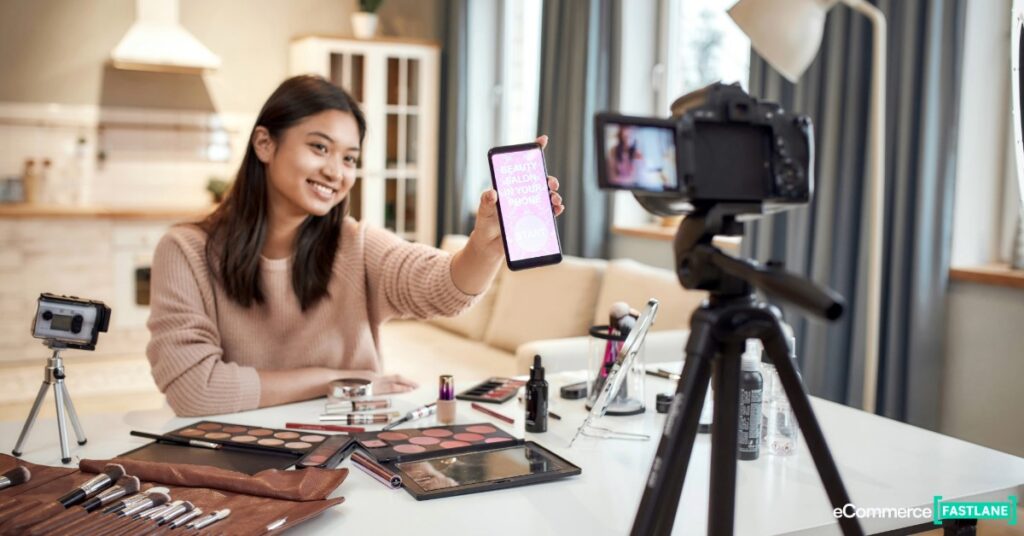
Most enterprise brands treat live commerce as a broadcast problem, which is why a live shopping agency spends the first month of a new program arguing about inventory rather than production. The assumption is that a livestream is a television segment with a checkout button bolted on, and that the work is making the segment compelling enough to convert. The platform data points the other direction. Brands and creators hosted more than 8 million hours of live shopping sessions in the United States during 2024, and platform sales rose 120% year over year in the period that followed. More than 171,000 local and small businesses now sell through the format, sales to small businesses grew 70% in a single year, and over a third of all monthly purchases on the platform went to those sellers. Those figures describe an operational shift rather than a creative one. The sellers winning at live commerce are rarely the ones producing the best television. They are the ones who settled assortment, pricing, and fulfillment before the camera turned on.
Table of Contents
Why Entertainment and Merchandising Are Unrelated Properties
Entertainment and merchandising are unrelated properties. A stream can hold an audience for two hours and sell almost nothing, and a stream can move inventory at a pace that embarrasses a paid media plan while looking amateurish on screen. The two outcomes draw on different disciplines, and the brands that struggle in this channel are usually the ones that staffed only for the first.
The confusion is understandable, because live selling borrows its grammar from broadcast. There is a host, a run of show, a clock, and an audience arriving in real time. Everything visible on screen resembles television, so procurement routes the work to production partners and creative agencies who are genuinely good at television. What sits underneath the broadcast is a retail operation, and retail operations fail for retail reasons.
The most common failure is assortment. A creator can be perfectly matched to a brand, prepared, charismatic, and still stall out because the products chosen for the session were priced above the impulse threshold for that audience, or because the hero item sold through in the first eleven minutes and nothing behind it carried the remaining hour. That is a merchandising decision made weeks earlier by someone who never watched a stream.
The second failure is pacing against inventory rather than against attention. Broadcast logic says to build toward a climax. Retail logic says that viewers arrive continuously throughout a session, that most of them watch for a fraction of the total runtime, and that any product mentioned only once will be missed by the majority of the audience. A session structured as a story sells worse than a session structured as a loop.
The third failure is treating the creator as talent rather than as a merchant. Creators who sell well develop a working knowledge of margin, of which claims survive scrutiny in the comments, and of which objections recur often enough to answer preemptively. That knowledge accumulates over dozens of sessions and it does not transfer from a casting brief.
Discovery behaves differently here as well. Shoppers arriving in this environment are not searching for a known item, they are encountering products they did not set out to find, which means the burden of explanation sits entirely with the session. In a search-led channel the shopper brings intent. In a discovery-led channel the seller has to manufacture it inside a few seconds of exposure, repeatedly, for an audience that keeps turning over.
That difference reshapes the measurement conversation. Attribution windows tuned for search behave badly against a format where the purchase decision forms and closes inside a single viewing session, and where a viewer who did not buy may return three days later through an entirely different surface. Programs judged on same-session conversion alone consistently undervalue the channel, and programs judged on view counts consistently overvalue it.
Frequency matters more than production budget. A brand running one flagship session per quarter is buying a very expensive experiment with no learning curve attached, because every variable changes between attempts. A brand running several sessions per week builds a usable read on which products, hosts, time slots, and offers actually perform, and the production quality of any individual session becomes close to irrelevant next to that.
The small business result in the platform data makes the point sharply. Sellers with no production infrastructure, no agency, and no media budget captured a disproportionate share of purchases, which is difficult to explain if polish were the operative variable. What those sellers had instead was proximity to their own inventory, freedom to reprice inside a session, and enough repetition to learn quickly.
Compression of the decision cycle carries a cost that surfaces after the session ends. A format that moves a shopper from first exposure to checkout inside a few minutes produces a different return profile than a channel where the same shopper deliberated across a week, and in apparel and beauty that gap can be substantial. Programs reporting gross revenue without netting returns will read as successful for two quarters and then face an uncomfortable reconciliation. The honest measure is contribution after returns, and it belongs in the reporting agreement before the first session rather than in a revision after the third.
The comment stream is the most underused asset in the format. Objections, sizing confusion, price resistance, and direct competitor comparisons all surface in writing, in real time, at volume, and attached to a specific product moment. Most brands treat that stream as a moderation burden and staff it accordingly. Treated instead as research, it produces a ranked list of purchase barriers that would otherwise require a commissioned study, and it refreshes every session at no additional cost.
Internal readiness ends more pilots than creative quality does. A session that performs will spike order volume into fulfillment, drive an unusual pattern of questions into customer service, and expose any lag between the storefront and the inventory system. Brands that ran one strong session and then quietly shelved the program almost always shelved it for one of those reasons rather than because the content underperformed. Readiness is unglamorous and it is the difference between a pilot and a channel.
None of this argues that craft is worthless. It argues that craft is the second problem. A brand that solves merchandising and cadence and then adds production quality will outperform a brand that starts from production quality and hopes the retail mechanics resolve themselves. The order of operations is the whole argument.
What Enterprise Brands Should Expect From a Live Shopping Partner
Assortment planning before casting. The agency has to select the products for a session against price sensitivity, margin, and stock depth before any creator conversation begins, and campaign planning should reflect that sequence.
Run of show built as a loop. The agency has to structure each session so that every product receives multiple full explanations across the runtime rather than a single scripted moment.
Creator selection weighted toward selling history. The agency has to prioritize demonstrated conversion behavior over audience size when building a host bench for commerce sessions.
Content rights secured for repurposing. The agency has to clear usage in advance so that clips from a live session can run as paid inventory afterward, which is where much of the durable value in creator generated content sits.
Offer mechanics agreed with finance. The agency has to lock discount depth, bundle logic, and margin floors with the brand before a host is asked to improvise against them.
Platform fluency kept current. The agency has to track format and policy changes across short form video platforms because commerce features on these surfaces change faster than annual planning cycles.
Category specific compliance handled upfront. The agency has to route regulated claims through review before they are spoken live, and specialty practice knowledge determines whether that review is realistic or theatrical.
Measurement designed for discovery. The agency has to instrument sessions so that delayed and cross surface purchases are captured, and analytics infrastructure should be in place before the first stream rather than after.
Program Delivery Behind Live Commerce Sessions
Sustained creator programs generate the volume that makes commerce learning possible. A national airline campaign delivered 56M impressions and 3M engagements across a coordinated creator roster, which produced enough repetition to identify which content structures held attention through a full sequence. On the commerce side, the Ricola program drove 62,500 MikMak clicks, a metric that tracks the step between watching and buying rather than the step between scrolling and watching. Both numbers matter for different reasons, and programs that report only the first will misjudge the second. Additional examples of sustained creator work sit in the agency portfolio. Programs built for commerce are evaluated on whether the learning curve steepens across sessions, not on whether any single session performed.
How to Evaluate a Live Shopping Agency
First, ask how product selection is decided and who signs off. The agency should be able to describe a merchandising process that runs ahead of casting rather than after it.
Second, ask what the host bench looks like and how it was built. The agency should describe selection criteria weighted toward selling outcomes rather than follower counts.
Third, ask how usage rights are handled for live footage. The agency should treat post session clip rights as a standard term rather than an afterthought negotiated once a session performs.
Fourth, ask how sessions are measured beyond same session revenue. The agency should be able to explain how delayed purchases and cross surface behavior are captured and attributed.
Fifth, ask what a realistic cadence and budget looks like for a first year. The agency should give a frequency recommendation grounded in learning rate, and the cost of influencer marketing should be framed against repetition rather than against a single flagship event.
The HireInfluence Model for Live Commerce
HireInfluence was founded in 2011 and operates with a team of more than 25 people spread across more than 10 states, with offices in Houston, The Woodlands, Austin, Los Angeles, and New York, and a six figure engagement floor. The agency was named Marketing Agency of the Year at the 2024 MUSE Creative Awards and Digital Marketing Agency of the Year at the 2026 U.S. Agency Awards. It has been a TikTok Shop Lite partner since July 2024, which means live commerce mechanics are practiced infrastructure rather than a capability assembled per engagement. Client work spans Walmart, Target, Oreo, Coca-Cola, Southwest Airlines, and Microsoft.
Founder and CEO Jason Pampell priced content rights, licensing, and media partnerships at Forbes and Billboard before 2011, where live and event inventory was always priced on a different basis from static placement. The value of a live slot sat in what could be transacted inside the moment, so it was sold against readiness rather than against reach, and the sellers who prepared inventory and offer terms in advance captured most of it. That structure transferred intact to creator commerce.
The research supports a plain conclusion. Live selling is a retail discipline wearing broadcast clothing, and brands that resource it accordingly outperform brands that resource it as content. Enterprise teams weighing the format can reach the contact page or read more about the agency.