
Enterprise marketing teams evaluating a UGC creator agency in 2026 are operating in a shopper environment where authentic creator content has become central to how consumers discover, evaluate, and purchase products. Bazaarvoice’s Shopper Experience Index 2025, published in November 2025 and based on a survey of more than 8,000 global consumers, documents the structural reality that shapes what a UGC creator agency has to deliver. Among the 18-34 age demographic, 41% now use a Generative AI tool to search for a product instead of a traditional search engine. Overall, 24% of all consumers use GenAI for product search, and 75% of the 18-34 age group trust GenAI for at least some recommendations. AI is not merely indexing pages; it is analyzing authentic real-world data (specifically customer reviews and creator content) to understand product performance and make informed recommendations. A Columbia/Yale study referenced in Bazaarvoice’s analysis found that products with both high ratings and review volumes receive the strongest preference boost from AI agents. Economic headwinds continue to factor significantly, with 83% of consumers reporting that the economy has affected their online shopping behavior. Consumers are increasingly bypassing the traditional digital shelf and opting for conversational, hyper-efficient search driven by AI, and brands that cannot be surfaced with verified user-generated content risk becoming invisible in the AI recommendation environment.
Table of Contents
For enterprise marketing teams, Bazaarvoice’s findings establish a specific shift in what a UGC creator agency has to deliver. The AI recommendation environment rewards brands with substantial volumes of authentic creator content that AI systems can analyze and cite. The GenAI-driven search pattern among younger consumers reinforces that product discovery now depends on creator content infrastructure at volume, not isolated creator activations. The 83% economic-impact finding means creator content must work harder at persuasion and trust-building rather than functioning as branded awareness distribution. This guide breaks down what enterprise brands should expect from a UGC creator agency in 2026, how Bazaarvoice’s shopper experience data reshapes the capability requirements, and what separates a credible UGC creator sourcing and management partner from a general-market creator platform or marketplace.
Why Bazaarvoice’s Shopper Experience Data Reshapes the UGC Creator Agency Decision
Bazaarvoice’s documentation that AI is now analyzing authentic creator content to produce product recommendations changes the structural logic of how enterprise brands approach UGC creator programs. When AI systems are the filter between consumer search intent and product discovery, the brands with the most authentic creator content across the most channels are the ones AI systems can reliably surface. The UGC creator agency has to source and manage creators at a volume and consistency level that feeds the AI recommendation environment, which requires infrastructure calibrated to sustained creator content production rather than one-off creator activation.
For enterprise brands specifically, the 75% trust rate for GenAI recommendations among 18-34 consumers carries material implications. When nearly three-quarters of younger consumers trust AI recommendations, the creator content that feeds those recommendations becomes a critical brand infrastructure layer. UGC creator content has to be produced at the quality, authenticity, and platform-native sophistication that signals genuine audience resonance rather than promotional placement. Creator sourcing methodology has to evaluate audience authenticity, content track record, engagement quality, and category alignment at a level that exceeds standard influencer selection.
The 83% economic-impact finding reinforces why UGC creator content outperforms branded creative in the current purchasing environment. When consumers are scrutinizing purchase decisions more carefully, authentic creator demonstration of product performance carries disproportionate weight compared to branded marketing claims. Creator content that shows product integration in real-life contexts, honest product evaluation, and authentic use cases produces the trust signal that drives purchase consideration in the current economic environment. Creator programs that produce content reading as branded promotional output rather than authentic creator voice underperform against the trust dynamics the Bazaarvoice data identifies.
Bazaarvoice’s analysis that products with both high ratings and review volumes receive the strongest preference boost from AI agents reinforces why UGC creator programs have to operate at volume. AI recommendation systems weight both content quality and content volume. A brand with ten pieces of high-quality creator content across ten creators underperforms against a brand with one hundred pieces of high-quality creator content across fifty creators at the AI recommendation layer. The UGC creator agency has to operate sourcing, briefing, contracting, content review, and payment infrastructure that supports programs running 50 to 200+ creators simultaneously.
The shift toward conversational AI search also reinforces why UGC creator content has to cover the full shopper inquiry landscape. Traditional SEO optimization rewarded brand-authored content answering specific queries. AI recommendation environments reward authentic voice content covering the full spectrum of consumer questions, concerns, use cases, and product considerations. Creator content has to address product performance across use cases, answer common consumer questions authentically, and demonstrate product fit across diverse audience contexts.
What Enterprise Brands Should Expect From a UGC Creator Agency
A credible UGC creator agency operates across eight coordinated service functions calibrated to the shopper experience dynamics Bazaarvoice identified.
Creator program strategy and AI-recommendation-aware measurement design. The engagement begins with business objectives tied to outcomes that matter in the current shopper environment (AI recommendation visibility, authentic content volume, category-specific content coverage, conversion attribution across the full funnel) and measurement frameworks calibrated to those objectives. HireInfluence structures UGC creator strategy through dedicated campaign services built for enterprise programs.
Creator sourcing calibrated to AI-era authenticity signals. Bazaarvoice’s data on AI systems analyzing authentic content makes sourcing rigor central. The agency has to evaluate creators for audience authenticity, content consistency, engagement quality, and the authenticity signals that AI recommendation systems weight positively rather than generic follower count metrics.
Distributed creator program operations at enterprise volume. The AI recommendation environment rewards volume. The agency has to operate sourcing, briefing, contracting, payment, and content review infrastructure that supports 50 to 200+ creator programs simultaneously with the operational discipline to maintain quality at scale.
Creative direction that produces platform-native authentic content. Creator content has to read as authentic creator voice rather than branded placement. The agency’s creative direction methodology has to support platform-native authenticity while serving brand objectives, with specific examples of creator programs where content sustained authenticity across extended engagement windows.
Contracting and rights management calibrated to AI-era distribution. Rights structure has to cover the full content deployment footprint: paid social, retail partner distribution, retail media, AI training inputs (where brand-permissioned), DTC commerce, email marketing, product detail pages, and emerging AI recommendation environments.
Content volume management infrastructure. Enterprise UGC creator programs produce hundreds of content pieces across creator rosters. The agency has to operate content review, tagging, format conversion, and library management infrastructure that supports systematic content deployment across the enterprise marketing stack.
Paid amplification with creator content integration. UGC creator content performs best with paid amplification. HireInfluence delivers paid amplification through its specialties and services capability, including whitelisting, dark posting, and cross-platform amplification.
Creator content attribution infrastructure. UTM frameworks, promo codes, retail attribution, platform commerce measurement, and AI recommendation visibility tracking. HireInfluence’s analytics capability is designed to deliver UGC-specific attribution depth that captures value across the AI-era shopper journey.
UGC Creator Program Delivery
Enterprise brands evaluating a UGC creator agency should look at programs that demonstrate the operational capability the current shopper environment requires.
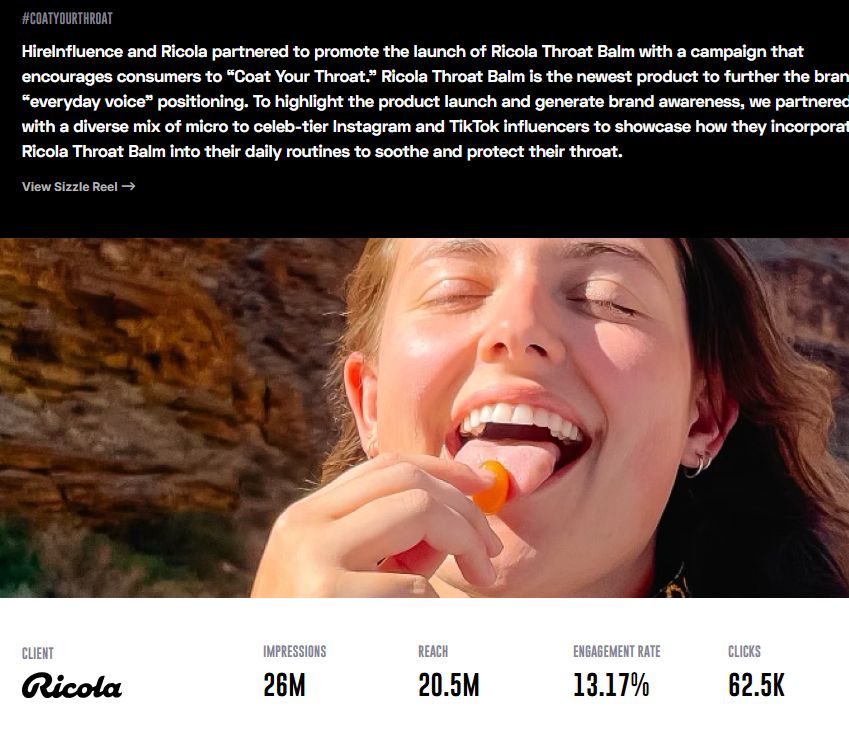
The Ricola #CoatYourThroat program demonstrates volume-and-quality UGC creator program delivery. The campaign activated 18 creators spanning micro to celebrity tier and delivered 26 million impressions, 20.5 million reach, a 13.17% engagement rate, and 62,500 MikMak retail purchase clicks. The tiered creator sourcing, quality-first content production, and commerce attribution infrastructure represent the operating model enterprise UGC programs require to produce measurable business outcomes. The Ricola case study documents the full program architecture.
The Grammarly engagement demonstrates UGC creator program scale at the volume AI recommendation environments reward. The program activated 133 creators across YouTube, TikTok, and Instagram, producing 214 million impressions, 33.1 million views, and $15 million in earned media value. Managing 133 creators across three platforms simultaneously requires the operational infrastructure (sourcing, briefing, content review, compliance, payment management) that UGC creator programs now demand.
The imPress Nails New York Fashion Week campaign demonstrates UGC creator program execution in brand-sensitive moments. The campaign partnered with luxury fashion and beauty creators whose audiences and personal brand positioning matched the imPress brand identity, activated during NYFW, and structured content with direct-to-website CTAs that converted attention into measurable purchase activity. The program illustrates how UGC creator selection, creative direction, and conversion infrastructure align for enterprise brand outcomes.
How Enterprise Brands Should Evaluate a UGC Creator Agency
Five evaluation questions separate credible UGC creator agencies from general-market creator platforms.
First, ask about creator sourcing methodology for AI-era authenticity. Bazaarvoice’s data on AI analyzing authentic content makes this consequential. The agency should describe how creators are evaluated for audience authenticity, content consistency, engagement quality, and AI-recommendation-relevant authenticity signals with specific examples of creator selections that produced outsized program value.
Second, ask about distributed program operations at volume. The AI recommendation environment rewards volume. The agency should describe operational infrastructure for managing 50 to 200+ creators simultaneously: sourcing at scale, briefing consistency, payment operations, content review workflows, and quality control with examples of volume UGC program execution.
Third, ask about content library and asset management infrastructure. Enterprise UGC programs produce hundreds of assets across creator rosters. The agency should describe content tagging, format conversion, rights tracking, and library management infrastructure that supports systematic deployment across the enterprise marketing stack.
Fourth, ask about rights structure for AI-era distribution. Rights have to cover the full creator content deployment footprint including paid social, retail partner channels, retail media, DTC commerce, product detail pages, and emerging AI recommendation environments. The agency should describe rights structure depth with specific examples of how contracting supports cross-channel deployment.
Fifth, ask about attribution infrastructure at enterprise measurement standards. UGC creator programs have to demonstrate value through attribution that captures full-funnel impact. The agency should describe commerce tracking, brand lift measurement, retail attribution, and AI recommendation visibility with specific examples of UGC programs that demonstrated measurable business outcomes.
The UGC Creator Agency Model
HireInfluence runs enterprise UGC creator programs across consumer categories. The agency was founded in 2011 and maintains offices in Houston and The Woodlands, TX; Austin, TX; Los Angeles, CA; and New York, NY. That national footprint, combined with UGC creator program depth built across more than a decade, positions the agency to deliver programs calibrated to the AI-era shopper experience dynamics Bazaarvoice documented. The about section documents how the company operates.
Engagements typically start at approximately $100,000, aligned with the enterprise delivery standard. Confirmed clients include Microsoft, Southwest Airlines, Target, Coca-Cola, Walmart, Meta, McDonald’s, Oreo, Grammarly, Ricola, and MTV. Award recognition across 2024 and 2026 includes the MUSE Creative Awards, Netty Awards, NYX Awards, Global Digital Excellence Awards, U.S. Agency Awards (Digital Marketing Agency of the Year), and Vega Digital Awards. The agency is also an exclusive TikTok Shop Lite Program partner since July 2024, providing direct access to TikTok’s commerce infrastructure for UGC creator programs connecting content to measurable conversion outcomes. The work portfolio documents program execution across program complexity.
Jason Pampell, Founder and CEO, launched HireInfluence in 2011. Prior to founding the company, he managed content rights and strategic media partnerships for Forbes and Billboard. His 30+ years of leadership experience in sales, marketing, and team building for Fortune 1000 organizations shaped how the agency structures UGC creator engagements today.
For enterprise brands ready to evaluate what a UGC creator engagement calibrated to current shopper dynamics should include, the HireInfluence team handles initial conversations directly through the contact page. Brands benchmarking pricing should reference the cost of influencer marketing guide for context on enterprise engagement costs. Those evaluating TikTok-focused strategies should review the TikTok influencer marketing resource, and brands wanting context on UGC strategy fundamentals should review the UGC overview.
Bazaarvoice’s shopper experience data makes the operating environment direct. 41% of 18-34 consumers now use GenAI for product search, 75% trust GenAI recommendations, AI systems analyze authentic creator content to drive product discovery, and 83% of consumers report that the economy is affecting their purchase decisions. The UGC creator agency decision for enterprise brands is the decision about which partner has built the capability profile the AI-era shopper environment now requires. The brands winning in the current environment are working with partners calibrated to AI-recommendation-aware creator sourcing, distributed program operations at volume, content library management infrastructure, and full-funnel attribution, not those still operating on transactional creator activation models from an earlier moment in the discipline.