The difference between a UGC marketing company that moves the needle and one that delivers a pile of social posts comes down to one question: does the content produced in a campaign have value beyond the day it posts?
Table of Contents
For most brands working with most UGC vendors, the answer is no. Content goes live, generates organic reach, and sits idle. The creator owns the rights. The brand cannot use it in paid ads. It does not appear on product pages. It never makes it into email campaigns. The investment in creator talent and production produced one organic moment and nothing after.
The UGC marketing companies generating the strongest returns structure things differently. Creator content is produced with commercial usage rights built into the contract. It is organized as a licensed library available for deployment across paid, owned, and earned channels. The result is a compounding asset rather than a one-time social post.
The Scale of the Creator Economy Context
According to inBeat Agency’s 2026 creator economy research, the creator economy now represents over $234 billion in global value. More than 200 million people worldwide consider themselves creators, with full-time creators now spanning every professional category from consumer lifestyle to B2B thought leadership. For enterprise brands, that supply of creator talent is both an opportunity and a sourcing challenge: the right creators for a given brand exist, but identifying them, vetting their audiences, and structuring the engagement correctly requires infrastructure that most brands do not have internally.
This is where the choice between a UGC marketing company and a self-serve platform becomes consequential. Platforms provide databases and basic workflow tools. Companies manage creator sourcing, vetting, contracting, content direction, compliance, rights management, and paid amplification as a unified service. For enterprise brands with meaningful budgets and real performance expectations, the managed model produces materially better outcomes.
What Genuine UGC Asset Management Looks Like
A UGC marketing company that operates at enterprise standard manages content as a systematic asset production and distribution program rather than a series of creator activations.
Creator selection starts with audience quality, not follower count. HireInfluence evaluates audience authenticity, engagement rate and quality, content history, brand safety profile, and category alignment before any creator is proposed for a brief. The agency’s proprietary Audience Quality Score synthesizes these factors into a systematic vetting output that eliminates the manual error and guesswork that plagues informal creator selection processes.
Usage rights are built into creator contracts as standard terms. Before any content is produced, the agreement covers organic use rights, commercial use permissions, paid amplification authorization, duration, exclusivity where applicable, and content format specifications. This means the content produced is a licensed asset from the moment it goes live, not something that requires additional negotiation to deploy.
Content is organized for multi-channel utility. A video Reel produced for an Instagram creator activation is also available as a paid social ad, a product detail page video, an email campaign asset, and a retail media placement, provided the brief was designed with those use cases in mind. HireInfluence’s White Glove UGC Services for enterprise clients manage this end-to-end, producing content that functions across channels rather than content that works only on the platform where it was produced.
Paid Amplification: The Multiplier That Most UGC Companies Miss
The performance advantage of creator content over brand-produced creative is well established. UGC generates four times higher click-through rates than traditional display advertising. Ads featuring creator content see 50% lower cost-per-click compared to brand equivalents. When creator content runs through paid amplification via influencer whitelisting, those performance advantages hold in paid contexts because the trust signal of creator-native content persists even in a paid placement.
Most UGC companies produce content for organic use and do not build paid amplification into their model. This leaves the most valuable performance lever unused. HireInfluence integrates paid amplification into every UGC program from the first brief. Commercial usage rights are secured upfront, performance data from organic posts informs which content gets amplified, and the agency’s paid media infrastructure manages distribution across TikTok, Instagram, YouTube, and Facebook without requiring the brand to manage a separate media buyer relationship.
Campaign Performance at Enterprise Scale
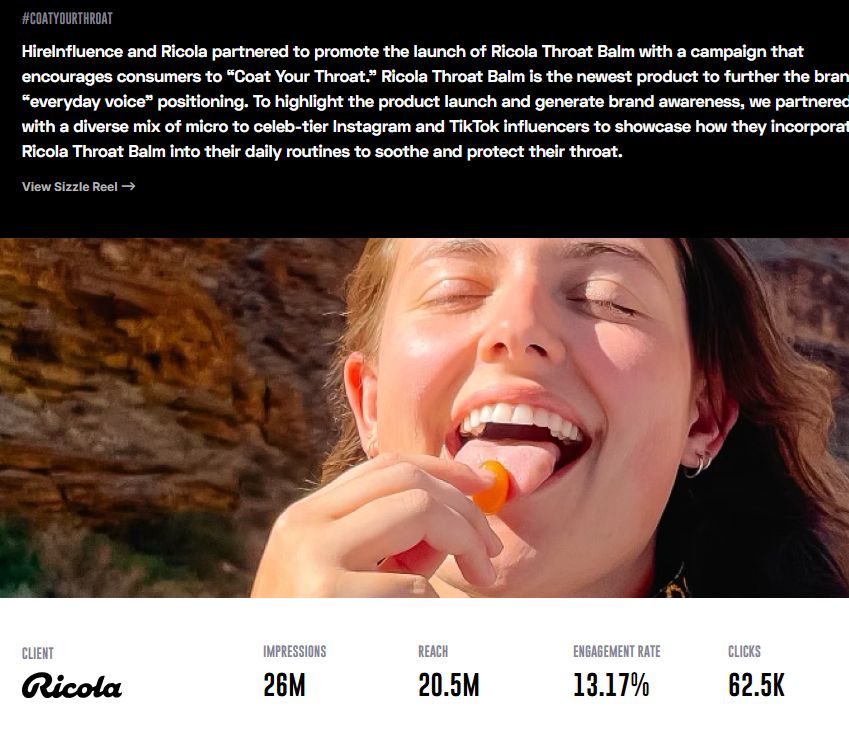
The Ricola #CoatYourThroat campaign is the clearest demonstration of UGC program performance at enterprise scale: 18 creators from micro to celebrity tier, 26 million impressions, 20.5 million reach, a 13.17% engagement rate, and 62,500 tracked retail purchase clicks through MikMak integration. The content was designed from the brief stage to connect creator engagement to retail purchase behavior, with attribution infrastructure built in before a single creator was contacted.
The Grammarly program deployed 133 creators across YouTube, TikTok, and Instagram, generating 214 million impressions, 33.1 million views, and $15 million in earned media value. At that creator volume, managing UGC as a systematic asset program means every piece of content is produced with multi-channel utility in mind, rights are secured across all formats, and the highest-performing organic content moves immediately into paid amplification without operational friction.
Organizing the UGC Library for Long-Term Use
One of the most undervalued capabilities of a top UGC marketing company is content library management. Enterprise brands running ongoing programs across multiple product lines and marketing windows need a structured system for accessing, deploying, and tracking the content they have paid to produce and license.
HireInfluence manages content organization and delivery as part of its White Glove UGC program, providing brand teams with access to a properly formatted, channel-ready content library following each campaign. Content is delivered in the formats required for each deployment context: social crop ratios for Instagram and TikTok, widescreen formats for YouTube and programmatic placements, static frames for email and product pages.
This operational detail sounds mundane but matters significantly in practice. Brand teams that receive a Google Drive folder of raw creator videos (without format optimization, channel tagging, or performance context) cannot deploy that content efficiently across the marketing calendar. Content that sits unused because it was not delivered in a usable format is wasted investment.
HireInfluence’s analytics platform tracks which assets are performing in paid and organic contexts simultaneously, feeding performance data back into future creator briefing and selection decisions. Over time, that data loop improves every aspect of the program: creator selection becomes more precise, content briefs become more effective, and paid amplification decisions are based on evidence rather than estimation.
Evaluating a UGC Marketing Company
When evaluating UGC marketing companies for enterprise engagements, the questions that reveal operational capability are practical rather than strategic. Are commercial usage rights included as standard contract terms, or do they cost extra? Does the company manage paid amplification natively, or does media buying get outsourced? What is the process for organizing and providing access to the content library after the campaign ends? How does the company track UGC performance across paid and organic contexts simultaneously?
HireInfluence’s analytics platform answers the last question with reporting built around client-defined business objectives. The minimum engagement starts at approximately $100,000. Named clients include Microsoft, Target, Grammarly, McDonald’s, Oreo, and Southwest Airlines. Review the campaign portfolio and connect at hireinfluence.com/contact/.