
Enterprise marketing teams evaluating a UGC production agency in 2026 are operating against a creator content investment environment that Kantar’s Marketing Trends 2026 report (published November 2025) documents clearly. A net 61% of marketers globally plan to increase their investment in creator content in 2026, reflecting the maturation of UGC as a core marketing investment category. But Kantar’s analysis also identifies the central challenge facing enterprise UGC programs: only 27% of creator content ties strongly to the brand. Coherent, cross-channel ideas are 2.5x more important to campaign success than a decade ago, but the creator content production gap between campaign volume and brand alignment is the defining performance variable in 2026. Kantar’s finding means that 73% of creator content produced in the current environment fails to strongly connect to brand messaging, which suggests that enterprise UGC programs have a systemic production quality problem. Budget increases combined with production quality gaps produce diminishing returns on creator content investment. Kantar’s recommendation: 2026 needs a shift from isolated creator executions to long-term creative platforms that align brand and creator-led content, with clear guardrails and success metrics that allow creators to produce authentically while serving brand objectives.
Table of Contents
- Why Kantar’s Creator Effectiveness Data Reshapes the UGC Production Agency Decision
- What Enterprise CPG Brands Should Expect From a UGC Production Agency
- UGC Production Delivery for CPG Brands
- How Enterprise CPG Brands Should Evaluate a UGC Production Agency
- The UGC Production Agency Model for CPG Brands
For enterprise marketing teams, Kantar’s findings establish a specific shift in what a UGC production agency has to deliver. The 73% creator-content-brand-alignment gap reinforces that production quality and brand alignment discipline are the critical differentiators separating creator content that produces business outcomes from creator content that generates activity without impact. The shift from isolated executions to long-term creative platforms means production infrastructure has to support sustained creator-brand content development rather than episodic creator activations. The emphasis on coherent cross-channel ideas means production has to deliver content that works across the full distribution footprint rather than platform-specific creative that cannot be deployed efficiently. This is particularly consequential for CPG brands (where creator content has to flow across retail partners, retail media networks, DTC commerce, paid social, and in-store digital channels simultaneously). This guide breaks down what enterprise brands (with specific CPG category framing given CPG’s multi-channel distribution complexity) should expect from a UGC production agency in 2026, how Kantar’s creator effectiveness data reshapes the capability requirements, and what separates a credible UGC production partner from a general creator platform or traditional content agency.
Why Kantar’s Creator Effectiveness Data Reshapes the UGC Production Agency Decision
Kantar’s documentation that only 27% of creator content ties strongly to the brand changes the structural logic of how enterprise brands approach UGC production. When the overwhelming majority of creator content fails to connect meaningfully to brand messaging, production quality and brand alignment discipline become the variables that determine program ROI. The UGC production agency that serves enterprise clients has to operate briefing, production direction, content review, and quality control infrastructure that produces creator content landing in the top 27% of brand-aligned production rather than the 73% that fails to connect.
For enterprise brands specifically (and CPG brands in particular), the 2.5x importance of coherent cross-channel ideas carries material implications. CPG creator content has to work across retail partner distribution, retail media networks, paid social, DTC commerce, connected TV, in-store digital, and emerging platforms simultaneously. Production has to be designed for cross-channel deployment from the brief stage, with content structure, format specifications, rights, and production outputs calibrated to the full distribution footprint. Creator content produced for single-platform deployment (then retrofitted for cross-channel use) underperforms against creator content produced from a cross-channel-first production framework.
Kantar’s recommendation for long-term creative platforms rather than isolated creator executions reinforces why UGC production has to operate on sustained-relationship infrastructure. Isolated creator executions produce content collections without thematic coherence. Long-term creative platforms produce content ecosystems where individual creator outputs reinforce a consistent brand story while preserving creator authentic voice. The UGC production agency has to demonstrate creative platform development capability, with specific examples of sustained creator-brand content programs that produced coherent content ecosystems across extended engagement windows.
For CPG brands specifically, the 61% marketer commitment to increased creator content investment reinforces the competitive intensity CPG creator programs now face. Every major CPG brand is expanding creator content production, which means production quality discipline is now the competitive differentiation variable. CPG brands operating with UGC production agencies that produce generic creator content across fragmented campaign activations will lose share to CPG brands operating with agencies that produce brand-aligned creator content at the production quality level Kantar’s data identifies as rare.
Kantar’s emphasis on clear guardrails and success metrics reinforces why UGC production requires briefing discipline combined with creator autonomy. Over-directed creator production strips authenticity; under-directed production produces misaligned content. The UGC production agency has to demonstrate briefing methodology that establishes clear brand guardrails while preserving creator voice, with measurement frameworks that evaluate creator content against both brand alignment and authentic resonance criteria.
What Enterprise CPG Brands Should Expect From a UGC Production Agency
A credible UGC production agency operating in the CPG category operates across eight coordinated service functions calibrated to Kantar’s creator effectiveness framework.
UGC production strategy and long-term creative platform design. The engagement begins with business objectives tied to CPG-specific outcomes (retail velocity, category share, household penetration, DTC conversion, cross-channel content utilization) and creative platform architecture that supports sustained creator content development rather than episodic activations. HireInfluence structures UGC production strategy through dedicated campaign services built for enterprise long-term engagements.
Creator sourcing calibrated to brand alignment and production capability. Kantar’s 27% brand-alignment data makes sourcing rigor central. The agency has to evaluate creators for genuine brand affinity, audience authenticity, production quality history, content consistency patterns, and predictive alignment with CPG category positioning beyond generic demographic matching.
Production direction that preserves creator authenticity within clear brand guardrails. Kantar’s emphasis on guardrails-plus-creator-autonomy makes this differentiating. The agency’s production direction has to establish brand guardrails that creators can work within authentically, with specific examples of CPG UGC production that sustained both brand alignment and creator voice across extended content cycles.
Contracting and rights management calibrated to CPG cross-channel distribution. Rights structure has to cover grocery retailer in-store screens and digital channels, club retailer distribution, mass retailer integration, drug retail deployment, specialty retail, retail media networks, DTC commerce, connected TV, paid social, and organic distribution. Multi-channel rights negotiated at production planning phase enable creator content to flow across the full CPG distribution footprint.
Production infrastructure for CPG content volume. Enterprise CPG UGC programs produce hundreds of content pieces across creator rosters, product launches, seasonal cycles, and regulatory windows. The agency has to operate production management, content review, regulatory compliance review, and delivery infrastructure that supports the CPG category’s volume and compliance complexity.
Paid amplification with CPG commerce integration. UGC production delivers maximum value when content pairs with paid amplification including retail media networks (Kroger Precision Marketing, Walmart Connect, Target Roundel, Amazon Advertising), TikTok Shop, Instagram Shopping, and connected TV integration. HireInfluence delivers paid amplification through its specialties and services capability.
CPG attribution infrastructure across retail and DTC channels. UTM frameworks, promo codes, MikMak retail attribution, retail partner tracking, retail media integration, platform commerce measurement, and DTC conversion attribution. HireInfluence’s analytics capability is designed to deliver CPG-specific UGC production attribution depth.
Regulatory compliance review infrastructure for CPG UGC content. CPG categories face varying regulatory requirements. Creator content has to comply with the full regulatory stack across every deployment channel. The agency should describe compliance review workflows, FTC monitoring, category-specific regulatory screening, and approval protocols for CPG creator content.
UGC Production Delivery for CPG Brands
CPG brands evaluating a UGC production agency should look at programs that demonstrate CPG category UGC production capability at the quality and volume Kantar’s data identifies as rare.
The Ricola #CoatYourThroat program is a direct CPG UGC production reference. The campaign activated 18 creators spanning micro to celebrity tier and delivered 26 million impressions, 20.5 million reach, a 13.17% engagement rate, and 62,500 MikMak retail purchase clicks. The MikMak integration is the specific capability CPG UGC production programs require: creator content connected directly to measurable retail purchase activity across the fragmented CPG retail footprint. The tiered creator sourcing, production direction, and retail attribution infrastructure represent the operating model enterprise CPG UGC programs require. The Ricola case study documents the full program architecture.
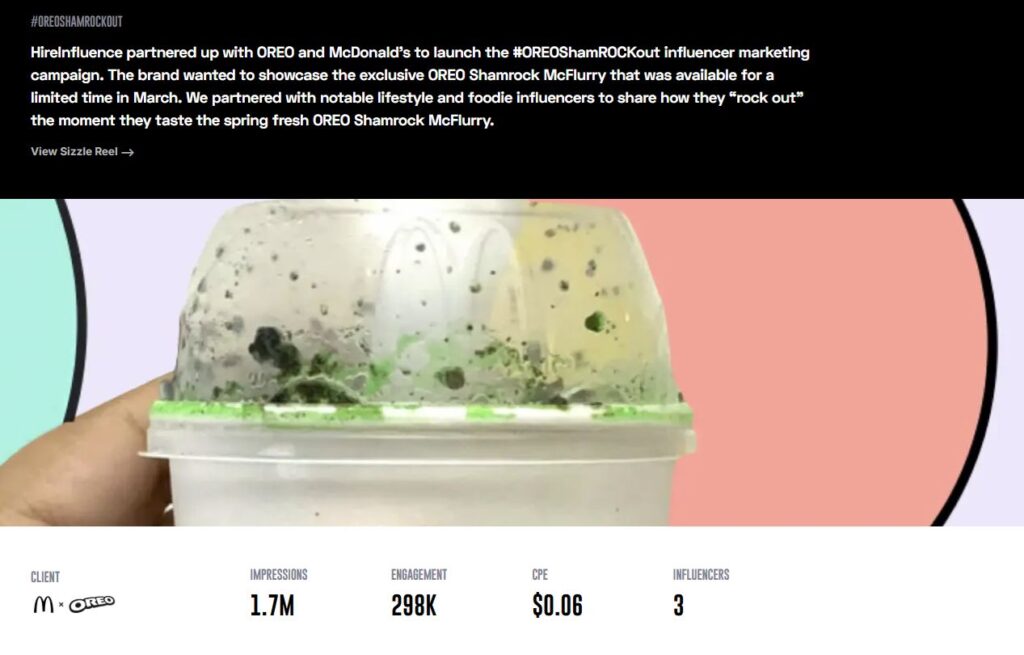
The Oreo/McDonald’s #OREOShamROCKout campaign demonstrates CPG co-branded UGC production with commerce efficiency. The campaign delivered 1.7 million impressions at $0.06 CPE. That cost-per-engagement efficiency metric establishes what CPG enterprise finance teams use to compare UGC production program spend against alternative paid media investments.
The broader HireInfluence engagement with CPG brands including Coca-Cola, McDonald’s, Oreo, Ricola, and Walmart (for CPG product activations) demonstrates CPG category depth at the scale enterprise UGC production programs require. The work portfolio includes additional CPG case examples worth referencing for brand buyers evaluating agency CPG experience.
The Grammarly engagement demonstrates multi-platform UGC production program scale relevant to CPG programs requiring cross-channel creator deployment. The program activated 133 creators across YouTube, TikTok, and Instagram, producing 214 million impressions, 33.1 million views, and $15 million in earned media value. Managing 133 creators across three platforms simultaneously requires the production infrastructure that CPG UGC programs increasingly demand as rosters expand to match CPG portfolio complexity.
How Enterprise CPG Brands Should Evaluate a UGC Production Agency
Five evaluation questions separate credible UGC production agencies from general-market creator content providers.
First, ask about creator-brand alignment methodology. Kantar’s 27% alignment data makes this the defining evaluation criterion. The agency should describe how creator selection is calibrated to brand alignment beyond demographic matching, including evaluation of genuine brand affinity, production quality history, and predictive alignment with CPG category positioning.
Second, ask about cross-channel production design. Kantar’s 2.5x coherent cross-channel importance makes this consequential. The agency should describe how UGC production is designed from the brief stage for cross-channel deployment (retail partners, retail media, paid social, DTC, connected TV) rather than platform-specific production with cross-channel retrofitting.
Third, ask about long-term creative platform development. Kantar’s recommendation for creative platforms over isolated executions makes this differentiating. The agency should describe platform architecture, sustained creator-brand content development capability, and examples of CPG UGC programs that produced coherent content ecosystems across extended engagement cycles.
Fourth, ask about CPG regulatory compliance infrastructure. CPG categories face varying regulatory requirements that creator content has to navigate. The agency should describe compliance review workflows, FTC monitoring, category-specific regulatory screening, and approval protocols with specific examples of CPG UGC programs that demonstrated regulatory discipline.
Fifth, ask about retail attribution capability. CPG UGC production has to connect to retail velocity outcomes. The agency should demonstrate MikMak integration, retail partner attribution, retail media network integration, and DTC conversion tracking with specific examples of CPG UGC programs that demonstrated measurable retail impact.
The UGC Production Agency Model for CPG Brands
HireInfluence runs enterprise UGC production programs for CPG brands across the category. The agency was founded in 2011 and maintains offices in Houston and The Woodlands, TX; Austin, TX; Los Angeles, CA; and New York, NY. That national footprint, combined with CPG category depth built across more than a decade, positions the agency to deliver UGC production programs calibrated to CPG business requirements and the creator effectiveness framework Kantar documented. The about section documents how the company operates.
Engagements typically start at approximately $100,000, aligned with the enterprise delivery standard. Confirmed clients include Microsoft, Southwest Airlines, Target, Coca-Cola, Walmart, Meta, McDonald’s, Oreo, Grammarly, Ricola, and MTV, multiple of which are direct CPG engagements across beverages, snacks, QSR, and retail. Award recognition across 2024 and 2026 includes the MUSE Creative Awards, Netty Awards, NYX Awards, Global Digital Excellence Awards, U.S. Agency Awards (Digital Marketing Agency of the Year), and Vega Digital Awards. The agency is also an exclusive TikTok Shop Lite Program partner since July 2024, providing direct access to TikTok’s commerce infrastructure for CPG UGC production programs requiring conversion-measurable delivery.
Jason Pampell, Founder and CEO, launched HireInfluence in 2011. Prior to founding the company, he managed content rights and strategic media partnerships for Forbes and Billboard. His 30+ years of leadership experience in sales, marketing, and team building for Fortune 1000 organizations shaped how the agency structures CPG UGC production engagements today.
For CPG brands ready to evaluate what a UGC production engagement calibrated to current CPG category dynamics should include, the HireInfluence team handles initial conversations directly through the contact page. Brands benchmarking pricing should reference the cost of influencer marketing guide for context on enterprise engagement costs. Those evaluating TikTok-focused strategies should review the TikTok influencer marketing resource, and brands wanting context on UGC strategy fundamentals should review the UGC overview. CPG brands specifically benefit from reviewing the F&B influencer marketing resource for category-adjacent context.
Kantar’s 2026 creator effectiveness data makes the operating environment direct. 61% of marketers plan to increase creator content investment but only 27% of creator content strongly ties to the brand, coherent cross-channel ideas are 2.5x more important to campaign success than a decade ago, and the industry is shifting from isolated creator executions to long-term creative platforms. The UGC production agency decision for enterprise CPG brands is the decision about which partner has built the capability profile the current environment now requires. The CPG brands winning in 2026 are working with partners calibrated to brand-alignment-first creator sourcing, cross-channel production design, long-term creative platform development, and CPG-specific attribution infrastructure, not those still operating on isolated-execution creator content models from an earlier moment in the discipline.