
Retail has become the largest creator advertising category in the United States. According to IAB data cited earlier in 2025, retail brands now account for more than $12 billion in annual creator ad spend, significantly more than any other vertical. That concentration reflects a structural shift in how retail marketing budgets are being allocated. Video content, delivered through creator partnerships and connected to commerce infrastructure, has become the most consequential content investment most enterprise retail brands make. The performance drivers are documented directly. According to Firework’s analysis of video commerce trends for 2025, video commerce is growing at a 26% compound annual growth rate and projected to reach $6 trillion by 2030. By 2025, approximately 90% of businesses are using video marketing to boost sales and engagement, with 75% of video plays happening on mobile devices. Firework’s data also documented that interactive commerce formats are driving unprecedented conversion rates, with 70% adoption among US retailers and 12% average conversion rates for shoppable video integrations.
Table of Contents
- Why Retail Video Content Marketing Requires Commerce-Connected Production Capability
- What Enterprise Retail Brands Should Expect From a Video Content Marketing Agency
- What Enterprise Retail Video Delivery Actually Produces
- How Enterprise Retail Brands Should Evaluate a Video Content Marketing Agency
- The Video Content Marketing Agency Model for Retail Brands
For retail marketing teams evaluating a video content marketing agency, those numbers establish a specific capability profile. Video content for retail brands is not brand content adapted for social distribution. It is commerce-connected video, produced at volume, optimized for mobile-first consumption, and structured to drive measurable sales outcomes. This guide breaks down what enterprise retail brands should expect from a video content marketing agency, how creator-powered video commerce has reshaped the retail video production model, and what separates a partner built for retail commerce outcomes from a generalist video agency.
Why Retail Video Content Marketing Requires Commerce-Connected Production Capability
Retail brands operate in a category where the distance between content consumption and purchase decision is measured in seconds. Firework’s data on shoppable video adoption (70% of US retailers) and average 12% conversion rates reveals what that proximity requires operationally. Video content has to be produced with commerce paths built in from the start, not added as an afterthought during distribution. That requirement changes what the video content marketing agency has to deliver. Traditional retail brand video (30-second spots, polished lifestyle footage, long-form brand films) does not convert at the rates that video commerce infrastructure now produces. The creator video that does convert is mobile-first, native to the platform where it distributes, structured around specific product hooks, and designed to move viewers directly into a purchase environment.
The mobile-first production requirement compounds the capability profile. Firework’s finding that 75% of video plays happen on mobile devices means every video produced for retail audiences has to be optimized for vertical formats, short attention windows, and the specific engagement patterns that drive mobile commerce conversion. A video content marketing agency still producing retail video in 16:9 horizontal formats intended for desktop or TV viewing is producing content calibrated for a different media environment than the one where retail video commerce actually happens.
Firework also documented that video commerce is projected to reach $6 trillion by 2030, growing at 26% CAGR. The enterprise retail brands capturing that growth are the ones running video commerce programs at scale, which means their video content marketing agencies have to deliver production capacity sufficient to meet multi-SKU, multi-platform, multi-season programs across dozens or hundreds of creators simultaneously. Traditional production models optimized for quarterly brand video cadences cannot support that scale.
The attribution requirement makes the capability demands specific. Enterprise retail brands expect creator video to connect to measurable commerce outcomes through platform commerce infrastructure (TikTok Shop, Instagram Shopping, YouTube Shopping), retail media network integration, and direct e-commerce attribution. A video content marketing agency that produces strong creative but cannot structure commerce attribution into the program architecture is not serving retail category requirements at enterprise scale.
What Enterprise Retail Brands Should Expect From a Video Content Marketing Agency
A credible video content marketing agency for retail brands operates across eight coordinated service functions calibrated to retail commerce dynamics.
Retail video strategy and format allocation. The engagement begins with business objectives tied to retail outcomes: e-commerce conversion, in-store traffic, retail partner co-marketing, loyalty program engagement, and basket-building. Format allocation has to cover short-form video for discovery, long-form for consideration, and live shopping video for commerce activation. HireInfluence structures retail strategy through dedicated campaign services built for enterprise retail engagements.
Creator sourcing calibrated to retail categories. Retail spans fashion, beauty, home, grocery, electronics, sporting goods, and specialty verticals. A credible agency runs tier-matched creator sourcing calibrated to the specific retail category, with audience demographics that match the retail purchase behavior the campaign is trying to influence.
Mobile-first creative direction. Firework’s 75% mobile play data makes mobile-first production a baseline requirement. Creative direction has to produce vertical video, short-form formats, and platform-native content calibrated to how retail audiences actually consume video. Horizontal-first content repurposed for mobile distribution consistently underperforms content produced mobile-first from the creative brief stage.
Contracting and rights management calibrated to retail usage. Video rights structure for retail programs has to cover retail partner distribution (in-store screens, retailer digital channels, retail media networks, email), platform commerce infrastructure (TikTok Shop, Instagram Shopping), and standard social, paid, and owned channel usage. Multi-channel rights negotiated at the contract phase are what enable creator video to flow across the full retail distribution footprint.
AI-integrated production workflows. AI tools for pre-production planning, post-production editing, captioning, dubbing, and format adaptation enable the production volume retail programs require. Enterprise retail brands running multi-SKU, multi-season programs across dozens of creators need production workflows that can deliver at that volume without sacrificing content quality.
Paid media amplification with commerce integration. Creator video performs best when organic distribution is paired with paid amplification on platforms with commerce infrastructure. HireInfluence covers this through its specialties and services capability, including whitelisting, dark posting, and cross-platform paid amplification. For retail brands specifically, integrated amplification across TikTok Shop, Instagram Shopping, Meta, YouTube, and retail media networks is the capability that connects video investment to measurable commerce outcomes.
Commerce-connected attribution infrastructure. UTM frameworks, promo code systems, pixel tracking, conversion event integration, platform commerce attribution, and retail media network measurement. HireInfluence’s analytics capability is designed to give enterprise retail clients the attribution depth that connects creator video to measurable sales outcomes.
Cross-channel content lifecycle management. Video produced through retail creator programs should flow across paid social, retail media networks, CTV, email, retailer digital channels, in-store screens, and owned channels without requiring separate production cycles. The agency has to manage that content lifecycle so the original creator video produces value across the full retail distribution footprint over extended time.
What Enterprise Retail Video Delivery Actually Produces
Enterprise retail brands evaluating a video content marketing agency should look at campaigns that demonstrate what video-powered retail delivery produces at scale.
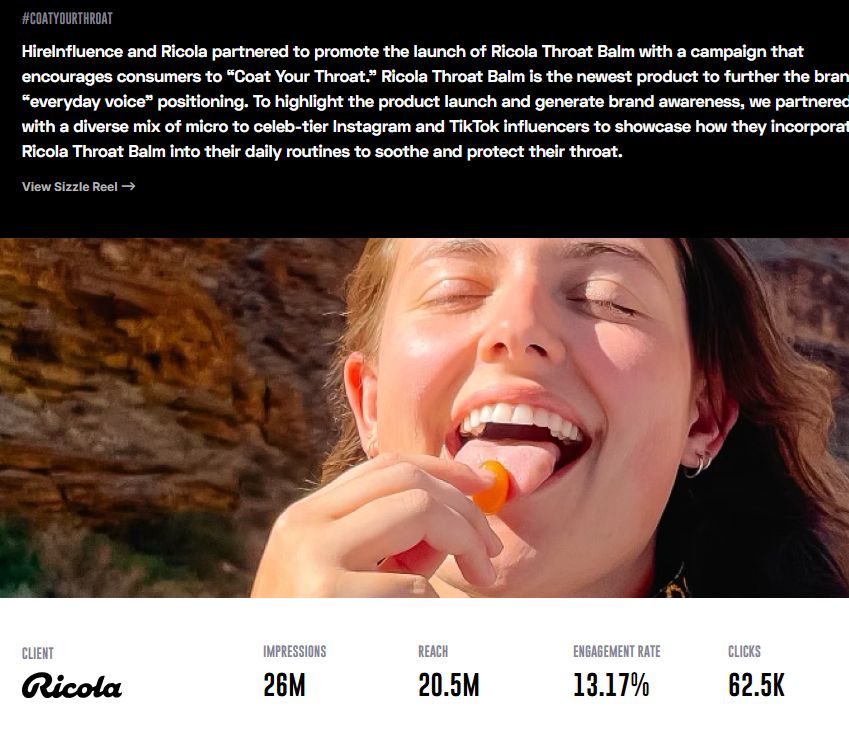
The Ricola #CoatYourThroat program is the reference benchmark for retail-connected creator video. The campaign drove 26 million impressions, 20.5 million reach, a 13.17% engagement rate across 18 influencers spanning micro to celebrity tier, and 62,500 MikMak retail purchase clicks. The MikMak integration is the exact capability that retail brands need to see demonstrated: creator video connected directly to trackable retail purchase activity. The Ricola case study shows how the operational layers (creator tier selection, content strategy, retail attribution) came together in a single program architecture.
The Grammarly engagement illustrates what scale looks like when video content flows across multiple platforms. The program activated 133 creators across YouTube, TikTok, and Instagram, producing 214 million impressions, 33.1 million views, and $15 million in earned media value. For retail brands running multi-platform video commerce programs, the Grammarly scale numbers demonstrate what enterprise delivery produces when creator sourcing, production direction, and amplification are coordinated as a single system.
HireInfluence’s engagement with Walmart, Target, and Coca-Cola demonstrates the retail category depth that enterprise video programs require. The imPress Nails campaign at New York Fashion Week shows how creator video adapts to retail-adjacent brand moments, with luxury-aligned creator selection and direct-to-website CTAs structured to convert moment-specific attention into purchase activity. The work portfolio documents additional retail-relevant case examples across categories.
How Enterprise Retail Brands Should Evaluate a Video Content Marketing Agency
Five evaluation questions separate credible retail video content marketing partners from generalist video agencies.
First, ask about retail commerce infrastructure integration. TikTok Shop, Instagram Shopping, YouTube Shopping, retail media network connectivity, MikMak integration, and direct e-commerce attribution. A retail video content program that cannot connect to commerce outcomes is not enterprise-ready.
Second, ask about mobile-first production capability. Firework’s 75% mobile play data makes this a baseline requirement. The agency should describe how mobile-first production is built into the creative brief stage, not applied during format adaptation after a horizontal-first shoot.
Third, ask about retail category experience specifically. Fashion, beauty, home, grocery, electronics, and specialty retail all have distinct audience dynamics and purchase behaviors. The agency should demonstrate direct experience in the specific retail categories the brand operates in.
Fourth, ask about high-volume production capability. Enterprise retail brands typically run multi-SKU, multi-season programs across dozens of creators simultaneously. The production workflow has to scale to meet that volume while maintaining content quality and brand consistency.
Fifth, ask about retail calendar alignment. Retail marketing operates on well-defined seasonal calendars (back-to-school, holiday, summer, spring reset) with specific promotional windows tied to retail partner plans. An agency that treats retail video like any other vertical will miss those timing dependencies entirely.
The Video Content Marketing Agency Model for Retail Brands
HireInfluence runs enterprise video content marketing programs for retail and retail-adjacent brands across multiple categories. The agency was founded in 2011 and maintains offices in Houston and The Woodlands, TX; Austin, TX; Los Angeles, CA; and New York, NY. That national footprint, combined with retail category depth built across more than a decade of engagements, positions the agency to deliver video content marketing programs calibrated specifically to retail commerce requirements.
Engagements typically start at approximately $100,000, aligned with the enterprise delivery standard that retail video content programs require. The confirmed client roster includes Microsoft, Southwest Airlines, Target, Coca-Cola, Walmart, Meta, McDonald’s, Oreo, Grammarly, Ricola, and MTV, multiple of which are direct retail engagements or retail-adjacent programs running through retail distribution. Award recognition across 2024 and 2026 includes the MUSE Creative Awards, Netty Awards, NYX Awards, Global Digital Excellence Awards, U.S. Agency Awards, and Vega Digital Awards. The agency is also an exclusive TikTok Shop Lite Program partner since July 2024, providing direct access to TikTok’s video commerce infrastructure for retail video programs that need to connect directly to platform commerce outcomes.
Jason Pampell, Founder and CEO, launched HireInfluence in 2011 after managing content rights and strategic media partnerships for Forbes and Billboard. His 30+ years of leadership experience in sales, marketing, and team building for Fortune 1000 organizations informs how the agency structures retail creator-powered video engagements. His approach to building the agency shaped how enterprise video content programs get delivered for retail clients today.
For enterprise retail brands ready to evaluate what a creator-powered, commerce-connected video content engagement should include, the HireInfluence team handles initial conversations directly. Brands benchmarking pricing should reference the cost of influencer marketing guide for context on enterprise engagement costs. Retail brands integrating creator video with broader UGC strategy should review the UGC overview for context on how those capabilities work together within an enterprise retail engagement. Those evaluating TikTok-focused retail video strategies should review the TikTok influencer marketing resource for platform-specific considerations.
Firework’s data frames the buying environment for retail video content marketing clearly. A $6 trillion video commerce market by 2030, growing at 26% CAGR, with 70% of US retailers running shoppable video integrations and 12% average conversion rates for those integrations, makes the video content marketing agency decision consequential in a way it was not five years ago. The partners built for this environment are the ones that have integrated creator partnerships, mobile-first production, AI-accelerated workflows, commerce-connected attribution, and multi-channel content lifecycle management into a single coordinated service model. For enterprise retail brands, that consolidation is the filter that separates partners built for retail commerce outcomes from generalist video agencies competing for the same budget.