
Most enterprise brands still treat influencer marketing and paid media as separate budget lines managed by separate teams. The influencer agency books creators and manages organic content. The media agency buys inventory and manages targeting. The two teams share a campaign brief but almost never share data, creative assets, or performance feedback in real time.
Table of Contents
That separation is costing brands measurable performance. The brands gaining ground in 2026 are the ones that have stopped treating influencer content as an organic-only channel and started treating it as their highest-performing paid media asset.
The Convergence of Influencer and Media Buying
According to Later’s 2026 influencer trends research, brands are increasingly licensing creator content, running it as paid social ads, and testing it with the same rigor they apply to any other creative. Organic posts surface what resonates with real audiences. Paid amplification scales the winners. That feedback loop, when it works correctly, produces a creative testing and distribution model that brand-produced ad creative cannot match for efficiency or authenticity.
The mechanism is straightforward. A creator produces content for a campaign. The content goes live organically and generates genuine audience engagement. The brand licenses the content, uses influencer whitelisting to run it as a paid ad through the creator’s account, and distributes it to precisely targeted audiences who have not yet seen it. The ad looks and feels like a native creator post because it is one. Audiences respond accordingly.
Influencer whitelisting consistently outperforms brand-produced social ad creative by 20% to 50% on engagement metrics. Cost-per-click and conversion rates on creator-sourced content run through paid channels frequently outperform equivalent brand-produced creative. For media buyers accustomed to optimizing CPMs and CTRs, those figures represent a meaningful shift in how creative budgets should be allocated.
What an Influencer Media Agency Does Differently
A traditional media agency knows how to buy inventory, manage targeting parameters, and optimize delivery. What it typically does not have is the influencer infrastructure: creator relationships, content licensing expertise, white-label UGC services, whitelisting capabilities, and the talent management experience to source and activate creators whose content will actually perform in a paid context.
A pure influencer agency, on the other hand, may have strong creator relationships but limited experience structuring paid distribution, negotiating usage rights for commercial advertising purposes, or optimizing content formats for paid social algorithms.
An influencer media agency closes that gap by integrating both functions. Creator sourcing and content production, combined with paid amplification strategy and execution, in a single managed program. HireInfluence was built as a full-service influencer marketing agency, and its paid media management capability is a native component of every campaign rather than an add-on managed by a separate team.
Building Usage Rights into the Upfront Contract
One of the most common points of failure in influencer media programs is rights negotiation. Brands identify creator content that performs well organically and then discover they cannot amplify it without reopening contract negotiations with the creator. That delay is expensive: the organic moment has peaked, the creator’s rate expectations have increased based on the content’s performance, and the brand has lost the window where amplification would have been most effective.
HireInfluence structures commercial usage rights as standard terms in creator contracts, negotiated at the outset of the campaign. When content performs organically and is ready for paid amplification, the brand already has the rights. There is no delay, no additional cost beyond what was planned, and no negotiation happening while the performance window closes.
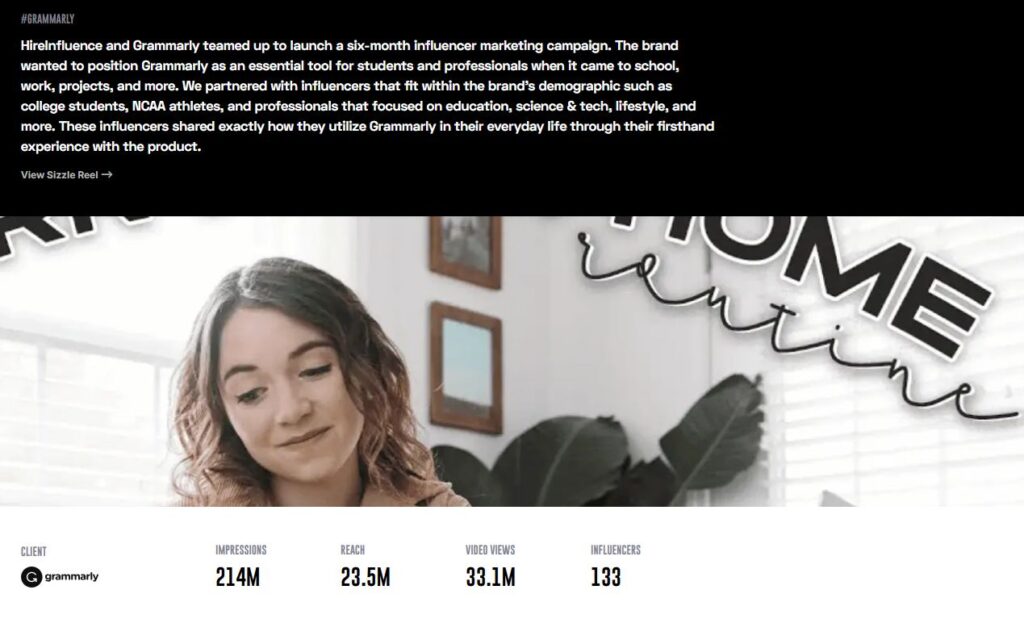
This is how the Grammarly program was structured. HireInfluence managed 133 top-tier lifestyle creators across TikTok, Instagram, and YouTube, generating 214 million impressions, 33.1 million views, and $15 million in earned media value. The paid amplification layer, built on top of strong organic performance, extended the reach of the best-performing creator content without requiring the brand to manage a separate vendor relationship or a mid-campaign rights renegotiation.
The Ricola #CoatYourThroat campaign demonstrates the same model with a retail attribution layer: 26 million impressions, 20.5 million reach, a 13.17% engagement rate, and 62,500 tracked retail purchase clicks via MikMak integration. The paid amplification extended the campaign’s reach into audiences beyond the creators’ organic followings while the MikMak tracking connected the full funnel from creator content to retail purchase intent.
Multi-Platform Paid Distribution
Influencer content does not perform the same way across every platform, and the paid amplification strategy needs to reflect those differences. TikTok Spark Ads allow brands to boost creator content directly through the creator’s account, preserving the native look and feel while dramatically extending reach. Instagram’s ad infrastructure supports both boosted creator posts and dark posting, where content is distributed as a paid ad without appearing on the creator’s organic feed. YouTube offers pre-roll and mid-roll placement for creator-sourced video content in paid contexts.
HireInfluence manages paid amplification across all major platforms as part of its full-service offering, with the campaign analytics infrastructure to track paid and organic performance simultaneously. For enterprise brands with complex paid social operations, that unified measurement layer is what connects influencer investment to the downstream business metrics that matter in CFO-level reporting.
Performance Measurement That Holds Up to Scrutiny
For influencer media programs to survive budget reviews at enterprise brands, the measurement has to connect creator activity to outcomes the business actually tracks. Impressions and engagement rates are useful directional signals. What enterprise CMOs and CFOs need is data that connects creator content to traffic, conversions, customer acquisition cost, and in applicable categories, retail purchase data.
HireInfluence’s analytics platform is built around client-defined objectives, tracking earned media value, sentiment, and conversion data in ways that support business-level reporting rather than social media vanity metrics. The agency has operated this model since its founding in 2011, building the reporting infrastructure that enterprise brands require to justify influencer investment at the CFO level. For brands that have struggled to justify influencer spend against performance channel benchmarks, that reporting infrastructure is often the deciding factor in whether a program gets renewed or cut.
Building the Integrated Program
For VP-level marketing leaders and CMOs evaluating influencer media agency partners, the key questions center on integration. Does the agency manage creator sourcing and paid media through the same team, with shared data and unified reporting? Are usage rights built into creator contracts by default, or negotiated ad hoc? Does the agency have platform-specific expertise for paid amplification on TikTok, Instagram, and YouTube, or does it outsource media buying to a separate vendor?
HireInfluence’s minimum engagement starts at approximately $100,000, reflecting the level of creative, operational, and media investment each program receives. Named clients include Microsoft, Target, Grammarly, McDonald’s, Oreo, and Southwest Airlines. To review documented campaign results and the campaign portfolio, and to start a conversation about building an integrated influencer media program for your brand, visit hireinfluence.com/contact/.